Results by title
1787 books match the query 'Literary Collections' and 59 start with e

Excellence in First-Year Writing 2017/2018
Edited by Dana Nichols
Michigan Publishing Services, 2018
Every day, students at the University of Michigan work hard to develop their skills as writers. Every winter, we have a chance to sample the fruits of this labor as we select winners for the first-year writing prize. The English Department Writing Program and the Sweetland Center for Writing established a first-year writing prize in 2010. With generous support from the Sweetland Center for Writing, Andrew Feinberg and Stacia Smith (both of whom earned English degrees from the University of Michigan), and the Granader Family, we have developed a tradition of honoring students who produce writing of exceptional quality.
In this collection, we share the writing of prize-winning students so that other writers may learn from, and feel inspired by, their examples. The featured essays illustrate how writers formulate compelling questions, engage in dialogue with other thinkers, incorporate persuasive and illuminating evidence, express powerful and poetic insights, and participate in meaningful conversations.
We are equally grateful to the many students who submitted essays for these writing prizes and the many instructors who encouraged and supported them. As writing teachers, we relish the opportunity to learn from the challenging questions, intellectual energy, creativity, and dedication that our students and their teachers bring to our classrooms. We hope that you will gain as much pleasure as we have from reading the writing contained in this volume.
Excellence in First-Year Writing 2018/2019
Dana Nichols
Michigan Publishing Services, 2019
Excellence in Upper-Level Writing 2016/2017
Dana Nichols, editor
Michigan Publishing Services, 2017
Ask any professional, business person, or employer about one of the most important qualifications for college-educated workers, and the answer will be nearly universal: the ability to write well. The Upper-Level Writing Requirement (ULWR) was established to enable undergraduates in the College of Literature, Science, and the Arts to develop their capacities as writers. Originally designed in 1978 to help students “understand and communicate effectively the central concepts, approaches, and materials of their discipline,” the ULWR supports a slightly different goal in today’s more interdisciplinary context. A significant percentage of students now have more than one major or fulfill the ULWR outside of their majors. Likewise, many faculty members are increasingly concerned with preparing students to write for various professional and public audiences as well as for discipline-based ones. However, whether students fulfill the ULWR within or outside of their majors or write for audiences within or outside of the academy, they are held to the same standards of effective writing.
This collection demonstrates the continuing value of the ULWR. Courses like the ones in which students produced these essays create contexts where students meet the expectations of the ULWR and can push beyond them to an even more impressive level of accomplishment. While the specifics of what counts as evidence and how one makes a convincing argument vary across the essays included here, each one embodies qualities that mark effective writing. The authors deal with a wide variety of topics, but in every case they combine deep understanding of a specific area with excellent prose. They take risks and adhere to conventions; they synthesize complex ideas and provide rich detail; they exert intellectual independence and respect disciplinary conventions, from creative nonfiction in the humanities to empirical research in the sciences.
We have been honoring students for outstanding writing in ULWR courses since 2010, but since 2014, thanks to a generous gift from the Granader Family, the prizes are more substantial. We are grateful to the Granaders for choosing to recognize student writing in this way. This collection is another form of recognition for the award-winning students. By publishing this student writing both online and in hard copy we make it available as a model and as a source of inspiration for others.
Talented and committed as they are, these students represented here did not become award-winners entirely on their own. Each of them benefited from well-designed assignments, careful reading, and suggestions for revision from the instructors who nominated them. The instructors’ introductions for each selection provide a window into student learning as well as into the specific dimensions of each student’s achievements.
Excellence in Upper-Level Writing 2017/2018
Edited by Dana Nichols
Michigan Publishing Services, 2018
Ask any professional, business person, or employer about one of the most important qualifications for college-educated workers, and the answer will be nearly universal: the ability to write well. The Upper-Level Writing Requirement (ULWR) was established to enable undergraduates in the College of Literature, Science, and the Arts to develop their capacities as writers. Originally designed in 1978 to help students "understand and communicate effectively the central concepts, approaches, and materials of their discipline," the ULWR supports a slightly different goal in today's more interdisciplinary context. A significant percentage of students now have more than one major or fulfill the ULWR outside of their majors. Likewise, many faculty members are increasingly concerned with preparing students to write for various professional and public audiences as well as for discipline-based ones. However, whether students fulfill the ULWR within or outside of their majors or write for audiences within or outside of the academy, they are held to the same standards of effective writing.
This collection demonstrates the continuing value of the ULWR. Courses like the ones in which students produced these essays create contexts where students meet the expectations of the ULWR and can push beyond them to an even more impressive level of accomplishment. While the specifics of what counts as evidence and how one makes a convincing argument vary across the essays included here, each one embodies qualities that mark effective writing. The authors deal with a wide variety of topics, but in every case they combine deep understanding of a specific area with excellent prose. They take risks and adhere to conventions; they synthesize complex ideas and provide rich detail; they exert intellectual independence and respect disciplinary conventions, from creative nonfiction in the humanities to empirical research in the sciences.
We have been honoring students for outstanding writing in ULWR courses since 2010, but since 2014, thanks to a generous gift from the Granader Family, the prizes are more substantial. We are grateful to the Granaders for choosing to recognize student writing in this way. This collection is another form of recognition for the award-winning students. By publishing this student writing both online and in hard copy we make it available as a model and as a source of inspiration for others.
Talented and committed as they are, these students represented here did not become award-winners entirely on their own. Each of them benefited from well-designed assignments, careful reading, and suggestions for revision from the instructors who nominated them. The instructors' introductions for each selection provide a window into student learning as well as into the specific dimensions of each student's achievements.
Excellence in Upper-Level Writing 2018/2019
Dana Nichols
Michigan Publishing Services, 2019
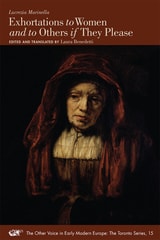
Exhortations to Women and to Others If They Please
Lucrezia Marinella
Iter Press, 2012
—Maria Galli Stampino
Associate Professor of French and Italian
University of Miami
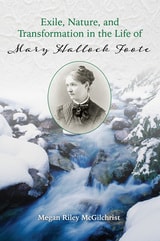
Exile, Nature, and Transformation in the Life of Mary Hallock Foote
Megan Riley McGilchrist
University of Nevada Press, 2021
Experience
Thinking, Writing, Language, and ReligionNorman Fischer
University of Alabama Press, 2015
An exploration of how language, creativity, and spiritual practice shape human experience.
By what narrow path is the ineffable silence of Zen cleft by the scratch of a pen? The distilled insights of forty years, Norman Fischer’s Experience: Thinking, Writing, Language, and Religion is a collection of essays by Zen master Fischer about experimental writing as a spiritual practice.
Raised in a Conservative Jewish family, Fischer embraced the twin practices of Zen Buddhism and innovative poetics in San Francisco in the early 1970s. His work includes original poetry, descriptions of Buddhist practice, translations of the Hebrew psalms, and eclectic writings on a range of topics from Homer to Heidegger to Kabbalah. Both Buddhist priest and participant in avant-garde poetry’s Language movement, Fischer has limned the fertile affinities and creative contradictions between Zen and writing, accumulating four decades of rich insights he shares in Experience.
Fischer’s work has been deeply enriched through his collaborations with leading rabbis, poets, artists, esteemed Zen Buddhist practitioners, Trappist monks, and renowned Buddhist leaders, among them the Dalai Lama. Alone and with others, he has carried on a deep and sustained investigation into the intersection of writing and consciousness as informed by meditation.
The essays in this artfully curated collection range across divers, fascinating topics such as time, the Heart Sutra, God in the Hebrew psalms, the supreme “uselessness” of art making, “late work” as a category of poetic appreciation, and the subtle and dubious notion of “religious experience.” From the theoretical to the revealingly personal, Fischer’s essays, interviews, and notes point toward a dramatic expansion of the sense of religious feeling in writing.
Readers who join Fischer on this path in Experience can discover how language is not a description of experience, but rather an experience itself: shifting, indefinite, and essential.
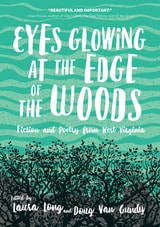
Eyes Glowing at the Edge of the Woods
Fiction and Poetry from West VirginiaLaura Long
West Virginia University Press, 2017
Throughout this collection, we see profound wonder, questioning, and conflicts involving family, sexual identity, class, discrimination, environmental beauty, and peril, and all the sorts of rebellion, error, contemplation, and contentment that an intrepid soul can devise. These stories and poems, all published within the last fifteen years, are grounded in what it means to live in and identify with a complex place.
With a mix of established writers like Jayne Anne Phillips, Norman Jordan, Ann Pancake, Maggie Anderson, and Denise Giardina and fresh voices like Matthew Neill Null, Ida Stewart, Rajia Hassib, and Scott McClanahan, this collection breaks open new visions of all-American landscapes of the heart. By turns rowdy and contemplative, hilarious and bleak, and lyrical and gritty, it is a collage of extraordinary literary visions.