Results by title
3064 books match the query 'Social conditions' and 72 start with e
Ethnographic Sorcery
Harry G. West
University of Chicago Press, 2007
According to the people of the Mueda plateau in northern Mozambique, sorcerers remake the world by asserting the authority of their own imaginative visions of it. While conducting research among these Muedans, anthropologist Harry G. West made a revealing discovery—for many of them, West’s efforts to elaborate an ethnographic vision of their world was itself a form of sorcery. In Ethnographic Sorcery, West explores the fascinating issues provoked by this equation.
A key theme of West’s research into sorcery is that one sorcerer’s claims can be challenged or reversed by other sorcerers. After West’s attempt to construct a metaphorical interpretation of Muedan assertions that the lions prowling their villages are fabricated by sorcerers is disputed by his Muedan research collaborators, West realized that ethnography and sorcery indeed have much in common. Rather than abandoning ethnography, West draws inspiration from this connection, arguing that anthropologists, along with the people they study, can scarcely avoid interpreting the world they inhabit, and that we are all, inescapably, ethnographic sorcerers.

Ethnography At The Border
Pablo Vila
University of Minnesota Press, 2003
An illuminating account of life at the U.S.-Mexico border
For cultural theorists, “the border” has proven a fluid and hybrid space profitably explored for new ideas about identity, gender, and ethnicity. But for those who occupy this region, the border is not merely a metaphor, but a lived experience, yielding immediate, often pressing ambiguities, problems, and perils.
Focusing on a particular area of the U.S.-Mexico border, Ciudad Juarez-El Paso, Ethnography at the Border brings out the complexity of the border experience through the voices of the diverse people who inhabit the region. In a series of ethnographic essays that investigate specific aspects of border existence, the contributors provide rich and detailed insights into such topics as life in illegal subdivisions, called colonias, in Texas; the experience of actually crossing the bridge between El Paso and Ciudad Juarez; the impact of Operation Blockade on illegal crossings; the controversy surrounding the El Paso Border Patrol’s proposal for a border wall in Sunland Park; the paradoxes of making “American products” using Mexican workers; and the relevance of grassroots efforts, environmental problems, and the multiple meanings of “Mexican.” The final chapter offers a critique of the all too metaphorical border often depicted by cultural studies. Painstakingly conveying how the border looks and feels to those on both sides, Ethnography at the Border transmutes statistics on migration, labor markets, and economic trends—as well as conceptualizations of cross-cultural identities—into the experience, the observations, and the troubling lessons of border life.Contributors: Eduardo Barrera, U of Texas, El Paso, and El Colegio de la Frontera Norte; Jessica Chapin, U of Texas, Austin; Tim J. Dunn, Salisbury U; Sarah Hill, Western Michigan U; Victor M. Ortiz, Northeastern Illinois U at Chicago; John A. Peterson, U of Texas, El Paso; Leslie Salzinger, U of Chicago; David Spener, Trinity U; María Socorro Tabuenca Córdoba, El Colegio de la Frontera Norte; Melissa W. Wright, Penn State U.
Europe in the Sixteenth Century
H. G. Koenigsberger, George L. Mosse, and G. Q. Bowler
University of Wisconsin Press, 2026
Every Day We Live Is the Future
Surviving in a City of DisastersBy Douglas Haynes
University of Texas Press, 2017
When she was only nine, Dayani Baldelomar left her Nicaraguan village with nothing more than a change of clothes. She was among tens of thousands of rural migrants to Managua in the 1980s and 1990s. After years of homelessness, Dayani landed in a shantytown called The Widows, squeezed between a drainage ditch and putrid Lake Managua. Her neighbor, Yadira Castellón, also migrated from the mountains. Driven by hope for a better future for their children, Dayani, Yadira, and their husbands invent jobs in Managua’s spreading markets and dumps, joining the planet’s burgeoning informal economy. But a swelling tide of family crises and environmental calamities threaten to break their toehold in the city.
Dayani’s and Yadira’s struggles reveal one of the world’s biggest challenges: by 2050, almost one-third of all people will likely live in slums without basic services, vulnerable to disasters caused by the convergence of climate change and breakneck urbanization. To tell their stories, Douglas Haynes followed Dayani’s and Yadira’s families for five years, learning firsthand how their lives in the city are a tightrope walk between new opportunities and chronic insecurity. Every Day We Live Is the Future is a gripping, unforgettable account of two women’s herculean efforts to persevere and educate their children. It sounds a powerful call for understanding the growing risks to new urbanites, how to help them prosper, and why their lives matter for us all.

Every Wrong Direction
An Emigré’s MemoirDan Burt
Rutgers University Press, 2023
Every Wrong Direction recreates and dissects the bitter education of Dan Burt, an American émigré who never found a home in America. It begins in the row homes of Jewish immigrants and working-class Italians on the mean streets of 1950s South Philadelphia. Every Wrong Direction follows the author from the rough, working-class childhood that groomed him to be a butcher or charter boat captain, through America, Britain and Saudi Arabia as student, lawyer, spy, culture warrior, and expatriate, ending with a photo of his college rooms at St John’s College, Cambridge. Between this beginning and end, through a Philadelphia commuter college, to Cambridge, then Yale Law School, across the working to upper classes, three countries, and seven cities over 43 years, it maps his pursuit of, realization, disillusionment with and abandonment of America and the American Dream.
Praise for Dan Burt's previous memoir, You Think It Strange:
“Burt’s early life was indeed a triumph of wit and will. He managed to escape a world filled with violence and a culture that valued street smarts over book smarts, all the while knowing that just about everyone around him thought little of his prospects. That he made it out at all is extraordinary. That he became a successful lawyer and writer is virtually unimaginable.” —Commonweal
“Dan Burt is a fine poet, and this memoir has all the sensitivity and vigilance you might expect from a writer with such a background. But his prose also has a robustness and documentary power that continually startles and engages. As it combines these things, You Think It Strange catches the strangeness of the world and makes it familiar.”
—Sir Andrew Motion, Poet Laureate of the United Kingdom, 1999-2009
Everyday Dirty Work
Invisibility, Communication, and Immigrant LaborWilfredo Alvarez
The Ohio State University Press, 2022
Winner, 2023 NCA Ethnography Division Best Book Award
Wilfredo Alvarez’s Everyday Dirty Work: Invisibility, Communication, and Immigrant Labor is an exploration into co-cultural communication practices within the workplace. Specifically, Alvarez investigates how Latin American immigrant janitors communicate from their marginalized standpoints in a predominantly White academic organization. He examines how custodial workers perceive, interpret, and thematize routine messages regarding race, ethnicity, social class, immigrant status, and occupation, and how those messages and overall communicative experiences affect both their work and personal lives.
A Latin American immigrant himself, Alvarez relates his own experiences to those of the research participants. His positionality informs and enhances his research as he demonstrates how everyday interpersonal encounters create discursive spaces that welcome or disqualify people based on symbolic and social capital. Alvarez offers valuable insights into the lived experiences of critical––but often undervalued and invisible––organizational members. Through theoretical insights and research data, he provides practical recommendations for organizational leaders to improve how they can relate to and support all stakeholders.
Everyday Economic Survival in Myanmar
Ardeth Maung Thawnghmung
University of Wisconsin Press, 2022
Thawnghmung conducted in-depth interviews and surveys of 372 individuals from all walks of life and across geographical locations in Myanmar between 2008 and 2015. To frame her analysis, she provides context from countries with comparable political and economic situations. Her findings will be welcomed by political scientists and policy analysts, as well by journalists and humanitarian activists looking for substantive, reliable information about everyday life in a country that remains largely in the shadows.
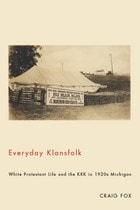
Everyday Klansfolk
White Protestant Life and the KKK in 1920s MichiganCraig Fox
Michigan State University Press, 2011
In 1920s Middle America, the Ku Klux Klan gained popularity not by appealing to the fanatical fringes of society, but by attracting the interest of “average” citizens. During this period, the Klan recruited members through the same unexceptional channels as any other organization or club, becoming for many a respectable public presence, a vehicle for civic activism, or the source of varied social interaction. Its diverse membership included men and women of all ages, occupations, and socio-economic standings. Although surviving membership records of this clandestine organization have proved incredibly rare, Everyday Klansfolk uses newly available documents to reconstruct the life and social context of a single grassroots unit in Newaygo County, Michigan. A fascinating glimpse behind the mask of America’s most notorious secret order, this absorbing study sheds light on KKK activity and membership in Newaygo County, and in Michigan at large, during the brief and remarkable peak years of its mass popular appeal.
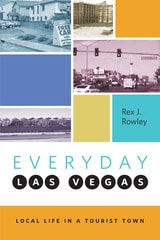
Everyday Las Vegas
Local Life in a Tourist TownRex J. Rowley
University of Nevada Press, 2014
Rowley considers such topics as why people move to Las Vegas, the nature of their work and personal lives, the impact of growth and rapid change, and interaction with the overwhelmingly touristic side of the city. He also considers the benefits and perils of living in a nonstop twenty-four-hour city rich in entertainment options and easy access to gambling, drugs, and other addictions. His examination includes the previously unstudied role of neighborhood casinos patronized by locals rather than tourists and the impact that a very mobile population has on schools, churches, and community life.
Rowley considers the very different ways people perceive a place as insiders or outsiders, a dichotomy that arises when tourism is a mainstay of the local economy. His work offers insights into what Las Vegas can teach us about other cities and American culture in general. It also contributes to our understanding of how people relate to places and how the personality of a place influences the lives of people who live there.
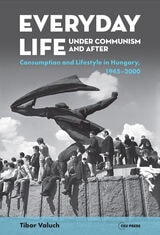
Everyday Life under Communism and After
Lifestyle and Consumption in Hungary, 1945–2000Tibor Valuch
Central European University Press, 2022
By providing a survey of consumption and lifestyle in Hungary during the second half of the twentieth century, this book shows how common people lived during and after tumultuous regime changes. After an introduction covering the late 1930s, the study centers on the communist era, and goes on to describe changes in the post-communist period with its legacy of state socialism.
Tibor Valuch poses a series of questions. Who could be called rich or poor and how did they live in the various periods? How did living, furnishings, clothing, income, and consumption mirror the structure of the society and its transformations? How could people accommodate their lifestyles to the political and social system? How specific to the regime was consumption after the communist takeover, and how did consumption habits change after the demise of state socialism? The answers, based on micro-histories, statistical data, population censuses and surveys help to understand the complexities of daily life, not only in Hungary, but also in other communist regimes in east-central Europe, with insights on their antecedents and afterlives.
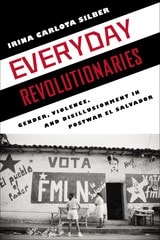
Everyday Revolutionaries
Gender, Violence, and Disillusionment in Postwar El SalvadorIrina Carlota Silber
Rutgers University Press, 2011
Winner of the 2013 International Latino Book Awards in the Best First Book, Nonfiction category
Everyday Revolutionaries provides a longitudinal and rigorous analysis of the legacies of war in a community racked by political violence. By exploring political processes in one of El Salvador's former war zones-a region known for its peasant revolutionary participation-Irina Carlota Silber offers a searing portrait of the entangled aftermaths of confrontation and displacement, aftermaths that have produced continued deception and marginalization.
Silber provides one of the first rubrics for understanding and contextualizing postwar disillusionment, drawing on her ethnographic fieldwork and research on immigration to the United States by former insurgents. With an eye for gendered experiences, she unmasks how community members are asked, contradictorily and in different contexts, to relinquish their identities as "revolutionaries" and to develop a new sense of themselves as productive yet marginal postwar citizens via the same "participation" that fueled their revolutionary action. Beautifully written and offering rich stories of hope and despair, Everyday Revolutionaries contributes to important debates in public anthropology and the ethics of engaged research practices.

Everyday Technology
Machines and the Making of India's ModernityDavid Arnold
University of Chicago Press, 2013
Evolution of Ceramic Production Organization in a Maya Community
Dean E. Arnold
University Press of Colorado, 2014
Although several kinds of production units developed, households were the most persistent units of production in spite of massive social change and the reorientation of pottery production to the tourist market. Entrepreneurial workshops, government-sponsored workshops, and workshops attached to tourist hotels developed more recently but were short-lived, whereas pottery-making households extended deep into the nineteenth century. Through this continuity and change, intermittent crafting, multi-crafting, and potters' increased management of economic risk also factored into the development of the production organization in Ticul.
Illustrated with more than 100 images of production units, The Evolution of Ceramic Production Organization in a Maya Community is an important contribution to the understanding of ceramic production. Scholars with interests in craft specialization, craft production, and demography, as well as specialists in Mesoamerican archaeology, anthropology, history, and economy, will find this volume especially useful.

Exchange Is Not Robbery
More Stories of an African Bar GirlJohn M. Chernoff
University of Chicago Press, 2004
In Exchange Is Not Robbery and its predecessor, Hustling Is Not Stealing, a chronicle of exploitation is transformed by verbal art into an ebullient comedy. In Hustling Is Not Stealing, Hawa is a playful warrior struggling against circumstances in Ghana and Togo. In Exchange Is Not Robbery, Hawa returns to her native Burkina Faso, where she achieves greater control over her life but faces new difficulties. As a woman making sacrifices to live independently, Hawa sees her own situation become more complex as she confronts an atmosphere in Burkina Faso that is in some ways more challenging than the one she left behind, and the moral ambiguities of her life begin to intensify.
Combining elements of folklore and memoir, Hawa's stories portray the diverse social landscape of West Africa. Individually the anecdotes can be funny, shocking, or poignant; assembled together they offer a sweeping critical and satirical vision.
Exchanging the Past
A Rainforest World of Before and AfterBruce M. Knauft
University of Chicago Press, 2002
In this book, Knauft explores the Gebusi's encounter with modern institutions and highlights what their experience tells us more generally about the interaction between local peoples and global forces. As desire for material goods grew among Gebusi, Knauft shows that they became more accepting of and subordinated by Christian churches, community schools,and government officials in their attempt to benefit from them—a process Knauft terms "recessive agency." But the Gebusi also respond actively to modernity, creating new forms of feasting, performance, and music that meld traditional practices with Western ones, all of which Knauft documents in this fascinating study.

Exclusion and Engagement
Social Policy in Latin AmericaEdited by Christopher Abel and Colin M. Lewis
University of London Press, 2002

Exclusive Revolutionaries
Liberal Politics, Social Experience, and National Identity in the Austrian Empire, 1848-1914Pieter M. Judson
University of Michigan Press, 1996
In the mid-1800s, Judson argues, German liberal activists built an effective political movement whose ideology was rooted in its members' social experience in voluntary associations. The liberals were committed to the creation of a market economy based on personal property rights, to a society based on the values of individual self-improvement and personal respectability, and to a fundamental distinction between active and passive citizenship. They were determined to achieve a harmonious community of free peoples, in which personal enlightenment would bring an end to the divisive influence of localism, ethnicity, religion, and feudal social hierarchy.
Yet after 1880, as newer, more radical mass political movements threatened their political fortunes, the liberals forged a German nationalist politics based increasingly on ethnic identity. Their emphasis on national identity became a way for former liberals to hold together an increasingly diverse coalition of German speakers who had little in common outside of their shared language. Only "Germanness" bridged the dangerous gulf between social classes. This nationalism helped the liberals to compete for power in the multinational, multicultural Austrian Empire down to 1914, but it left a legacy of nationalist extremism and tolerance of anti-Semitism that continues to influence political cultures in the former lands of the Habsburg Monarchy today.

Exhortations to Women and to Others If They Please
Lucrezia Marinella
Iter Press, 2012
—Maria Galli Stampino
Associate Professor of French and Italian
University of Miami
Exiled Memories
Stories of Iranian DiasporaZohreh T. Sullivan
Temple University Press, 2001
These are the words of one Iranian emigre, driven from Tehran by the revolution of 1979. They are echoed time and again in this powerful portrayal of loss and survival. Impelled by these word and her own concerns about nationality and identity, Zohreh Sullivan has gathered together here the voices of sixty exiles and emigres. The speakers come from various ethnic and religious backgrounds and range in age from thirteen to eighty-eight. Although most are from the middle class, they work in a variety of occupations in the United States. But whatever their differences, here they engage in remembering the past, producing a discourse about their lives, and negotiating the troubled transitions from one culture to another.
Unlike man other Iranian oral history projects, Exiled Memories looks at the reconstruction of memory and identity through diasporic narratives, through a focus on the Americas rather than on Iran. The narratives included here reveal the complex ways in which events and places transform identities, how overnight radical s become conservatives, friends become enemies, the strong become weak. Indeed, the narratives themselves serve this function -- serving to transfer or transform power and establish credibility. They reveal a diverse group of people in the process of knitting the story of themselves with the story of the collective after it has been torn apart.

Exit Zero
Family and Class in Postindustrial ChicagoChristine J. Walley
University of Chicago Press, 2012
In 1980, Christine J. Walley’s world was turned upside down when the steel mill in Southeast Chicago where her father worked abruptly closed. In the ensuing years, ninety thousand other area residents would also lose their jobs in the mills—just one example of the vast scale of deindustrialization occurring across the United States. The disruption of this event propelled Walley into a career as a cultural anthropologist, and now, in Exit Zero, she brings her anthropological perspective home, examining the fate of her family and that of blue-collar America at large.
This book is part of a project that also includes a documentary film.

Exotics at Home
Anthropologies, Others, and American ModernityMicaela di Leonardo
University of Chicago Press, 1998
"An impressive work of scholarship that is mordantly witty, passionately argued, and takes no prisoners."—Lesley Gill, News Politics
"[Micaela] di Leonardo eloquently argues for the importance of empirical, interdisciplinary social science in addressing the tragedy that is urban America at the end of the century."—Jonathan Spencer, Times Literary Supplement
"In her quirky new contribution to the American culture brawl, feminist anthropologist Micaela di Leonardo explains how anthropologists, 'technicians of the sacred,' have distorted American popular debate and social life."—Rachel Mattson, Voice Literary Supplement
"At the end of di Leonardo's analyses one is struck by her rare combination of rigor and passion. Simply, [she] is a marvelous iconoclast."—Matthew T. McGuire, Boston Book Review
Explaining Economic Backwardness
Post-1945 Polish Historians on Eastern EuropeAnna Sosnowska
Central European University Press, 2019