Results by title
4030 books match the query 'Language Arts & Disciplines' and 134 start with e
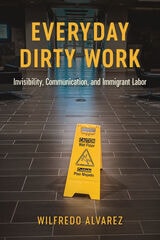
Everyday Dirty Work
Invisibility, Communication, and Immigrant LaborWilfredo Alvarez
The Ohio State University Press, 2022
Winner, 2023 NCA Ethnography Division Best Book Award
Wilfredo Alvarez’s Everyday Dirty Work: Invisibility, Communication, and Immigrant Labor is an exploration into co-cultural communication practices within the workplace. Specifically, Alvarez investigates how Latin American immigrant janitors communicate from their marginalized standpoints in a predominantly White academic organization. He examines how custodial workers perceive, interpret, and thematize routine messages regarding race, ethnicity, social class, immigrant status, and occupation, and how those messages and overall communicative experiences affect both their work and personal lives.
A Latin American immigrant himself, Alvarez relates his own experiences to those of the research participants. His positionality informs and enhances his research as he demonstrates how everyday interpersonal encounters create discursive spaces that welcome or disqualify people based on symbolic and social capital. Alvarez offers valuable insights into the lived experiences of critical––but often undervalued and invisible––organizational members. Through theoretical insights and research data, he provides practical recommendations for organizational leaders to improve how they can relate to and support all stakeholders.
Everyday Evidence-Based Practice in Academic Libraries
Case Studies and ReflectionsClare Walker Wiley
Assoc of College & Research Libraries, 2023
Everyday Evidence-Based Practice in Academic Libraries: Case Studies and Reflections collects excellent, thorough examples of EBP across functional areas of academic libraries and includes many evidence types in a variety of contexts. Five sections explore:
- Understanding Users
- Leadership and Management
- Instruction and Outreach
- Collections
- Open Initiatives
Everyday Evidence-Based Practice in Academic Libraries offers high-quality evidence from a variety of perspectives and inspires a commitment to evidence-based practice in your day-to-day work and library culture.
Everyday Genres
Writing Assignments across the DisciplinesMary Soliday
Southern Illinois University Press, 2011
Soliday provides an overview of the contemporary theory and research in Writing across the Curriculum programs, focusing specifically on the implementation of the Writing Fellows Program at the City College of New York. Drawing on her direct observations of colleagues and students at the school, she addresses the everyday challenges that novice writers face, such as developing an appropriate "stance" in one's writing, and the intricacies of choosing and developing content.
The volume then goes on to address some of the most pressing questions being asked by teachers of composition: To what extent can writing be separated from its situation? How can rhetorical expertise be shared across fields? And to what degree is writing ability local rather than general? Soliday argues that, while writing is closely connected to situation, general rhetorical principles can still be capably applied if those situations are known. The key to improving writing instruction, she maintains, is to construct contexts that expose writers to the social actions that genres perform for readers.
Supplementing the author's case study are six appendixes, complete with concrete examples and helpful teaching tools to establish effective classroom practices and exercises in Writing across the Curriculum programs. Packed with useful information and insight, Everyday Genres is an essential volume for both students and teachers seeking to expand their understanding of the nature of writing.

Everyday HR
A Human Resources Handbook for Academic Library StaffGail Munde
American Library Association, 2013
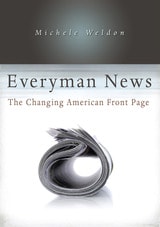
Everyman News
The Changing American Front PageMichele Weldon
University of Missouri Press, 2007
One need only look at the front pages of newspapers over the past few years to see that something has changed. Stories are more personal, more inclusive, less distant from readers’ experiences. Once called the first draft of history, news has become more of an anecdotal companion. The evidence is telling: stories use more unofficial sources than ever before; the “inverted pyramid” form of news writing is barely practiced; and, especially after 9/11, tragedy has become more humanized.
Scanning the crowded media landscape, Michele Weldon—a journalist passionate about her profession—takes a fresh look at how newspapers have carved out a narrative niche that reflects society’s fascination with personal stories and readers’ demands for diversity in content. Comparing some 850 stories, story approaches, and unofficial sourcing in twenty American newspapers for eight dates in 2001 and 2004—a total of 160 front pages—she shows a shift toward features over hard news, along with an increase in anecdotal or humanistic approaches to all stories.
Everyman News offers a provocative look at why American newspapers have become story papers, with their content and style saying as much about our culture as they do about the journalists and the readers. Weldon shows that a variety of forces both inside and outside journalism—blogs, citizen journalism, newsroom diversity, and other factors—have converged to remake the front page, and she unveils the content of “everyman news” as a commodity apart from the mode of delivery. Her assessment also incorporates more than fifty interviews with people connected to journalism about what these changes mean—revealing that not everyone in the industry believes they are for the better.
Is everyman news perhaps right for its time, or is it merely a symptom of what Weldon calls “Chicken Little journalism”? Weighing in on such matters as the New York Times’s “Portraits of Grief” series and the dangers of the blogosphere, she invites readers to make their own calls in this original and important contribution to the study of media. Everyman News is a book that will contribute to our understanding of newspapers in the new century—must reading for professionals and an eye-opener for anyone trying to comprehend the significant shifts in today’s front pages.
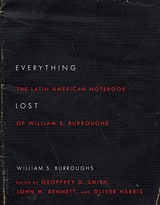
Everything Lost
The Latin American Notebook of William S. Burroughs, Revised EditionWilliam S. Burroughs, Edited by Geoffrey D. Smith, John M. Bennett, and Oliver Harris
The Ohio State University Press, 2017
In late summer 1953, as he returned to Mexico City after a seven-month expedition through the jungles of Ecuador, Colombia, and Peru, William Burroughs began a notebook of final reflections on his four years in Latin America. His first novel, Junkie, had just been published and he would soon be back in New York to meet Allen Ginsberg and together complete the manuscripts of what became The Yage Letters and Queer. Yet this notebook, the sole survivor from that period, reveals Burroughs not as a writer on the verge of success, but as a man staring down personal catastrophe and visions of looming cultural disaster.
Losses that will not let go of him haunt Burroughs throughout the notebook: “Bits of it keep floating back to me like memories of a daytime nightmare.” However, out of these dark reflections we see emerge vivid fragments of Burroughs’ fiction and, even more tellingly, unique, primary evidence for the remarkable ways in which his early manuscripts evolved. Assembled in facsimile and transcribed by Geoffrey D. Smith, John M. Bennett, and Burroughs scholar Oliver Harris, the notebook forces us to change the way we see both Burroughs and his writing at a turning point in his literary career.
Everything that Linguists have Always Wanted to Know about Logic . . . But Were Ashamed to Ask
James D. McCawley
University of Chicago Press, 1993
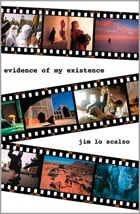
Evidence of My Existence
Jim Lo Scalzo
Ohio University Press, 2007
From a leper colony in India to an American research station on the Antarctic Peninsula, from the back rooms of the White House to the battlefields of Iraq and Afghanistan, Evidence of My Existence tells a unique and riveting story of seventeen years spent racing from one photo assignment to the next. It is also a story of photojournalism and theconsequences of obsessive wanderlust.
When the book opens, Jim Lo Scalzo is a blur to his wife, her remarkable tolerance wearing thin. She is heading to the hospital with her second miscarriage, and Jim is heading to Baghdad to cover the American invasion of Iraq. He hates himself for this—for not giving her a child, for deserting her when she soobviously needs him, for being consumed by his job—but how to stop moving? Sure, there have been some tough trips. He’s been spit on by Mennonites in Missouri, by heroin addicts in Pakistan, and by the KKK in South Carolina. He’s contracted hepatitis on the Navajo Nation, endured two bouts of amoebic dysentery in India and Burma and four cases of giardia in Nepal, Peru, Afghanistan, and Cuba. He’s been shot with rubber bullets in Seattle, knocked to the ground by a water cannon in Quebec, and sprayed with more teargas than he cares to recall. But photojournalism is his career, and travel is his compulsivecraving.
We follow Lo Scalzo through the maze of airports and crowds and countries as he chases the career he has always wanted, struggles with his family problems, and reveals the pleasures of a life singularly focused. For him, as for so many photojournalists, it is always about the going.

Evo Morales and the Movimiento Al Socialismo in Bolivia
The First Term in Context, 2005-2009Edited by Adrian Pearce
University of London Press, 2011
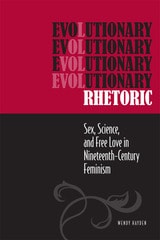
Evolutionary Rhetoric
Sex, Science, and Free Love in Nineteenth-Century FeminismWendy Hayden
Southern Illinois University Press, 2013
In Evolutionary Rhetoric, scholar Wendy Hayden provides a comprehensive examination of the relationship between scientific and feminist rhetorics in free-love feminism, studying the movement from its inception in the 1850s to its dark turn toward eugenics in the early 1900s. Hayden organizes her provocative study by scientific discipline—evolution, physiology, bacteriology, embryology, and heredity. Each chapter explores how free-love feminists adopted the evidence of that discipline in their arguments for increased sex education, women’s sexual rights, reproductive freedom, and the abolition of a marriage system that repressed the rights and the sexuality of women.
Hayden takes our conventional understanding of the relationship between nineteenth-century feminism and science and expands it. The author provides examples of the powerful words of free-love feminists to show exactly how these exceptional women used science as a rhetorical platform to promote feminist, and often radical, social reforms.
Considering why the free-love movement has not yet been studied, Hayden also discusses how the recovery of this movement may impact larger goals in the recovery of women’s rhetoric. This important and timely study of a long-forgotten movement adds to our understanding of the complexities of the history of feminism.
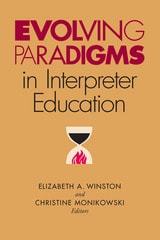
Evolving Paradigms in Interpreter Education
Elizabeth A. Winston
Gallaudet University Press, 2013
This volume brings together a cadre of world-renowned interpreting educators and researchers who conduct a rich exploration of paradigms, both old and new, in interpreter education. They review existing research, explicate past and current practices, and call for a fresh look at the roots of interpreter education in anticipation of the future. Expert commentary accompanies each chapter to provide a starting point for reflection on and discussion of the growing needs in this discipline.
Volume coeditor Christine Monikowski begins by considering how interpreter educators can balance their responsibilities of teaching, practice, and research. Her chapter is accompanied by commentary about the capacity to “academize” what has been thought of as a semi-profession. Helen Tebble shares research on medical interpreting from an applied linguistic perspective. Terry Janzen follows with the impact of linguistic theory on interpretation research methodology. Barbara Shaffer discusses how interpreting theory shapes the interpreter’s role. Elizabeth A. Winston, also a volume coeditor, rounds out this innovative collection with her chapter on infusing evidence-based teaching practices into interpreting education. Noted interpreter educators and researchers also provide an international range of insights in this collection, including Rico Peterson, Beppie van den Bogaerde, Karen Bontempo, Ian Mason, Ester Leung, David Quinto-Pozos, Lorraine Leeson, Jemina Napier, Christopher Stone, Debra Russell, and Claudia Angelelli.
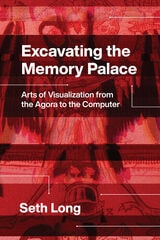
Excavating the Memory Palace
Arts of Visualization from the Agora to the ComputerSeth Long
University of Chicago Press, 2020
In Excavating the Memory Palace, Seth David Long mines the history of Europe’s arts of memory to find the origins of today’s data visualizations, unearthing how ancient constructions of cognitive pathways paved the way for modern technological interfaces. Looking to techniques like the memory palace, he finds the ways that information has been tied to sensory and visual experience, turning raw data into lucid knowledge. From the icons of smart phone screens to massive network graphs, Long shows us the ancestry of the cyberscape and unveils the history of memory as a creative act.
Excellence in First-Year Writing
2019/2020Dana Nichols
Michigan Publishing Services, 2020
Excellence in Upper-Level Writing
2019/2020Dana Nichols
Michigan Publishing Services, 2020
Excellent Books for Early and Eager Readers
Kathleen T. Isaacs
American Library Association, 2016
Executing Democracy
Volume One: Capital Punishment & the Making of America, 1683-1807Stephen J. Hartnett
Michigan State University Press, 2010
Executing Democracy: Capital Punishment & the Making of America, 1683-1807 is the first volume of a rhetorical history of public debates about crime, violence, and capital punishment in America. This examination begins in 1683, when William Penn first struggled to govern the rowdy indentured servants of Philadelphia, and continues up until 1807, when the Federalists sought to impose law-and-order upon the New Republic.
This volume offers a lively historical overview of how crime, violence, and capital punishment influenced the settling of the New World, the American Revolution, and the frantic post-war political scrambling to establish norms that would govern the new republic.
By presenting a macro-historical overview, and by filling the arguments with voices from different political camps and communicative genres, Hartnett provides readers with fresh perspectives for understanding the centrality of public debates about capital punishment to the history of American democracy.
Executing Democracy
Volume Two: Capital Punishment and the Making of America, 1835-1843Stephen Hartnett
Michigan State University Press, 2024
This eye-opening and well-researched companion to the first volume of Executing Democracy enters the death-penalty discussion during the debates of 1835 and 1843, when pro-death penalty Calvinist minister George Barrell Cheever faced off against abolitionist magazine editor John O’Sullivan. In contrast to the macro-historical overview presented in volume 1, volume 2 provides micro-historical case studies, using these debates as springboards into the discussion of the death penalty in America at large. Incorporating a wide range of sources, including political poems, newspaper editorials, and warring manifestos, this second volume highlights a variety of perspectives, thus demonstrating the centrality of public debates about crime, violence, and punishment to the history of American democracy. Hartnett’s insightful assessment bears witness to a complex national discussion about the political, metaphysical, and cultural significance of the death penalty.
Exhibits in Archives and Special Collections Libraries
Jessica L. Lacher-Feldman
American Library Association, 2013
Experiencing America's Story through Fiction
Historical Novels for Grades 7-12Hilary Susan Crew
American Library Association, 2014
Experiencing War Memorials
Environment, Affect, and Public MemoryEdited by Jennifer K. Ladino
University of Alabama Press, 2026
Examines the emotional, formal, and environmental dimensions of war commemoration
Experiencing War Memorials is a compelling edited collection of essays that examines how war is commemorated through public memorials and the powerful emotions and ideologies these sites generate. Drawing on fields such as war studies, affect studies, public memory studies, and the environmental humanities, the volume demonstrates that commemoration is not only an intellectual act but an embodied, affective experience.
Through diverse case studies, contributors analyze how memorials shape public feelings about fast and slow violence, including battles, massacres, and incarceration. The essays reveal how materials, landscapes, narrative conventions, and innovative memorial forms guide emotional responses such as grief, pride, ambivalence, and outrage while making injustice perceptible. Against the backdrop of ongoing debates over heritage and violence, the collection insists on the importance of attending to the messy and disordered emotional dimensions of public memory. Some essays explore varied human and animal experiences, including military working dogs; scrutinize unsettling sites such as Confederate monuments and overlooked Holocaust locations; and consider digital, ecological, and pandemic-era memorials that expand the boundaries of commemoration.
Edited by Jennifer K. Ladino, Experiencing War Memorials offers nuanced insights into how memorial practices shape national identities, ethical understanding, and the possibilities for social change, illuminating the profound ways public remembrance influences how societies feel, remember, and reckon with violence in all its forms. This volume will appeal to scholars and students of memory studies, war and cultural studies, environmental humanities, and American studies, as well as museum professionals, artists, and readers interested in the politics and emotions of public commemoration.
Explanation Points
Publishing in Rhetoric and CompositionJohn R Gallagher
Utah State University Press, 2019
Rhetoric and composition is a uniquely democratic field, made of a group of scholars who, rather than competing with one another, lift each other up and work together to move the field forward. This lively, engaging, story-anchored book offers advice from a range of authors—including emeritus faculty, prolific authors, and early career researchers. Organized by various stages in the writing and publishing process, Explanation Points presents the advice shared between colleagues, passed along from professor to student, or offered online in abbreviated tweets and updates.
The best advice book on writing and publishing in the field, Explanation Points is a useful resource for rhetoric and composition scholars including faculty, graduate students, and advanced undergraduate students; writing center administrators, staff, and consultants; graduate pratica and seminars; writing workshop classes; and editors, associate editors, assistant editors, and other academic journal staff.
Contributors:
Tim Amidon, Chris Anson, Nancy G. Barron, Ellen Barton, Michael Baumann, Steve Bernhardt, Kristine L. Blair, David Blakesley, Lynn Z. Bloom, Marcia Bost, James Brown, Amber Buck, Rebecca Burnett, Joyce Carter, Kate Comer, Janice Cools, Marilyn Cooper, Craig Cotich, Ellen Cushman, Gabriel Cutrufello, Courtney Danforth, Sid Dobrin, William Duffy, Norbert Elliot, Jessica Enoch, Doug Eyman, Michael Faris, Jenn Fishman, Linda Flower, Brenda Glasscot, Laura Gonzales, Jeffrey T. Grabill, Laurie Gries, Bump Halbritter, Joseph Harris, Byron Hawk, Douglas Hesse, Troy Hicks, Bruce Horner, Asao Inoue, Darin L. Jensen, Erin Jensen, Johndan Johnson-Eilola, Gesa E. Kirsch, Sarah Kornfield, Ashanka Kumari, Christina M. LaVecchia, Donna LeCourt, Barbara L’Eplattenier, Heather Lettner-Rust, Justin Lewis, Julie Lindquist, Tara Lockhart, Andrea Abernethy Lunsford, Katie Manthey, Lisa Mastrangelo, Ben McCorkle, Heidi McKee, Cruz Medina, Laura R. Micciche, Holly Middleton, Lilian Mina, Janine Morris, Joan Mullin, Kim Hensley Owens, Jason Palmeri, Mike Palmquist, Steve Parks, Juli Parrish, Staci Perryman-Clark, Mya Poe, Jacqueline Rhodes, Jeff Rice, Jim Ridolfo, Shirley K Rose, Stuart A. Selber, Jody Shipka, Naomi Silver, Ryan Skinnell, Trixie Long Smith, Kyle Stedman, Patrick Sullivan, Carrie Strand Tebeau, Christie Toth, John Trimbur, Chris Warnick, Kathleen Blake Yancey
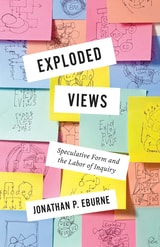
Exploded Views
Speculative Form and the Labor of InquiryJonathan Eburne
University of Minnesota Press, 2025
Idiosyncratic essays use their “exploded” forms to examine how inquiry functions
Insect galls, time, memory systems, orgone energy, and a bookstore that doesn’t yet exist. These disparate topics have persistently fascinated scholar Jonathan P. Eburne, yet each defied his previous efforts at classification through scholarly writing, resulting in five essays suspended in process. In Exploded Views, Eburne returns to these essays with the metaphorical tool of the exploded-view diagram, expanding them into entirely new, hybrid forms that unpack their inspirations and trace the wayward paths they followed.
An experiment into the nature of inquiry that spelunks, rather than shies from, the rabbit holes of scholarly curiosity, each essay gives way to sidelights and dilations to reveal the palimpsest of knowledge hiding beneath the surface of the academic form. A book about process—the process of turning ideas into things, and vice versa, as well as the particular tendency for research, scholarly inquiry, and critical writing to come apart and go awry—Exploded Views is a refreshing exploration of how the tools of creative critical thinking work at their most basic level.
Reflecting on the methods of scholarly knowledge production and the contextual factors that shape new ideas, Eburne boldly replaces the seamlessness of the finished manuscript with the friction and even messiness of the incomplete, inviting readers to think in new and invigorating ways.
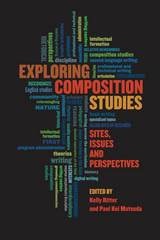
Exploring Composition Studies
Sites, Issues, PerspectivesKelly Ritter and Paul Matsuda
Utah State University Press, 2012
Kelly Ritter and Paul Kei Matsuda have created an essential introduction to the field of composition studies for graduate students and instructors new to the study of writing. The book offers a careful exploration of this diverse field, focusing specifically on scholarship of writing and composing. Within this territory, the authors draw the boundaries broadly, to include allied sites of research such as professional and technical writing, writing across the curriculum programs, writing centers, and writing program administration.
Importantly, they represent composition as a dynamic, eclectic field, influenced by factors both within the academy and without. The editors and their sixteen seasoned contributors have created a comprehensive and thoughtful exploration of composition studies as it stands in the early twenty-first century. Given the rapid growth of this field and the evolution of it research and pedagogical agendas over even the last ten years, this multi-vocal introduction is long overdue.
Exploring Digital Cultural Heritage
Access, Use, Value and SustainabilityEdited by Eirini Goudarouli, Anna-Maria Sichani, and Jane Winters
University of London Press, 2026
An accessible starting point for those interested in the past, present, and future of digital cultural heritage.
The digitization of cultural heritage has reshaped humanities research and professional practice, though its full impact is still emerging. As more cultural heritage becomes born-digital, new archives and collections introduce complexity, challenges, and shared methods across sectors. Exploring Digital Cultural Heritage examines interpretations, contexts, and uses across four themes—access, use and reuse, value(s), and sustainability—spanning digitized and born-digital materials. Drawing on case studies and practical examples, it provides an overview of the concepts, processes, and technologies shaping digital cultural heritage, as well as its future challenges and directions.
Exploring Discovery
The Front Door to Your Library's Licensed and Digitized ContentKenneth J. Varnum
American Library Association, 2016
Exploring Environmental Science with Children and Teens
Eileen G. Harrington
American Library Association, 2014
Exploring Inclusive & Equitable Pedagogies
Creating Space for All LearnersMelissa Mallon
Assoc of College & Research Libraries, 2023
In Exploring Inclusive & Equitable Pedagogies: Creating Space for All Learners, seven thorough sections across two volumes examine:
- Anti-Racist Approaches
- Intentional Information Literacy
- Engendering Care and Empathy
- Community Building
- Universal Design for Learning: An Important Benchmark
- Instructor Identity and Positionality
- Professional Development
Chapters cover topics including dismantling, reexamining, and reconstructing notions of authority in information literacy instruction; teaching technology inclusively; using primary sources to research queer and feminist histories; cocreating knowledge practices with students; prioritizing accessibility in synchronous and asynchronous learning environments; cultural humility, funds of knowledge, and information literacy instruction with first-generation students; designing and managing inclusive group projects; and much more.
To become the instructors our students need, we must adopt the mindsets and develop the underlying skills to enact inclusive and equitable teaching and learning. Exploring Inclusive & Equitable Pedagogies offers reflections, practices, and models that deepen our collective understanding of equitable and inclusive theories and practices and present new grounding for both our individual teaching and our instruction programs.
Exploring Inclusive & Equitable Pedagogies
Creating Space for All LearnersMelissa Mallon
Assoc of College & Research Libraries, 2023
In Exploring Inclusive & Equitable Pedagogies: Creating Space for All Learners, seven thorough sections across two volumes examine:
- Anti-Racist Approaches
- Intentional Information Literacy
- Engendering Care and Empathy
- Community Building
- Universal Design for Learning: An Important Benchmark
- Instructor Identity and Positionality
- Professional Development
Chapters cover topics including dismantling, reexamining, and reconstructing notions of authority in information literacy instruction; teaching technology inclusively; using primary sources to research queer and feminist histories; cocreating knowledge practices with students; prioritizing accessibility in synchronous and asynchronous learning environments; cultural humility, funds of knowledge, and information literacy instruction with first-generation students; designing and managing inclusive group projects; and much more.
To become the instructors our students need, we must adopt the mindsets and develop the underlying skills to enact inclusive and equitable teaching and learning. Exploring Inclusive & Equitable Pedagogies offers reflections, practices, and models that deepen our collective understanding of equitable and inclusive theories and practices and present new grounding for both our individual teaching and our instruction programs.
Exploring Inclusive & Equitable Pedagogies
Creating Space for All Learners, 2 volume setMelissa Mallon
Assoc of College & Research Libraries, 2023
In Exploring Inclusive & Equitable Pedagogies: Creating Space for All Learners, seven thorough sections across two volumes examine:
- Anti-Racist Approaches
- Intentional Information Literacy
- Engendering Care and Empathy
- Community Building
- Universal Design for Learning: An Important Benchmark
- Instructor Identity and Positionality
- Professional Development
Chapters cover topics including dismantling, reexamining, and reconstructing notions of authority in information literacy instruction; teaching technology inclusively; using primary sources to research queer and feminist histories; cocreating knowledge practices with students; prioritizing accessibility in synchronous and asynchronous learning environments; cultural humility, funds of knowledge, and information literacy instruction with first-generation students; designing and managing inclusive group projects; and much more.
To become the instructors our students need, we must adopt the mindsets and develop the underlying skills to enact inclusive and equitable teaching and learning. Exploring Inclusive & Equitable Pedagogies offers reflections, practices, and models that deepen our collective understanding of equitable and inclusive theories and practices and present new grounding for both our individual teaching and our instruction programs.
Exploring Options in Academic Writing
Effective Vocabulary and Grammar UseJan Frodesen and Margi Wald
University of Michigan Press, 2016
Following a unit on using resources for vocabulary development, the contents are divided into three parts: Showing Relationships within Sentences, Connecting and Focusing across Sentences, and Qualifying Statements and Reporting Research. Part 1 focuses on verbs and modifiers that express increases and decreases, verbs and abstract nouns that describe change, connectors and verbs describing causal relationships, and parallel structures. Part 2 explores the words that help connect ideas and add cohesion. Part 3 discusses how to express degrees of certainty and accuracy and the use of reporting verbs.
Extensible Processing for Archives and Special Collections
Reducing Processing BacklogsDaniel A. Santamaria
American Library Association, 2015
Extensions of the Burkeian System
James W. Chesebro
University of Alabama Press, 1993
Extensions of the Burkeian System constitutes one of the first projects to meet the requirements Burke has established for his operation benchmark. This volume its origins in the scholarly contributions of Kenneth Burke. All of the authors of the chapters in this volume adopt stances that defer to Burke’s initial contributions, ultimately casting their work as extensions of ideas and claims posited by Burke. Yet, all of the authors also make significant departures from positions Burke has articulated. The range of these reactions varies tremendously. Several of the authors cast their positions as augmentations. They offer supplements to Burke's claims that constitute logical additions to Burke's initial observations, but even these authors provide adjustments to the Burkeian system that make a difference in how the system is perceived and understood. Other essays are cast in a more challenging mode, arguing explicitly for alternative viewpoints. Displeased with Burke's analysis at a given point for one reason or another, they posit positions different than those advanced by Burke.
Extraordinary from the Ordinary
Personal Experience Narratives in American Sign LanguageKristin J. Mulrooney
Gallaudet University Press, 2009
Personal narratives are one way people code their experiences and convey them to others. Given that speakers can simultaneously express information and define a social situation, analyzing how and why people structure the telling of personal narratives can provide insight into the social dimensions of language use. In Extraordinary from the Ordinary: Personal Experience Narratives in American Sign Language, Kristin Jean Mulrooney shows that accounts by Deaf persons expressed in ASL possess the same characteristics and perform the same function as oral personal narratives.
Mulrooney analyses12 personal narratives by ASL signers to determine how they “tell” their stories. She examines the ASL form of textual narration to see how signers use lexical signs to grammatically encode information, and how they also convey perceived narration. In perceived narration, the presenter depicts a past occurrence in the immediate environment that allows the audience to partially witness and interpret the event. Mulrooney determined that ASL narratives reveal a patterned structure consisting of an introduction, a main events section for identifying and describing past events, and a conclusion. They also can include background information, an explication section in which the presenter expands or clarifies an event, and a section that allows the presenter to explain his or her feelings about what happened. Liberally illustrated with photographs from videotaped narratives, Extraordinary from the Ordinary offers an engrossing, expansive view of personal narratives embodying the unique linguistic elements of ASL.
ePortfolios@edu
What We Know, What We Don’t Know, and Everything In-BetweenMary Ann Dellinger
University Press of Colorado, 2021
This book is also available as an open access ebook through the WAC Clearinghouse.