Results by title
8642 books match the query '20th Century' and 236 start with e
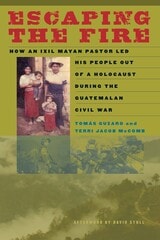
Escaping the Fire
How an Ixil Mayan Pastor Led His People Out of a Holocaust During the Guatemalan Civil WarBy Tomás Guzaro and Terri Jacob McComb
University of Texas Press, 2010
During the height of the Guatemalan civil war, Tomás Guzaro, a Mayan evangelical pastor, led more than two hundred fellow Mayas out of guerrilla-controlled Ixil territory and into the relative safety of the government army's hands. This exodus was one of the factors that caused the guerrillas to lose their grip on the Ixil, thus hastening the return of peace to the area.
In Escaping the Fire, Guzaro relates the hardships common to most Mayas and the resulting unrest that opened the door to civil war. He details the Guatemalan army's atrocities while also describing the Guerrilla Army of the Poor's rise to power in Ixil country, which resulted in limited religious freedom, murdered church leaders, and threatened congregations. His story climaxes with the harrowing vision that induced him to guide his people out of their war-torn homeland.
Guzaro also provides an intimate look at his spiritual pilgrimage through all three of Guatemala's main religions. The son of a Mayan priest, formerly a leader in the Catholic Church, and finally a convert to Protestantism, Guzaro, in detailing his religious life, offers insight into the widespread shift toward Protestantism in Latin America over the past four decades.
Riveting and highly personal, Escaping the Fire ultimately provides a counterpoint to the usual interpretation of indigenous agency during the Guatemalan civil war by documenting the little-studied experiences of Protestants living in guerrilla-held territory.
Essays on Twentieth-Century History
Edited by Michael Adas for the American Historical Association
Temple University Press, 2010
In the sub-field of world history, there has been a surprising paucity of thinking and writing about how to approach and conceptualize the long twentieth century from the 1870s through the early 2000s. The historiographic essays collected in Essays on Twentieth Century History will go a long way to filling that lacuna.
Each contribution covers a key theme and one or more critical sub-fields in twentieth century global history. Chapters address migration patterns, the impact of world wars, transformations in gender and urbanization, as well as environmental transitions. All are written by leading historians in each of the sub-fields represented, and each is intended to provide an introduction to the literature, key themes, and debates that have proliferated around the more recent historical experience of humanity.
Estonian Life Stories
Tiina Kirss
Central European University Press, 2009
After a short period of independence, Estonia was occupied in World War II by the Red Army, then Nazi Germany, and again, for a lasting occupation, by the Soviets. No wonder that a greater part of the roughly one million Estonians had harshly eventful lives.
This anthology contains 25 selected life stories collected from Estonians who lived through the tribulations of the 20th century, and describe the travails of ordinary people under numerous regimes. The autobiographical accounts provide authentic perspectives on events of this period, where time is placed in the context of life-spans, and subjects grounded in personal experience. Most of the life stories reveal sufferings under foreign (Russian) oppression.
The volume is the product of a large-scale national project to record history by collecting autobiographical accounts, and a process of engaged selection for publication which followed. The variety of life-experiences recorded offers comparison across cultures, as well as an overview of the powerful neighbors as they relinquish and strengthen their hold on Estonia.
Estonian Short Stories
Kajar Pruul and Darlene Reddaway
Northwestern University Press, 1996
Eternalized Fragments
Reclaiming Aesthetics in Contemporary World FictionW. Michelle Wang
The Ohio State University Press, 2020
Since postmodern and contemporary fiction tend to be dominated by disjunctures, paradoxes, and incongruities, this book offers an account of how and why readers choose to engage regardless, articulating the cognitive rewards such difficulties offer. By putting narrative and philosophical approaches in conversation with evolutionary psychology and contemporary neuroscience, W. Michelle Wang examines the value of attending to aesthetic experiences when we read literature and effectively demonstrates that despite the aesthetic’s stumble in time, our ongoing love affair with fiction is grounded in our cognitive engagements with the text’s aesthetic dimensions.
Drawing on a diverse range of works by Gabriel García Márquez, Kazuo Ishiguro, Arundhati Roy,Cormac McCarthy, Jeanette Winterson, Jennifer Egan, Italo Calvino, Flann O’Brien, and Alasdair Gray, Eternalized Fragments lucidly renders the aesthetic energies at work in the novels’ rich potentialities of play, the sublime’s invitation to affective renegotiations, and beauty’s polysemy in shaping readerly capacities for nuance.
Ethics by Committee
A History of Reasoning Together about Medicine, Science, Society, and the StateNoortje Jacobs
University of Chicago Press, 2022
Ethics boards have become obligatory passage points in today’s medical science, and we forget how novel they really are. The use of humans in experiments is an age-old practice that records show goes back to at least the third century BC, and it has been popular as a practice since the early modern period. Yet in most countries around the world, hardly any formal checks and balances existed to govern the communal oversight of experiments involving human subjects until at least the 1960s. Ethics by Committee traces the rise of ethics boards for human experimentation in the second half of the twentieth century.
Using the Netherlands as a case study, historian Noortje Jacobs shows how the authority of physicians to make decisions about clinical research in this period gave way in most developed nations to formal mechanisms of communal decision-making that served to regiment the behavior of individual researchers. This historically unprecedented change in scientific governance came out of the growing international wariness of medical research in the decades after World War II and was meant to solidify a new way of reasoning together in liberal democracies about medicine and science. But what reasoning together meant, and who was invited to participate, changed drastically over time. In detailing this history, Jacobs shows that research ethics committees were originally intended not only to make human experimentation more ethical but also to raise its epistemic quality and intensify the use of new clinical research methods. By examining complex negotiations over the appropriate governance of human subjects research, Ethics by Committee is an important contribution to our understanding of the randomized controlled trial and the history of research ethics and bioethics more generally.
Ethiopia Unbound
A Critical EditionJ. E. Casely Hayford
Michigan State University Press, 2024
Ethnic Drag
Performing Race, Nation, Sexuality in West GermanyKatrin Sieg
University of Michigan Press, 2002
Using engaging case studies, Ethnic Drag traces the classical and travestied traditions of Jewish impersonation from the eighteenth century onward to construct a pre-history of postwar ethnic drag. It examines how, shortly after World War II, mass culture and popular practices facilitated the repression and refashioning of Nazi racial precepts. During a time when American occupation authorities insisted on remembrance and redress for the Holocaust, the Wild West emerged as a displaced theater of the racial imagination, where the roles of victim, avenger, and perpetrator of genocide were reassigned.
Ethnic Drag is an accessible and sophisticated, critical and entertaining book that examines the phenomenon of cultural masquerade in order to examine racial feeling, thought, and behavior in postwar German culture. Contributing to considerations of drag in postcolonial, feminist, and queer scholarships, this book will be of interest to people in German studies, theater performance, ethnic studies, and women's/queer studies.
Katrin Sieg is Associate Professor, Department of German and Center for German and European Studies, Georgetown University.
Ethnic Elites
Japanese, Ukrainians, and Scots, 1919-1971Aya Fujiwara
University of Manitoba Press, 2012
Ethnic Passages
Literary Immigrants in Twentieth-Century AmericaThomas J. Ferraro
University of Chicago Press, 1993
Ferraro engages the literature of immigration and mobility by asking what motivates its authors and what their work actually accomplishes. He concentrates on five diverse examples of the "up-from-the-ghetto" narrative: Mario Puzo's The Godfather, Anzia Yezierska's Bread Givers, Henry Roth's Call It Sleep, Henry Miller's "The Tailor Shop," and Maxine Hong Kingston's The Woman Warrior. To Ferraro the unsuspected value of these works is that they recast the conventions of ethnic representation, illustrating the power of ethnic writing to capture and redirect the national literary imagination.
Ferraro's sharply observed reading of these five works shows how such reenactments of immigrant mobility test the ideology of assimilation against the writer's experience. Ethnic Passages will refocus discussion of how literature addresses the American conflict between ethnic heritage and the greater opportunities of "mainstream" society.
Ethnic Pride, American Patriotism
Slovaks And Other New ImiigrantsJune Granatir Alexander
Temple University Press, 2004
Ethnic Relations in the Baltic Reconsidered
Bradley D. Woodworth
Central European University Press, 2026
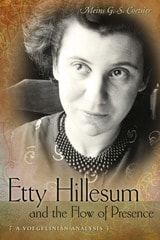
Etty Hillesum and the Flow of Presence
A Voegelinian AnalysisMeins G. S. Coetsier
University of Missouri Press, 2008
Although she died cruelly at Auschwitz at the age of twenty-nine, Etty Hillesum left a lasting legacy of mystical thought in her letters and diaries. Hillesum was a complex and powerful witness to the openness of the human spirit to the call of God, even under the most harrowing circumstances. Her life was as much shaped by Hitler’s regime as was that of philosopher Eric Voegelin, and as Meins Coetsier reveals, her thought lends itself to interpretation from a uniquely Voegelinian perspective.
Etty Hillesum and the Flow of Presence analyzes the life and writings of Hillesum from the standpoint of Voegelin’s views on consciousness—especially his philosophy of luminous participation in the transcendent ground of being. Through a careful reading of her letters and diaries, Coetsier reveals the inner development of Hillesum’s mystically grounded resistance to Nazism as he guides readers through the symbolism of her spiritual journey, making effective use of Voegelin’s analytics of experience and symbolization to trace her path to spiritual truth.
Intertwining the lives, works, and visions of these two mystical thinkers, Coetsier demonstrates his mastery of both Voegelin’s philosophy and Hillesum’s Dutch-language materials. He shows how mystical attunement to the “flow of presence”—Voegelin’s designation for human responsiveness to the divine—is the key to the development of Hillesum’s life and writings. He displays a special affinity for the suffering and grace-filled transformation that she underwent as she approached the end of her life and gained insight into the ultimate purpose of each individual’s contribution to the well-being and maintenance of the human spirit.
Retrieving one of the lesser-known but most compelling figures of the Holocaust, Etty Hillesum and the Flow of Presence is an original contribution to both Voegelin and Hillesum scholarship that reflects these writers’ strong valuation of the human person. It presents Hillesum’s life and work in an original and provocative context, shedding new light on her experiences and their symbolizations while further broadening the application of Voegelin’s thought
Eugene Jolas
Critical Writings, 1924-1951Eugene Jolas
Northwestern University Press, 2009
Dividing his youth between the United States and the bilingual Alsace-Lorraine, Eugene Jolas (1894–1952) flourished in three languages. As an editor and poet, he came to know the major writers and artists of his time and enjoyed a pivotal position between the Anglo-American and Continental avant-garde. His editorship of transition, the leading avant-garde journal of Paris in the twenties and early thirties, provided a major impetus to writers from James Joyce (whose Finnegans Wake was serialized in transition) to Gertrude Stein, and Samuel Beckett, with first translations of André Breton, and Franz Kafka, among others. Jolas’s critical work, collected in this volume, includes introductions to anthologies, manifestoes like the famous Vertical, essays, some published here for the first time, on writers as various as Novalis, Trakl, the major Surrealists, Heidegger, and other philosophers. An acute observer of the literary scene as well as of the roiling politics of the time, Jolas emerges here in his role at the very center of avant-garde activity between the wars. Accordingly, this book is of signal importance to anyone with an interest in modernism, avant-garde, multilingualism, and the culture of Western Europe in the first half of the twentieth century.
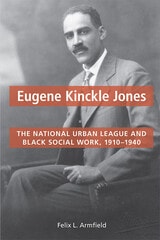
Eugene Kinckle Jones
The National Urban League and Black Social Work, 1910-1940Felix L. Armfield
University of Illinois Press, 2014
Drawing on interviews with Jones's colleagues and associates, as well as recently opened family and Urban League archives, Felix L. Armfield blends biography with an in-depth discussion of the roles of black institutions and organizations. The result is a work that offers new details on the growth of African American communities, the evolution of African American life, and the role of black social workers in the years before the civil rights era.
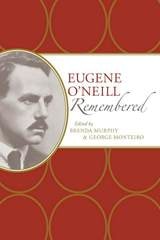
Eugene O'Neill Remembered
Edited by Brenda Murphy and George Monteiro
University of Alabama Press, 2017
A primary-source portrait of Eugene O’Neill through the voices that knew him.
Known principally as the author of some of the most significant plays in the American dramatic canon and as one of America’s Nobel Laureates in literature, O'Neill rarely gave interviews and offered few details about himself. As a consequence, his life has long been shrouded in myth. He also abetted some of the misconceptions about his youth by, for example, advocating the story that he was expelled from Princeton for throwing a rock through Woodrow Wilson's window or by exaggerating the amount of time he had spent at sea. The legend of the hard-drinking, tormented playwright with a grim view of life was further reinforced when Long Day's Journey into Night was produced in 1956, three years after his death instead of the twenty-five years he had insisted on.
The portrayal of O’Neill as a tragic figure has been solidified in a number of biographies. The purpose of this collection, however, is to present O'Neill as others saw him and described him in their first-person accounts. In the course of these reminiscences, many of the vast and various narrators conflict with and contradict each other. Unlike other accounts of O’Neill’s life, much of the focus is on impressions instead of facts. The result is a revealing composite portrait of a key figure in twentieth-century American literary history.
This extensive collection offers insights unavailable in any other book and will hold massive appeal for scholars and students interested in American literature, Eugene O’Neill, and theater history, as well as anyone keen to uncover intimate details of the life of one of America’s greatest writers.
Eugene O'Neill's America
Desire Under DemocracyJohn Patrick Diggins
University of Chicago Press, 2007
In the face of seemingly relentless American optimism, Eugene O’Neill's plays reveal an America many would like to ignore, a place of seething resentments, aching desires, and family tragedy, where failure and disappointment are the norm and the American dream a chimera. Though derided by critics during his lifetime, his works resonated with audiences, won him the Nobel Prize and four Pulitzer, and continue to grip theatergoers today. Now noted historian John Patrick Diggins offers a masterly biography that both traces O’Neill’s tumultuous life and explains the forceful ideas that form the heart of his unflinching works.
Diggins paints a richly detailed portrait of the playwright’s life, from his Irish roots and his early years at sea to his relationships with his troubled mother and brother. Here we see O’Neill as a young Greenwich Village radical, a ravenous autodidact who attempted to understand the disjunction between the sunny public face of American life and the rage that he knew was simmering beneath. According to Diggins, O’Neill mined this disjunction like no other American writer. His characters burn with longing for an idealized future composed of equal parts material success and individual freedom, but repeatedly they fall back to earth, pulled by the tendrils of family and the insatiability of desire. Drawing on thinkers from Emerson to Nietzsche, O’Neill viewed this endlessly frustrated desire as the problematic core of American democracy, simultaneously driving and undermining American ideals of progress, success, and individual freedom.
Melding a penetrating assessment of O’Neill’s works and thought with a sensitive re-creation of his life, Eugene O’Neill’s America offers a striking new view of America’s greatest playwright—and a new picture of American democracy itself.
Eugenics in the Garden
Transatlantic Architecture and the Crafting of ModernityBy Fabiola López-Durán
University of Texas Press, 2018
Winner, Robert Motherwell Book Award, Outstanding Book on Modernism in the Arts, The Dedalus Foundation, 2019
As Latin American elites strove to modernize their cities at the turn of the twentieth century, they eagerly adopted the eugenic theory that improvements to the physical environment would lead to improvements in the human race. Based on Jean-Baptiste Lamarck’s theory of the “inheritance of acquired characteristics,” this strain of eugenics empowered a utopian project that made race, gender, class, and the built environment the critical instruments of modernity and progress.
Through a transnational and interdisciplinary lens, Eugenics in the Garden reveals how eugenics, fueled by a fear of social degeneration in France, spread from the realms of medical science to architecture and urban planning, becoming a critical instrument in the crafting of modernity in the new Latin world. Journeying back and forth between France, Brazil, and Argentina, Fabiola López-Durán uncovers the complicity of physicians and architects on both sides of the Atlantic, who participated in a global strategy of social engineering, legitimized by the authority of science. In doing so, she reveals the ideological trajectory of one of the most celebrated architects of the twentieth century, Le Corbusier, who deployed architecture in what he saw as the perfecting and whitening of man. The first in-depth interrogation of eugenics’ influence on the construction of the modern built environment, Eugenics in the Garden convincingly demonstrates that race was the main tool in the geopolitics of space, and that racism was, and remains, an ideology of progress.
Eulogy for the Living
Taking FlightChrista Wolf
Seagull Books, 2018
Christa Wolf tried for years to find a way to write about her childhood in Nazi Germany. In her 1976 book Patterns of Childhood, she explained why it was so difficult: “Gradually, over a period of months, the dilemma has emerged: to remain speechless or to live in the third person, these seem to be the options. One is impossible, the other sinister.” During 1971 and 1972 she made thirty-three attempts to start the novel, abandoning each manuscript only pages in. Eulogy for the Living, written over the course of four weeks, is the longest of those fragments. In its pages, Wolf recalls with crystalline precision the everyday details of her life as a middle-class grocer’s daughter, and the struggles within the family—struggles common to most families, but exacerbated by the rise of Nazism. And as Nazism fell, the Wolfs fled west, trying to stay ahead of the rampaging Red Army.
Evangelical News
Politics, Gender, and Bioethics in Conservative Christian Magazines of the 1970s and 1980sAnja-Maria Bassimir
University of Alabama Press, 2022
A comprehensive study of evangelical magazine discourse during the 1970s and 1980s and how it navigated and sustained religious convictions in a time of dramatic social change
The 1970s and 1980s were a tumultuous period in US history. In tandem with a dramatic political shift to the right, evangelicalism also entered the public discourse as a distinct religious movement and was immediately besieged by cultural appropriations and internal fragmentations. Americans in general and evangelicals in particular grappled with issues and ideas such as feminism, abortion, birth control, and restructuring traditional roles for women and the family. During this time, there was a surge in readership for evangelical periodicals such as Christianity Today, Moody Monthly, Eternity, and Post-Americans/Sojourners as well as the feminist newsletter Daughters of Sarah.
While each of these magazines—and other publications and media—contributed to and participated in the overall dissemination of evangelical ideology, they also had their own outlooks and political leanings concerning hot-button issues. In Evangelical News: Politics, Gender, and Bioethics in Conservative Christian Magazines of the 1970s and 1980s, Anja-Maria Bassimir presents a nuanced view of evangelicalism in the late twentieth century through the lens of the movement’s own media.
Bassimir argues that community can be produced in discourse, especially when shared rhetoric, concepts, and perspectives signal belonging. To accomplish this, Evangelical News traces the emergence of evangelical social and political awareness in the 1970s to the height of its power as a political program. The chapters investigate such topics as how evangelicals reenvisioned gender norms and relations in light of the feminist movement, the use of childhood as a symbol of unspoiled innocence, and the place of evangelicals as political actors.
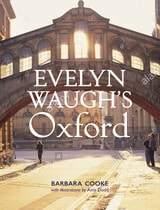
Evelyn Waugh's Oxford
Barbara Cooke
Bodleian Library Publishing, 2018
Following a brief overview of Waugh’s life and work, subsequent chapters examine the prose and graphic art Waugh produced as an undergraduate, together with his portrayal of Oxford in Brideshead Revisited and his memoir, A Little Learning. A specially commissioned, hand-drawn trail around Evelyn Waugh’s Oxford guides the reader around the city Waugh knew and loved through such iconic locations as the Botanic Garden, the Oxford Union, and the Chequers.
A unique literary biography, this book brings to life Waugh’s Oxford, exploring the lasting impression it made on one of the most accomplished literary craftsmen of the twentieth century.
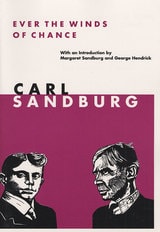
Ever the Winds of Chance
POEMSCarl Sandburg
University of Illinois Press, 1983
Ever the Winds of Chance opens in 1898 when the twenty-year-old Sandburg, recently returned from the Spanish-American war, enrolls at Lombard College in his native Galesburg, Illinois. Sandburg writes about his job at the fire station; his teachers, inspired or otherwise; his classmates and their camaraderie; his observations on great literary works and writers; and his own writings for the school newspaper, literary review, and yearbook and for the Galesburg Mail. But he also includes much about life between school years and after college, recounting his various brief careers as a fireman, salesman of stereoscopic views, advertising copywriter, vagabond, "jailbird," and budding poet and socialist. Together these reminiscences provide an intimate look at the formative years of a preeminent figure in American letters.
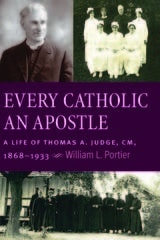
Every Catholic An Apostle
A Life of Thomas A. Judge, CM, 1868-1933William L. Portier
Catholic University of America Press, 2017
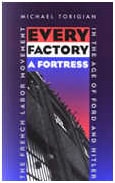
Every Factory a Fortress
The French Labor Movement in the Age of Ford and HitlerMichael Torigian
Ohio University Press, 1999
French trade unions played a historical role in the 1930s quite unlike that of any other labor movement. Against a backdrop of social unrest, parliamentary crisis, and impending world war, industrial unionists in the great metal-fabricating plants of the Paris Region carried out a series of street mobilizations, factory occupations, and general strikes that were virtually unique in Western history.
The unionization of the metal industry, following a series of anti-fascist demonstrations and plant seizures, would constitute the defining episode in modern French labor history and one of the great chapters in European social history. Yet little is known of these extraordinary events.
With a style that captures the vivid character of these experiences, Every Factory a Fortress tells the story of the Paris metal workers, who succeeded in organizing the largest Communist union in the Western world, reshaping the parameters of French social relations, and, ultimately, altering the course of French destinies.
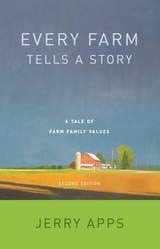
Every Farm Tells a Story
A Tale of Family ValuesJerry Apps
Wisconsin Historical Society Press, 2018
“Do your chores without complaining. Show up on time. Do every job well. Always try to do better. Never stop learning. Next year will be better. Care for others, especially those who have less than you. Accept those who are different from you. Love the land.”
In this paperback edition of a beloved Jerry Apps classic, the rural historian captures the heart and soul of life in rural America. Inspired by his mother’s farm account books—in which she meticulously recorded every farm purchase—Jerry chronicles life on a small farm during and after World War II. Featuring a new introduction exclusive to this 2nd edition, Every Farm Tells a Story reminds us that, while our family farms are shrinking in number, the values learned there remain deeply woven in our cultural heritage.
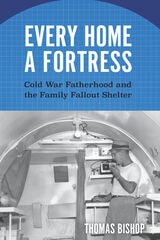
Every Home a Fortress
Cold War Fatherhood and the Family Fallout ShelterThomas Bishop
University of Massachusetts Press, 2020
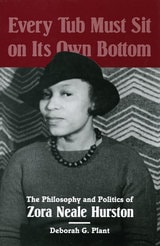
Every Tub Must Sit on Its Own Bottom
The Philosophy and Politics of Zora Neale HurstonDeborah G. Plant
University of Illinois Press, 1995
needed at this point in the evolving critical assessment of Hurston. It
is a paradigm for the study of individual African American women writers."
-- Alice Deck, University of Illinois at Urbana-Champaign
In a ground-breaking study
of Zora Neale Hurston, Deborah Plant takes issue with current notions
of Hurston as a feminist and earlier impressions of her as an intellectual
lightweight who disregarded serious issues of race in American culture.
Instead, Plant calls Hurston a "writer of resistance" who challenged
the politics of domination both in her life and in her work. One of the
great geniuses of the Harlem Renaissance, Hurston stands out as a strong
voice for African-American women. Her anthropological inquiries as well
as her evocative prose provide today's readers with a rich history of
African American folk culture, a folk culture through which Hurston expressed
her personal and political strategy of resistance and self-empowerment.
Through readings of Hurston's
fiction and autobiographical writings, Plant offers one of the first book-length
discussions of Hurston's personal philosophy of individualism and self-preservation.
From a discussion of Hurston's preacher father and influential mother,
whose guiding philosophy is reflected in the title of this book, to the
influence of Spinoza and Nietzsche, Plant puts into perspective the driving
forces behind Hurston's powerful prose.
This fresh look at one of
the most important writers of the twentieth century is sure to shape future
study of Hurston and her work.
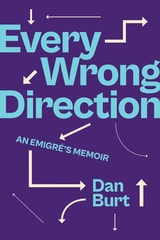
Every Wrong Direction
An Emigré’s MemoirDan Burt
Rutgers University Press, 2023
Every Wrong Direction recreates and dissects the bitter education of Dan Burt, an American émigré who never found a home in America. It begins in the row homes of Jewish immigrants and working-class Italians on the mean streets of 1950s South Philadelphia. Every Wrong Direction follows the author from the rough, working-class childhood that groomed him to be a butcher or charter boat captain, through America, Britain and Saudi Arabia as student, lawyer, spy, culture warrior, and expatriate, ending with a photo of his college rooms at St John’s College, Cambridge. Between this beginning and end, through a Philadelphia commuter college, to Cambridge, then Yale Law School, across the working to upper classes, three countries, and seven cities over 43 years, it maps his pursuit of, realization, disillusionment with and abandonment of America and the American Dream.
Praise for Dan Burt's previous memoir, You Think It Strange:
“Burt’s early life was indeed a triumph of wit and will. He managed to escape a world filled with violence and a culture that valued street smarts over book smarts, all the while knowing that just about everyone around him thought little of his prospects. That he made it out at all is extraordinary. That he became a successful lawyer and writer is virtually unimaginable.” —Commonweal
“Dan Burt is a fine poet, and this memoir has all the sensitivity and vigilance you might expect from a writer with such a background. But his prose also has a robustness and documentary power that continually startles and engages. As it combines these things, You Think It Strange catches the strangeness of the world and makes it familiar.”
—Sir Andrew Motion, Poet Laureate of the United Kingdom, 1999-2009
Everybody's Autonomy
Connective Reading and Collective IdentityJuliana Spahr
University of Alabama Press, 2001
Contemporary avant garde writing has often been overlooked by those who study literature and identity. Such writing has been perceived as unrelated, as disrespectful of subjectivity. But Everybody's Autonomy instead locates within avant garde literature models of identity that are communal, connective, and racially concerned. Everybody's Autonomy, as it tackles literary criticism's central question of what sort of selves do works create, looks at works that encourage connection, works that present and engage with large, public worlds that are in turn shared with readers. With this intent, it aligns the iconoclastic work of Gertrude Stein with foreign, immigrant Englishes and their accompanying subjectivities. It examines the critique of white individualism and privilege in the work of language writers Lyn Hejinian and Bruce Andrews. It looks at how Harryette Mullen mixes language writing's open text with the distinctivesness of African-American culture to propose a communal, yet still racially conscious identity. And it examines Theresa Hak Kyung Cha's use of broken English and French to unsettle readers' fluencies and assimilating comprehensions, to decolonize reading. Such works, the book argues, well represent and expand changing notions of the public, of everybody.
Everybody's History
Indiana's Lincoln Inquiry and the Quest to Reclaim a President's PastKeith A. Erekson
University of Massachusetts Press, 2012
Revered by the public, respected by scholars, and imitated by politicians, Abraham Lincoln remains influential more than two hundred years after his birth. His memory has inspired books, monuments, and museums and also sparked controversies, rivalries, and forgeries. That so many people have been interested in Lincoln for so long makes him an ideal subject for exploring why history matters to ordinary Americans as well as to academic specialists.
In Everybody's History, Keith A. Erekson focuses on the Southwestern Indiana Historical Society—an organization composed of lawyers, historians, collectors, genealogists, teachers, college presidents, and newspaper editors—who joined together during the 1920s and 1930s to recover a part of Lincoln's life his biographers had long ignored: the years from age seven to twenty-one when he lived on the Indiana frontier. Participants in the “Lincoln Inquiry,” as it was commonly known, researched old records, interviewed aging witnesses, hosted pageants, built a historical village, and presented their findings in public and in print. Along the way they defended their methods and findings against competitors in the fields of public history and civic commemoration, and rescued some of Indiana's own history by correcting a forgotten chapter of Lincoln's.
Everybody's History traces the development of popular interest in Lincoln to uncover the story of an extensive network of nonprofessional historians who contested old authorities and advanced new interpretations. In so doing, the book invites all who are interested in the past to see history as both vital to public life and meaningful to everybody.

Everybody’s Family Romance
Reading Incest in Neoliberal AmericaGillian Harkins
University of Minnesota Press, 2009
In the 1990s, a boom in autobiographical novels and memoirs about incest emerged, making incest one of the hottest topics to connect daytime TV talk shows, the self-help industry, and the literary publishing circuit. In Everybody's Family Romance, Gillian Harkins places this proliferation of incest literature at the center of transformations in the political and economic climate of the late twentieth century.
Harkins's interdisciplinary approach reveals how women's narratives about incest were co-opted by-and yet retained resistant strains against-the cultural logics of the neoliberal state. Across chapters examining legal cases on recovered memory, popular journalism, and novels and memoirs by Dorothy Allison, Carolivia Herron, Kathryn Harrison, and Sapphire, Harkins demonstrates that incest narratives look backward into the past. In these accounts, images of incest forge links between U.S. chattel slavery and the distributive impasses of the welfare state and between decades-distant childhoods and emergent memories of the present.
In contrast to recent claims that incest narratives eclipse broader frameworks of political and economic power, Harkins argues that their emergence exposes changing structural relations between the family and the nation and, in doing so, transforms the analyses of American familial sexual violence.
Everyday Ecofascism
Crisis and Consumption in American LiteratureAlexander Menrisky
University of Minnesota Press, 2025
A timely look into how fascist ideas permeate contemporary culture well beyond the far right
As challenges posed by climate change have intensified in the twenty-first century, right-wing figures in the United States and abroad have increasingly framed anti-immigrant, anti-Indigenous, and white-supremacist sentiments in terms of environmental survival. Everyday Ecofascism explores the insidious nature of this tendency, revealing how permutations of these perspectives in fact resonate across the political spectrum. Drawing on comparative studies of fascism writ large, Alexander Menrisky demonstrates that ecofascism is best understood not as a uniquely right-wing ideology but as a political genre that reinforces white supremacy and other forms of domination.
Presenting a view of fascism as a complex power network that plays out on scales both large and small, Menrisky shows how extremist sentiments have crept into everyday language, stories, and ideas. Through a literary and cultural studies lens, he illuminates ecofascism’s narrative patterns and their easy permeation of environmentalist discourses, from back-to-the-land movements to the resurgence of psychedelic drugs, food localism, and pandemic politics. Opposite his analysis of ecofascism in action, Menrisky sheds important light on narrative resistances to dominant conceptions of race, nation, and territory by Native, queer, and women-of-color writers who have countered ethnonationalism for generations.
Bridging past and present, Menrisky powerfully nails down the emergent concept of ecofascism and forms a basis for understanding phenomena like Covid-19, ecological utopianism, and psychedelic environmentalism that detangles ecofascist tendencies from justice-oriented visions of place-based belonging.
Retail e-book files for this title are screen-reader friendly.
Everyday Forms of State Formation
Revolution and the Negotiation of Rule in Modern MexicoGilbert M. Joseph and Daniel Nugent, eds.
Duke University Press, 1994
Structured in the form of a dialogue between a distinguished array of Mexicanists and comparative social theorists, this volume boldly reassesses past analyses of the Mexican revolution and suggests new directions for future study. Showcasing a wealth of original archival and ethnographic research, this collection provides a new and deeper understanding of Mexico’s revolutionary experience. It also speaks more broadly to a problem of extraordinary contemporary relevance: the manner in which local societies and self-proclaimed "revolutionary" states are articulated historically. The result is a unique collection bridging social history, anthropology, historical sociology, and cultural studies in its formulation of new approaches for rethinking the multifaceted relationship between power, culture, and resistance.
Contributors. Ana María Alonso, Armando Bartra, Marjorie Becker, Barry Carr, Philip Corrigan, Romana Falcón, Gilbert M. Joseph, Alan Knight, Florencia E. Mallon, Daniel Nugent, Elsie Rockwell, William Roseberry, Jan Rus, Derek Sayer, James C. Scott
Everyday Life under Communism and After
Lifestyle and Consumption in Hungary, 1945–2000Tibor Valuch
Central European University Press, 2022
By providing a survey of consumption and lifestyle in Hungary during the second half of the twentieth century, this book shows how common people lived during and after tumultuous regime changes. After an introduction covering the late 1930s, the study centers on the communist era, and goes on to describe changes in the post-communist period with its legacy of state socialism.
Tibor Valuch poses a series of questions. Who could be called rich or poor and how did they live in the various periods? How did living, furnishings, clothing, income, and consumption mirror the structure of the society and its transformations? How could people accommodate their lifestyles to the political and social system? How specific to the regime was consumption after the communist takeover, and how did consumption habits change after the demise of state socialism? The answers, based on micro-histories, statistical data, population censuses and surveys help to understand the complexities of daily life, not only in Hungary, but also in other communist regimes in east-central Europe, with insights on their antecedents and afterlives.
Everyday Modernism
Architecture and Society in SingaporeJiat-Hwee Chang and Justin Zhuang
National University of Singapore Press, 2022
A richly illustrated account of the development of Singapore’s modern built environment.
Everyday Modernism is the first comprehensive documentation of Singapore’s modern built environment. Through a lens of social, cultural, and architectural histories, the book uncovers the many untold stories of the Southeast Asian city-state’s modernization, from the rise of heroic skyscrapers, such as the Pearl Bank Apartments, to the spread of typical utilitarian buildings like the multistory parking garage. It investigates how modernism, through both form and function, radically transformed Singapore and made its inhabitants into modern citizens. The most intensive period of such change, the author shows, happened in the 1960s and 1970s under the rise of a developmental state that sought to safeguard its new-found independence. The book also looks both earlier and later, however, ranging from the 1930s to the 1980s to cover a wider range of histories, building types, and architectural styles, expanding from the International Style and Brutalism into Art Deco and even a touch of Postmodernism. The book’s essays are richly illustrated with hundreds of archival images and illustrations, as well as contemporary photos by architectural photographer Darren Soh. By examining the evolution of the once exceptional into the typical and by learning how abstract spaces become lived places, the book traces how modernism has become part of everyday life in Singapore.
Everyday People and the Stories of Freedom in the Sixties
Craig Werner
University of Massachusetts Press, 2027
Showing that the most important figures of the 1960s were not always the most famous ones
Just weeks back from Vietnam, guitarist Larry Lee stood on stage at Woodstock alongside Jimi Hendrix, but he isn’t given more than a glance in the festival’s documentary. In Selma, Alabama, in March 1965, an eight-year-old girl named Sheyann Webb wrote her own obituary before joining the march across the Edmund Pettus Bridge. She survived Bloody Sunday, swept off the bridge in the arms of Hosea Williams as state troopers on horseback swung bullwhips and clubs. These are just a couple of the regular people at the heart of Craig Werner’s sweeping, mosaic history of the 1960s; it is their stories, not those of the icons, that give the era its deeper meaning.
In Everyday People and the Stories of Freedom in the Sixties, Werner assembles a rich and kaleidoscopic portrait of a decade in which Americans across the entire political spectrum claimed freedom as their cause. Moving beyond familiar myths and simplified narratives, he reveals a period defined by three interlocking realities: everything was open to change, everything seemed to happen at once, and everyone believed their vision of freedom was the one worth fighting for.
Bringing together stories too often told in isolation—the Civil Rights Movement, Vietnam, the global Cold War, the women’s movement, and the intertwined worlds of sex, drugs, and rock 'n' roll—Werner integrates the experiences of African Americans, women, Native Americans, Latinx communities, LGBTQ people, and immigrants into a single, propulsive narrative. Music, film, art, and fashion are not treated as colorful backdrops but as central forces in the making of political and social change. This book illuminates the economic, political, technological, and cultural forces that shaped the 1960s and continue to influence the present. It is a history of a decade told not from the top down, but from the ground up, by the people who lived it.
Supplemental materials for readers, students, and instructors are available on the publisher’s website, including full citations, playlists, images, and thematic sections on the Global Sixties, science and technology, religion, literature, music, film, visual art, and major figures and events.
Everyday Reading
Middlebrow Magazines and Book Publishing in Post-Independence IndiaAakriti Mandhwani
University of Massachusetts Press, 2024
Finalist for the 2025 SHARP Book History Book Prize
During the two difficult decades immediately following the 1947 Indian Independence, a new, commercially successful print culture emerged that articulated alternatives to dominant national narratives. Through what Aakriti Mandhwani defines as middlebrow magazines—like Delhi Press’s Saritā—and the first paperbacks in Hindi—Hind Pocket Books—North Indian middle classes cultivated new reading practices that allowed them to reimagine what it meant to be a citizen. Rather than focusing on individual sacrifices and contributions to national growth, this new print culture promoted personal pleasure and other narratives that enabled readers to carve roles outside of official prescriptions of nationalism, austerity, and religion.
Utilizing a wealth of previously unexamined print culture materials, as well as paying careful attention to the production of commercial publishing companies and the reception of ordinary reading practices—particularly those of women—Everyday Reading offers fresh perspectives into book history, South Asian literary studies, and South Asian gender studies.
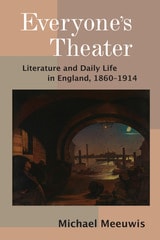
Everyone’s Theater
Literature and Daily Life in England, 1860–1914Michael Meeuwis
University of Michigan Press, 2019
Nearly all residents of England and its colonies between 1860 and 1914 were active theatergoers, and many participated in the amateur theatricals that defined late Victorian life. The Victorian theater was not an abstract figuration of the world as a stage, but a media system enmeshed in mass lived experience that fulfilled in actuality the concept of a theatergoing nation. Everyone’s Theater turns to local history, the words of everyday Victorians found in their diaries and production records, to recover this lost chapter of theater history in which amateur drama domesticates the stage. Professional actors and playwrights struggled to make their productions compatible with ideas and techniques that could be safely reproduced in the home—and in amateur performances from Canada to India. This became the first true English national theater: a society whose myriad classes found common ground in theatrical display. Everyone’s Theater provides new ways to extend Victorian literature into the dimension of voice, sound, and embodiment, and to appreciate the pleasures of Victorian theatricality.
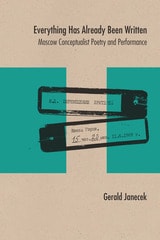
Everything Has Already Been Written
Moscow Conceptualist Poetry and PerformanceGerald Janecek
Northwestern University Press, 2019
Innovative poets such as Vsevolod Nekrasov, Lev Rubinstein, and Dmitry Prigov are among the most prominent literary figures of Russia in the 1980s and 1990s, yet they are virtually unknown outside Russia. The same is true of the numerous active Russian performance art groups, especially the pioneering Collective Actions group led by the brilliantly inventive Andrei Monastyrsky. Everything Has Already Been Written strives to make Moscow Conceptualism more accessible, to break the language barrier and to foster understanding among an international readership by thoroughly discussing a broad range of specific works and theories. Janecek’s study is the first comprehensive analysis of Moscow Conceptualist poetry and theory, vital for an understanding of Russian culture in the post‑Conceptualist era.
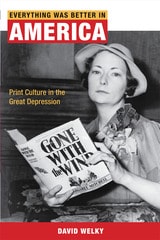
Everything Was Better in America
Print Culture in the Great DepressionDavid Welky
University of Illinois Press, 2007
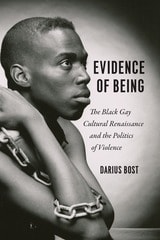
Evidence of Being
The Black Gay Cultural Renaissance and the Politics of ViolenceDarius Bost
University of Chicago Press, 2018
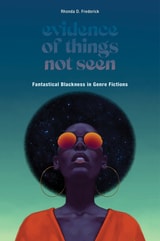
Evidence of Things Not Seen
Fantastical Blackness in Genre FictionsRhonda D. Frederick
Rutgers University Press, 2022
Evil & the Evidence For God
The Challenge of John Hick's TheodicyR. Geivett
Temple University Press, 1995
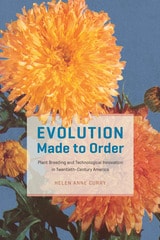
Evolution Made to Order
Plant Breeding and Technological Innovation in Twentieth-Century AmericaHelen Anne Curry
University of Chicago Press, 2016
In Evolution Made to Order, Helen Anne Curry traces the history of America’s pursuit of tools that could intervene in evolution. An immersive journey through the scientific and social worlds of midcentury genetics and plant breeding and a compelling exploration of American cultures of innovation, Evolution Made to Order provides vital historical context for current worldwide ethical and policy debates over genetic engineering.
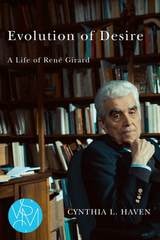
Evolution of Desire
A Life of René GirardCynthia L Haven
Michigan State University Press, 2018
Evolutionary Restraints
The Contentious History of Group SelectionMark E. Borrello
University of Chicago Press, 2010
Evolving Images
Jewish Latin American CinemaEdited by Nora Glickman and Ariana Huberman
University of Texas Press, 2017
Jews have always played an important role in the generation of culture in Latin America, despite their relatively small numbers in the overall population. In the early days of cinema, they served as directors, producers, screenwriters, composers, and broadcasters. As Latin American societies became more religiously open in the later twentieth century, Jewish characters and themes began appearing in Latin American films and eventually achieved full inclusion. Landmark films by Jewish directors in Argentina, Mexico, and Brazil, which are home to the largest and most influential Jewish communities in Latin America, have enjoyed critical and popular acclaim.
Evolving Images is the first volume devoted to Jewish Latin American cinema, with fifteen critical essays by leading scholars from Latin America, the United States, Europe, and Israel. The contributors address transnational and transcultural issues of Jewish life in Latin America, such as assimilation, integration, identity, and other aspects of life in the Diaspora. Their discussions of films with Jewish themes and characters show the rich diversity of Jewish cultures in Latin America, as well as how Jews, both real and fictional, interact among themselves and with other groups, raising the question of how much their ethnicity may be adulterated when adopting a combined identity as Jewish and Latin American. The book closes with a groundbreaking section on the affinities between Jewish themes in Hollywood and Latin American films, as well as a comprehensive filmography.
Excursions
Michael Jackson
Duke University Press, 2007
Focusing on the struggles and quandaries of everyday life, Jackson touches on matters at the core of anthropology—the state, violence, exile and belonging, labor, indigenous rights, narrative, power, home, and history. He is particularly interested in the gaps that characterize human existence, such as those between insularity and openness, between the things over which we have some control and the things over which we have none, and between ourselves and others as we talk past each other, missing each others’ meanings. Urging a recognition of the limits to which human existence can be explained in terms of cause and effect, he suggests that knowing why things happen may ultimately be less important than trying to understand how people endure in the face of hardship.
Executing Freedom
The Cultural Life of Capital Punishment in the United StatesDaniel LaChance
University of Chicago Press, 2016
That question is at the heart of Executing Freedom, a powerful, wide-ranging examination of the place of the death penalty in American culture and how it has changed over the years. Drawing on an array of sources, including congressional hearings and campaign speeches, true crime classics like In Cold Blood, and films like Dead Man Walking, Daniel LaChance shows how attitudes toward the death penalty have reflected broader shifts in Americans’ thinking about the relationship between the individual and the state. Emerging from the height of 1970s disillusion, the simplicity and moral power of the death penalty became a potent symbol for many Americans of what government could do—and LaChance argues, fascinatingly, that it’s the very failure of capital punishment to live up to that mythology that could prove its eventual undoing in the United States.
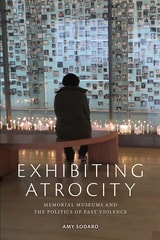
Exhibiting Atrocity
Memorial Museums and the Politics of Past ViolenceSodaro, Amy
Rutgers University Press, 2018
Today, nearly any group or nation with violence in its past has constructed or is planning a memorial museum as a mechanism for confronting past trauma, often together with truth commissions, trials, and/or other symbolic or material reparations. Exhibiting Atrocity documents the emergence of the memorial museum as a new cultural form of commemoration, and analyzes its use in efforts to come to terms with past political violence and to promote democracy and human rights.
Through a global comparative approach, Amy Sodaro uses in-depth case studies of five exemplary memorial museums that commemorate a range of violent pasts and allow for a chronological and global examination of the trend: the U.S. Holocaust Memorial Museum in Washington, DC; the House of Terror in Budapest, Hungary; the Kigali Genocide Memorial Centre in Rwanda; the Museum of Memory and Human Rights in Santiago, Chile; and the National September 11 Memorial Museum in New York. Together, these case studies illustrate the historical emergence and global spread of the memorial museum and show how this new cultural form of commemoration is intended to be used in contemporary societies around the world.
Download open access ebook.