Results by title
2817 books match the query 'Nature' and 164 start with e
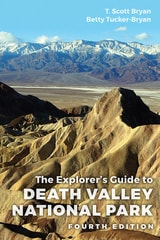
Explorer's Guide to Death Valley National Park, Fourth Edition
T. Scott Bryan
University Press of Colorado, 2020
Originally published in 1995, soon after Death Valley National Park became the fifty-third park in the US park system, The Explorer’s Guide to Death Valley National Park was the first complete guidebook available for this spectacular area. Now in its fourth edition, this is still the only book that includes all aspects of the park. Much more than just a guidebook, it covers the park’s cultural history, botany and zoology, hiking and biking opportunities, and more. Information is provided for all of Death Valley’s visitors, from first-time travelers just learning about the area to those who are returning for in-depth explorations.
This new edition features a number of important changes—including information on the boundary and wilderness changes that resulted from the Dingell Act of 2019, the reopened Keane Wonder Mine area, the devastating flash flooding of Scotty’s Castle, scenic river designations, the Inn and Ranch resorts, renovated and now operated as the Oasis at Death Valley—as well as new maps and updated color photos. With extensive input from National Park Service resource management, law enforcement, and interpretive personnel, as well as a thorough bibliography for suggested reading, The Explorer’s Guide to Death Valley National Park, Fourth Edition is the most up-to-date, accurate, and comprehensive guide available for this national treasure.
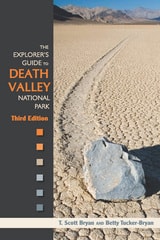
Explorer's Guide to Death Valley National Park, Third Edition
T. Scott Bryan and Betty Tucker Bryan
University Press of Colorado, 2015
Originally published in 1995, soon after Death Valley National Park became the fifty-third park in the U.S. park system, The Explorer's Guide to Death Valley National Park was the first complete guidebook available for this spectacular area.
Now in its third edition, this is still the only book that includes all aspects of the park. Much more than just a guidebook, it covers the park's cultural history, botany and zoology, hiking and biking opportunities, and more. Information is provided for all of Death Valley's visitors, from first-time travelers just learning about the area to those who are returning for in-depth explorations.
The book includes updated point-to-point logs for every road within and around the park, as well as more accurate map than those in any other publication. With extensive input from National Park Service resource management, law enforcement, and interpretive personnel, as well as a thorough bibliography for suggested reading, The Explorer's Guide to Death Valley National Park, Third Edition is the most up-to-date, accurate, and comprehensive guide available for this national treasure.
Exploring Nature in Illinois
A Field Guide to the Prairie StateMichael Jeffords and Susan Post
University of Illinois Press, 2014
From the colorful variety of birds at War Bluff Valley Audubon Sanctuary to the exposed bedrock and cliff faces of Apple River Canyon, Exploring Nature in Illinois will inspire readers to explore wonders hidden from urban sprawl and cultivated farmland. Maps and descriptions help travelers access even hard-to-find sites while a wealth of detail and photography offers nature-lovers insights into the flora, fauna, and other aspects of vibrant settings and ecosystems. The authors also include diary entries describing their own impressions of and engagement with the sites.
A unique and much-needed reference, Exploring Nature in Illinois will entertain and enlighten hikers, cyclers, students and scouts, morning walkers, weekend drivers, and anyone else seeking to get back to nature in the Prairie State.
Exploring Nature's Bounty
One Hundred Outings Near New York CityRosenfeld, Lucy D
Rutgers University Press, 2012
When lifelong friends Lucy D. Rosenfeld and Marina Harrison set off on their outings in the region, they are always on the lookout for the gifts that nature offers. Exploring Nature’s Bounty, their ninth collaboration, invites us to share the rich array of agricultural delights they’ve discovered within a two-hour radius of New York City—from beautiful vineyards to the latest in hydroponic greenhouses to peach-filled orchards to community farms and historic sites.
The places chosen all welcome visitors who will see first hand the art of agriculture, pick their own produce, help out on the farm, or simply enjoy being outdoors so close to the city. Many of them are off-the-beaten-track locations where readers and their families can walk among rows of grapes, cornstalks, apple trees, and so much more. The sites range from traditional fruit orchards to greenhouses filled with water-grown tomatoes and basil to neatly ordered herb gardens in historic settings. Local vineyards make wineries fun and glamorous places to visit, whether on the North Fork of Long Island or in the Hudson Valley. Some venues focus on crop preservation—the American chestnut, for example—while others introduce readers to honey making and maple sugaring. Those interested in taking classes or seeing demonstrations will find places to do just that, and many activities are geared toward children, from corn mazes to hayrides to pumpkin picking.
Rosenfeld and Harrison provide a list of festivals featuring local produce and, at the end of the book, a guide to choosing an outing that will best fit readers, their families, and their taste buds. Directions are provided in each write-up as well as information on schedules, guided tours, and walks within many of the sites.
Exploring Nature’s Bounty focuses on the natural, the organic, the sustainable, and the close-at-hand. By avoiding places overrun with commercialism, it helps readers create their own adventures, enjoy time with family and friends, and connect to the farms that nourish us all.
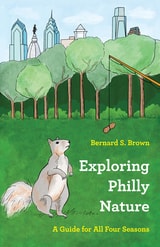
Exploring Philly Nature
A Guide for All Four SeasonsBernard S. Brown
Temple University Press, 2022
Do snakes and salamanders fascinate you or make you squeamish? Have you ever listened closely to the birds chirping in your neighborhood? Can you identify the flowers growing in Philadelphia’s urban parks? (Moreover, are the mushrooms safe to eat?) Exploring Philly Nature is amateur naturalist, urban herper,* and Grid contributor Bernard Brown’s handy guide to experiencing the flora and fauna in Philly.
This compact illustrated volume contains 52 activities from birding, (squirrel) fishing, and basement bug-hunting to joining a frog call survey and visiting a mussel hatchery. Brown encourages kids (as well as their parents) to connect with the natural world close to home. Each entry contains information on where and when to participate, what you will need (even if it is only patience), and tips on clubs and organizations to contact for access.
The city and its environs contain a multitude of species from the lichen that grows on gravestones or trees to nocturnal animals like opossums, bats, and raccoons. Exploring Philly Nature is designed to get readers eager to discover, observe, and learn more about the concrete jungle that is Philadelphia.
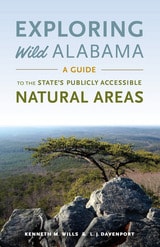
Exploring Wild Alabama
A Guide to the State's Publicly Accessible Natural AreasKenneth M. Wills and L. J. Davenport
University of Alabama Press, 2016
The most comprehensive guide available to Alabama’s publicly accessible natural destinations.
Exploring Wild Alabama is an exceptionally detailed guide to the most beautiful natural destinations in the state. From the rocky outcrops of the Appalachian plateaus to the sugar-white beaches of the Gulf Coast’s Orange Beach and Dauphin Island, Alabama offers a wealth of remarkable sites to explore by car or canoe, bicycle or motorcycle, or on foot.
Intrepid explorers Kenneth M. Wills and L. J. Davenport divide Alabama into eleven geographic regions that feature state parks and preserves, national monuments and forests, wildlife management areas, Nature Conservancy and Forever Wild properties, botanical gardens and arboreta, as well as falls, caverns, and rock cliffs. Exploring Wild Alabama provides detailed site entries to one hundred and fifty destinations. Each section is beautifully illustrated with color photographs and area maps.
Exploring Wild Alabama includes a large state map and numerous local topographic maps to help readers locate each site. Individual site entries include
· written directions to each site and GPS coordinates;
· engaging notes about the ecology, landscape features, and local species of plants and animals of the sites; and
· international recreation symbols for hiking, fishing, boating, camping, hunting, and other fun outdoor activities.
Wills and Davenport guide travelers to Alabama jewels such as Sand Mountain’s Chitwood Barrens, which harbors the rare Green Pitcher Plant and other exotic botanical species; Blowing Springs Cave in Lauderdale County, named for the cool air and the clear spring flowing out of the cave opening; Jackson Prairies in the Lime Hills region; and Booker’s Mill in Conecuh County, offering diverse habitats and historic structures.
Long a favorite destination for outdoor sports enthusiasts, Alabama is fast becoming a major “ecotourism” destination, with thousands of travelers discovering the state’s unsung natural treasures. Exploring Wild Alabama will be used and trusted by anyone who loves the outdoors—birders, botanists, cave explorers, cyclists, hunters, fishermen, rock climbers, canoeists, teachers, and other outdoor enthusiasts.
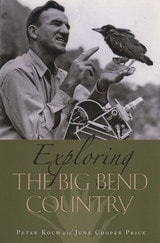
Exploring the Big Bend Country
By Peter Koch and June Cooper Price
University of Texas Press, 2007
Photographer-naturalist Peter Koch first visited the new Big Bend National Park in February, 1945, on assignment to take promotional pictures for the National Park Service. He planned to spend a couple of weeks—and ended up staying for the rest of his life. Koch's magnificent photographs and documentary film-lectures Big Bend, Life in a Desert Wilderness and Desert Gold introduced the park to people across the United States, drawing thousands of visitors to the Big Bend. His photographs and films of the region remain among the best ever produced, and are an invaluable visual record of the first four decades of Big Bend National Park.
In this highly readable book, Koch's daughter June Cooper Price draws on the newspaper columns her father wrote for the Alpine Avalanche, supplemented by his photographs, journal entries, and short pieces by other family members, to present Peter Koch's vision of the Big Bend. The book opens with his first "big adventure," a six-day photographic trip through Santa Elena Canyon on a raft made from agave flower stalks. From there, Koch takes readers hiking on mountain trails and driving the scenic loop around Fort Davis. He also describes "wax smuggling" and other ways of making a living on the Mexican border; ranching in the Big Bend; the prehistory and Native Americans of the region; collaborating with botanist Barton Warnock on books of Trans-Pecos wildflowers; and the history and beauty of Presidio County, the Rio Grande, and the Chihuahuan Desert.
This fascinating blend of firsthand adventures, natural history, and personal musings on anthropology and history creates an unforgettable portrait of both Peter Koch and the Big Bend region he so loved.
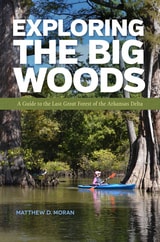
Exploring the Big Woods
A Guide to the Last Great Forest of the Arkansas DeltaMatthew D. Moran
University of Arkansas Press, 2016
Exploring the Big Woods: A Guide to the Last Great Forest of Eastern Arkansas is both a natural history and a guide to one of the last remnants of Mississippi bottomland forest, an ecosystem that once stretched from southern Illinois to the Gulf Coast.
Crossed by the White River and its tributaries, which periodically flood and release nutrients, the Big Woods is one of the few places in the Mississippi River Valley where this life-giving flood cycle persists. As a result, it is home to an unusual abundance of animals and plants.
Immense cypresses, hickories, sweetgums, oaks, and sycamores; millions of migrating waterfowl; incredible scenery; and the complex relationship between humans and nature are all to be discovered here.
Exploring the Big Woods will introduce readers to the natural features, plants, animals, and hiking and canoeing trails going deep into the forests and swamps of this rare and beautiful natural resource.
Exploring the Nature of Law
Thomistic Juridical Realism and the Elements of Law's OntologyPetar Popovic
Catholic University of America Press, 2025
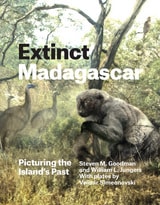
Extinct Madagascar
Picturing the Island's PastSteven M. Goodman and William L. Jungers
University of Chicago Press, 2014
In Extinct Madagascar, noted scientists Steven M. Goodman and William L. Jungers explore the recent past of these land animal extinctions. Beginning with an introduction to the geologic and ecological history of Madagascar that provides context for the evolution, diversification, and, in some cases, rapid decline of the Malagasy fauna, Goodman and Jungers then seek to recapture these extinct mammals in their environs. Aided in their quest by artist Velizar Simeonovski’s beautiful and haunting digital paintings—images of both individual species and ecosystem assemblages reproduced here in full color—Goodman and Jungers reconstruct the lives of these lost animals and trace their relationships to those still living.
Published in conjunction with an exhibition of Simeonovski’s artwork set to open at the Field Museum, Chicago, in the fall of 2014, Goodman and Jungers’s awe-inspiring book will serve not only as a sobering reminder of the very real threat of extinction, but also as a stunning tribute to Madagascar’s biodiversity and a catalyst for further research and conservation.
Extinctions
From Dinosaurs to YouCharles Frankel
University of Chicago Press, 2024
On its face, the story of mass extinction on Earth is one of unavoidable disaster. Asteroid smashes into planet; goodbye dinosaurs. Planetwide crises seem to be beyond our ability to affect or evade. Extinctions argues that geological history tells an instructive story, one that offers important signs for us to consider. When the asteroid struck, Charles Frankel explains, it set off a wave of cataclysms that wore away at the global ecosystem until it all fell apart. What if there had been a way to slow or even turn back these tides? Frankel believes that the answer to this question holds the key to human survival.
Human history, from the massacre of Ice Age megafauna to today’s industrial climate change, has brought the planet through another series of cataclysmic events. But the history of mass extinction together with the latest climate research, Frankel maintains, shows us a way out. If we curb our destructive habits, particularly our drive to kill and consume other species, and work instead to conserve what biodiversity remains, the Earth might yet recover. Rather than await decisive disaster, Frankel argues that we must instead take action to reimagine what it means to be human. As he eloquently explains, geological history reminds us that life is not eternal; we can disappear, or we can become something new and continue our evolutionary adventure.

Extraordinary Orchids
Sandra Knapp
University of Chicago Press, 2021
Orchids deserve such a visual celebration: parts of the orchid flower have shapes unlike any other flowering plant, and the sheer number of species means they have a seemingly endless ability to create ever more fantastical forms. In fact, many orchid common names refer to the shape-shifting forms of their flowers—the “man-orchids” or “monkey-orchids” are so called because of their resemblance to the primate form. Orchids lend themselves to depiction, and botanical artworks of them abound. Who could resist painting or drawing such odd shapes?
Illustrated with stunning artwork, much from the archives of the Natural History Museum in London and never before published, Extraordinary Orchids includes depictions from celebrated botanical artists such as Ferdinand and Franz Bauer, Arthur Harry Church, and Sydney Parkinson, revealing the weird and wonderful lives of this most diverse of plant families.
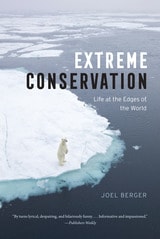
Extreme Conservation
Life at the Edges of the WorldJoel Berger
University of Chicago Press, 2018
On the Tibetan Plateau, there are wild yaks with blood cells thinner than those of horses’ by half, enabling the endangered yaks to survive at 40 below zero and in the lowest oxygen levels of the mountaintops. But climate change is causing the snow patterns here to shift, and with the snows, the entire ecosystem. Food and water are vaporizing in this warming environment, and these beasts of ice and thin air are extraordinarily ill-equipped for the change. A journey into some of the most forbidding landscapes on earth, Joel Berger’s Extreme Conservation is an eye-opening, steely look at what it takes for animals like these to live at the edges of existence. But more than this, it is a revealing exploration of how climate change and people are affecting even the most far-flung niches of our planet.
Berger’s quest to understand these creatures’ struggles takes him to some of the most remote corners and peaks of the globe: across Arctic tundra and the frozen Chukchi Sea to study muskoxen, into the Bhutanese Himalayas to follow the rarely sighted takin, and through the Gobi Desert to track the proboscis-swinging saiga. Known as much for his rigorous, scientific methods of developing solutions to conservation challenges as for his penchant for donning moose and polar bear costumes to understand the mindsets of his subjects more closely, Berger is a guide par excellence. He is a scientist and storyteller who has made his life working with desert nomads, in zones that typically require Sherpas and oxygen canisters. Recounting animals as charismatic as their landscapes are extreme, Berger’s unforgettable tale carries us with humor and expertise to the ends of the earth and back. But as his adventures show, the more adapted a species has become to its particular ecological niche, the more devastating climate change can be. Life at the extremes is more challenging than ever, and the need for action, for solutions, has never been greater.
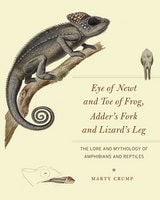
Eye of Newt and Toe of Frog, Adder's Fork and Lizard's Leg
The Lore and Mythology of Amphibians and ReptilesMarty Crump
University of Chicago Press, 2015
Frogs are worshipped for bringing nourishing rains, but blamed for devastating floods. Turtles are admired for their wisdom and longevity, but ridiculed for their sluggish and cowardly behavior. Snakes are respected for their ability to heal and restore life, but despised as symbols of evil. Lizards are revered as beneficent guardian spirits, but feared as the Devil himself.
In this ode to toads and snakes, newts and tuatara, crocodiles and tortoises, herpetologist and science writer Marty Crump explores folklore across the world and throughout time. From creation myths to trickster tales; from associations with fertility and rebirth to fire and rain; and from the use of herps in folk medicines and magic, as food, pets, and gods, to their roles in literature, visual art, music, and dance, Crump reveals both our love and hatred of amphibians and reptiles—and their perceived power. In a world where we keep home terrariums at the same time that we battle invasive cane toads, and where public attitudes often dictate that the cute and cuddly receive conservation priority over the slimy and venomous, she shows how our complex and conflicting perceptions threaten the conservation of these ecologically vital animals.
Sumptuously illustrated, Eye of Newt and Toe of Frog, Adder’s Fork and Lizard’s Leg is a beautiful and enthralling brew of natural history and folklore, sobering science and humor, that leaves us with one irrefutable lesson: love herps. Warts, scales, and all.