Results by title
8642 books match the query '20th Century' and 236 start with e
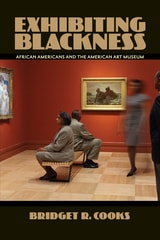
Exhibiting Blackness
African Americans and the American Art MuseumBridget R. Cooks
University of Massachusetts Press, 2011
In Exhibiting Blackness, art historian Bridget R. Cooks analyzes the curatorial strategies, challenges, and critical receptions of the most significant museum exhibitions of African American art. Tracing two dominant methodologies used to exhibit art by African Americans—an ethnographic approach that focuses more on artists than their art, and a recovery narrative aimed at correcting past omissions—Cooks exposes the issues involved in exhibiting cultural difference that continue to challenge art history, historiography, and American museum exhibition practices. By further examining the unequal and often contested relationship between African American artists, curators, and visitors, she provides insight into the complex role of art museums and their accountability to the cultures they represent.
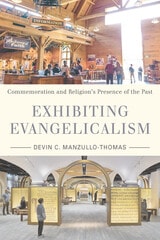
Exhibiting Evangelicalism
Commemoration and Religion’s Presence of the PastDevin C. Manzullo-Thomas
University of Massachusetts Press, 2022
Religion is a subject often overlooked or ignored by public historians. Whether they are worried about inadvertent proselytizing or fearful of contributing to America’s ongoing culture wars, many heritage professionals steer clear of discussing religion’s formative role in the past when they build collections, mount exhibits, and develop educational programming. Yet religious communities have long been active contributors to the nation’s commemorative landscape.
Exhibiting Evangelicalism provides the first account of the growth and development of historical museums created by white evangelical Christians in the United States over the twentieth and twenty-first centuries. Exploring the histories of the Museum of the Bible, the Billy Graham Center Museum, the Billy Sunday Home, and Park Street Church, Devin C. Manzullo-Thomas illustrates how these sites enabled religious leaders to develop a coherent identity for their fractious religious movement and to claim the centrality of evangelicalism to American history. In their zeal to craft a particular vision of the national past, evangelicals engaged with a variety of public history practices and techniques that made them major players in the field—including becoming early adopters of public history’s experiential turn.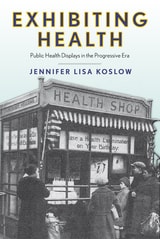
Exhibiting Health
Public Health Displays in the Progressive EraJennifer Lisa Koslow
Rutgers University Press, 2020
Exhuming Franco
Spain's Second Transition, Second EditionSebastiaan Faber
Vanderbilt University Press, 2023
This new edition, with additional interviews and a new introduction, illuminates the dangers of the rise of right-wing nationalist revisionism by using Spain as a case study for how nations face, or don't face, difficult questions about their past.
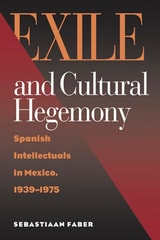
Exile and Cultural Hegemony
Spanish Intellectuals in Mexico, 1939-1975Sebastiaan Faber
Vanderbilt University Press, 2002
The first study of its kind to place the exiles' ideological evolution in a broad historical context, Exile and Cultural Hegemony takes into account developments in both Spanish and Mexican politics from the early 1930s through the 1970s. Faber pays particular attention to the intellectuals' persistent nationalism and misplaced illusions of pan-Hispanist grandeur, which included awkward and ironic overlaps with the rhetoric employed by their enemies on the Francoist right. This embrace of nationalism, together with the intellectuals' dependence on the increasingly authoritarian Mexican regime and the international climate of the Cold War, eventually caused them to abandon the Gramscian ideal of the intellectual as political activist in favor of a more liberal, apolitical stance preferred by, among others, the Spanish philosopher Jose Ortega y Gasset.
With its comprehensive approach to topics integral to Spanish culture, both students of and those with a general interest in twentieth-century Spanish literature, history, or culture will find Exile and Cultural Hegemony a fascinating and groundbreaking work.
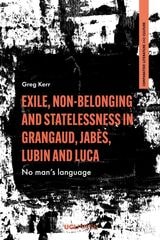
Exile, Non-Belonging and Statelessness in Grangaud, Jabès, Lubin and Luca
No Man's LanguageGreg Kerr
University College London, 2021
Poetry has often been understood as a powerful vector of collective belonging. The idea that certain poets are emblematic of a national culture is one of the chief means by which literature historicizes itself, inscribes itself in a shared cultural past, and supplies modes of belonging to those who consume it. But, how does the exiled, migrant, or translingual poet complicate this narrative? For Armen Lubin, Ghérasim Luca, Edmond Jabès, and Michelle Grangaud, the practice of poetry is inseparable from a sense of restlessness or unease. Ranging across borders within and beyond the Francosphere—from Algeria, Armenia, Egypt, and Romania—this book shows how a poetic practice inflected by exile, statelessness, or non-belonging has the potential to disrupt long-held assumptions about the relation between subjects, the language they use, and the place from which they speak.
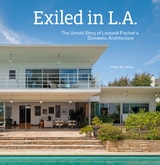
Exiled in L.A.
The Untold Story of Leopold Fischer’s Domestic ArchitectureVolker M. Welter
J. Paul Getty Trust, The, 0
In 1936, Leopold Fischer (1901–1975), in exile from Nazi Germany, arrived in California, where he created a small but distinct oeuvre of mostly domestic architecture. In contrast to his famous peers Rudolph Schindler and Richard Neutra, immigrants whose Southern California buildings are frequently examined—and who, like Fischer, studied with the modernist architect Adolf Loos—Fischer and his California structures have, until now, escaped the attention of architectural history.
Exiled in L.A. examines Fischer’s important, yet overlooked, contributions to Southern California architecture. As the whereabouts of Fischer’s archives remain unknown, Volker M. Welter grounds the designer’s California works in comparison with his pre-exile projects and the compositions of fellow architects in California. In the 1920s, Fischer created experimental working-class housing estates in Germany that pioneered ecological construction and living practices. Comparable to their predecessors, Fischer's California buildings revolve around the “functioning, the organization of a home,” as he defined domestic architecture in 1926. Featuring new photography and detailed architectural plans, this book is an original contribution to the literature on Southern California’s built heritage.
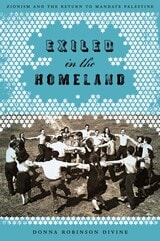
Exiled in the Homeland
Zionism and the Return to Mandate PalestineBy Donna Robinson Divine
University of Texas Press, 2009
Offering a new perspective on Zionism, Exiled in the Homeland draws on memoirs, newspaper accounts, and archival material to examine closely the lives of the men and women who immigrated to Palestine in the early twentieth century. Rather than reducing these historic settlements to a single, unified theme, Donna Robinson Divine's research reveals an extraordinary spectrum of motivations and experiences among these populations.
Though British rule and the yearning for a Jewish national home contributed to a foundation of solidarity, Exiled in the Homeland presents the many ways in which the message of emigration settled into the consciousness of the settlers. Considering the benefits and costs of their Zionist commitments, Divine explores a variety of motivations and outcomes, ranging from those newly arrived immigrants who harnessed their ambition for the goal of radical transformation to those who simply dreamed of living a better life. Also capturing the day-to-day experiences in families that faced scarce resources, as well as the British policies that shaped a variety of personal decisions on the part of the newcomers, Exiled in the Homeland provides new keys to understanding this pivotal chapter in Jewish history.

Exit Zero
Family and Class in Postindustrial ChicagoChristine J. Walley
University of Chicago Press, 2012
In 1980, Christine J. Walley’s world was turned upside down when the steel mill in Southeast Chicago where her father worked abruptly closed. In the ensuing years, ninety thousand other area residents would also lose their jobs in the mills—just one example of the vast scale of deindustrialization occurring across the United States. The disruption of this event propelled Walley into a career as a cultural anthropologist, and now, in Exit Zero, she brings her anthropological perspective home, examining the fate of her family and that of blue-collar America at large.
This book is part of a project that also includes a documentary film.

Exit Zero
Family and Class in Postindustrial ChicagoChristine J. Walley
University of Chicago Press, 2012
Winner of CLR James Book Prize from the Working Class Studies Association and 2nd Place for the Victor Turner Prize in Ethnographic Writing.
In 1980, Christine J. Walley’s world was turned upside down when the steel mill in Southeast Chicago where her father worked abruptly closed. In the ensuing years, ninety thousand other area residents would also lose their jobs in the mills—just one example of the vast scale of deindustrialization occurring across the United States. The disruption of this event propelled Walley into a career as a cultural anthropologist, and now, in Exit Zero, she brings her anthropological perspective home, examining the fate of her family and that of blue-collar America at large.
This book is part of a project that also includes a documentary film.
Expanding American Anthropology, 1945-1980
A Generation ReflectsEdited by Alice Beck Kehoe and Paul L. Doughty
University of Alabama Press, 2012
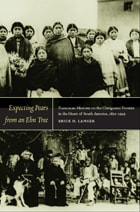
Expecting Pears from an Elm Tree
Franciscan Missions on the Chiriguano Frontier in the Heart of South America, 1830–1949Erick D. Langer
Duke University Press, 2009
Expecting Pears from an Elm Tree is based on twenty years of research, including visits to the sites of nearly every mission discussed and interviews with descendants of mission Indians, Indian chiefs, Franciscan friars, mestizo settlers, and teachers. Langer chronicles how, beginning in the 1840s, the establishment of missions fundamentally changed the relationship between the Chiriguano villages and national society. He looks at the Franciscan missionaries’ motives, their visions of ideal missions, and the realities they faced. He also examines mission life from the Chiriguano point of view, considering their reasons for joining missions and their resistance to conversion, as well as the interrelated issues of Indian acculturation and the development of the mission economy, particularly in light of the relatively high rates of Indian mortality and outmigration. Expanding his focus, Langer delves into the complex interplay of Indians, missionaries, frontier society, and the national government until the last remaining missions were secularized in 1949. He concludes with a comparative analysis between colonial and republican-era missions throughout Latin America.
Expelled
James Lawson Jr. and Vanderbilt UniversityBenjamin Houston
Vanderbilt University Press, 2026
In February 1960, as lunch counter sit-ins began in Southern cities, national attention focused on Nashville, where demonstrations were carried out by an unusually organized and disciplined group of students tutored extensively in nonviolent direct action. Their mentor was Reverend James Lawson Jr., a graduate student at Vanderbilt University Divinity School with longstanding nonviolent credentials. His workshops with Nashville students, exploring Gandhian style philosophies and tactics, had predated the famed Greensboro sit-ins.
As demonstrations continued in Nashville and successive sit-ins saw violence erupt downtown, local Black ministers demanded an audience with Mayor Ben West. At this meeting, an exchange occurred that was misconstrued by subsequent newspaper reportage. Shortly thereafter, Lawson was summarily expelled from Vanderbilt, one semester shy of graduating.
Lawson’s ouster triggered a wave of repercussions and headlines. After extended negotiations with their superiors were rebuffed, a large contingent of Divinity School faculty resigned en masse. Simmering dissension between the university’s professors, Board of Trust, and administrators kept the crisis ongoing. Sustained criticism of Vanderbilt both within the city and nationally made for a turbulent situation as Lawson’s expulsion came to symbolize profound tensions about civil rights and racial justice.
Experiencing Fiction
Judgments, Progressions, and the Rhetorical Theory of NarrativeJames Phelan
The Ohio State University Press, 2007
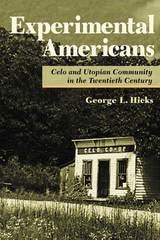
Experimental Americans
Celo and Utopian Community in the Twentieth CenturyGeorge L. Hicks
University of Illinois Press, 2001
From colonial times to the present, the United States has been home to a steady stream of utopian experimental communities. In Experimental Americans, George L. Hicks takes us inside one of the longer-lived of such communities, Celo Community in western North Carolina, to explore the dynamics of intentional communities in America.
Founded in 1937 by Arthur Morgan, first chairman of the Tennessee Valley Authority, Celo (pronounced see-lo) established its own rules of land tenure and taxation, conducted its internal business by consensus, and did not require its members to accept any particular ideology or religious creed. Drawing on extensive fieldwork in Celo and among its local neighbors, consultation of Celo's documentary records, and interviews with ex-members, Hicks traces the Community's ups and downs. Attacked for its opposition to World War II, Celo was revived by pacifists released from prisons and Civilian Public Service camps after the war; debilitated in the 1950s by bitter feuds with ex-members, it was buoyed up in the 1960s by the radical enthusiasm of new currents in the nation.
Hicks assesses the Community's success in creating alternatives to mainstream social relations and examines the interactions between Celo and its neighboring community. He considers variations in paths taken by utopian communities, with a look at a close cousin of Celo, the Macedonia Community in Georgia. He also discusses the Community's "post-utopian" phase, marked by a shift in the late 1970s from social goals to straightforward land management.
While utopian communities might hope to secede from American society in varying degrees and to institute new and improved cultural models, nonetheless they express in many ways the attempt--characteristic of the nation itself--to balance individualism and egalitarianism. By providing the context, utopian and conventional, within which Celo and other experimental communities emerge and change, Experimental Americans illuminates an ongoing encounter with persistent tensions and contradictions in America's cultural postulates.
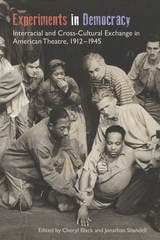
Experiments in Democracy
Interracial and Cross-Cultural Exchange in American Theatre, 1912-1945Edited by Cheryl Black and Jonathan Shandell
Southern Illinois University Press, 2016
In Experiments in Democracy, edited by Cheryl Black and Jonathan Shandell, theatre historians examine a wide range of performances—from Broadway, folk plays and dance productions to scripted political rallies and radio dramas. Contributors look at such diverse groups as the Theatre Union, La Unión Martí-Maceo, and the American Negro Theatre, as well as individual playwrights and their works, including Theodore Browne’s folk opera Natural Man, Josefina Niggli’s Soldadera, and playwright Lynn Riggs’s Cherokee Night and Green Grow the Lilacs (the basis for the musical Oklahoma!). Exploring the ways progressive artists sought to connect isolated racial and cultural groups in pursuit of a more just and democratic society, contributors take into account the blind spots, compromised methods, and unacknowledged biases at play in their practices and strategies. Essays demonstrate how the gap between the ideal of American democracy and its practice—mired in entrenched systems of white privilege, economic inequality, and social prejudice—complicated the work of these artists.
Focusing on questions of race, ethnicity, gender, and sexuality on the stage in the decades preceding the Civil Rights era, Experiments in Democracy fills an important gap in our understanding of the history of the American stage—and sheds light on these still-relevant questions in contemporary American society.
Experiments with Empire
Anthropology and Fiction in the French AtlanticJustin Izzo
Duke University Press, 2019
Explaining Economic Backwardness
Post-1945 Polish Historians on Eastern EuropeAnna Sosnowska
Central European University Press, 2019
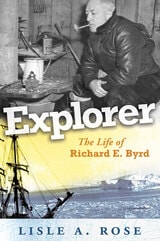
Explorer
The Life of Richard E. ByrdLisle A. Rose
University of Missouri Press, 2008
“Danger was all that thrilled him,” Dick Byrd’s mother once remarked, and from his first pioneering aviation adventures in Greenland in 1925, through his daring flights to the top and bottom of the world and across the Atlantic, Richard E. Byrd dominated the American consciousness during the tumultuous decades between the world wars. He was revered more than Charles Lindbergh, deliberately exploiting the public’s hunger for vicarious adventure. Yet some suspected him of being a poseur, and a handful reviled him as a charlatan who claimed great deeds he never really accomplished.
Then he overreached himself, foolishly choosing to endure a blizzard-lashed six-month polar night alone at an advance weather observation post more than one hundred long miles down a massive Antarctic ice shelf. His ordeal proved soul-shattering, his rescue one of the great epics of polar history. As his star began to wane, enemies grew bolder, and he struggled to maintain his popularity and political influence, while polar exploration became progressively bureaucratized and militarized. Yet he chose to return again and again to the beautiful, hateful, haunted secret land at the bottom of the earth, claiming, not without justification, that he was “Mayor of this place.”
Lisle A. Rose has delved into Byrd’s recently available papers together with those of his supporters and detractors to present the first complete, balanced biography of one of recent history’s most dynamic figures. Explorer covers the breadth of Byrd’s astonishing life, from the early days of naval aviation through his years of political activism to his final efforts to dominate Washington’s growing interest in Antarctica. Rose recounts with particular care Byrd’s two privately mounted South Polar expeditions, bringing to bear new research that adds considerable depth to what we already know. He offers views of Byrd’s adventures that challenge earlier criticism of him—including the controversy over his claim to being the first to have flown over the North Pole in 1926—and shows that the critics’ arguments do not always mesh with historical evidence.
Throughout this compelling narrative, Rose offers a balanced view of an ambitious individual who was willing to exaggerate but always adhered to his principles—a man with a vision of himself and the world that inspired others, who cultivated the rich and famous, and who used his notoriety to espouse causes such as world peace. Explorer paints a vivid picture of a brilliant but flawed egoist, offering the definitive biography of the man and armchair adventure of the highest order.
Exploring Federalism
Daniel J. Elazar
University of Alabama Press, 1987
CHOICE OUTSTANDING ACADEMIC BOOK
A definitive exploration of the ideas, institutions, and principles that shape federal government.
Exploring Federalism is a seminal study by political scientist Daniel J. Elazar that examines the origins, evolution, and enduring significance of federal systems of government. Widely regarded as one of the leading scholars of federalism, Elazar offers a comprehensive analysis of how federal principles have shaped political institutions across diverse societies and historical periods. Rather than limiting his discussion to the United States, he adopts a global and comparative perspective, exploring how federal arrangements provide workable solutions for nations seeking to balance unity with diversity, shared governance with local autonomy, and collective action with individual liberty.
Drawing on history, constitutional theory, and political philosophy, Elazar investigates the covenantal foundations of federalism and explains how federal systems distribute authority, protect regional identities, and promote democratic participation. He also examines contemporary trends toward both centralization and decentralization, arguing that federalism remains one of the most effective frameworks for governing pluralistic societies. Exploring Federalism remains an essential resource for students, scholars, policymakers, and anyone interested in constitutional government and democratic institutions.
Exploring Phenomenology
A Guide to the Field & Its LiteratureDavid Stewart
Ohio University Press, 1990
Existential philosophy has perhaps captured the public imagination more completely than any other philosophical movement in the twentieth century. But less is known about the phenomenological method lying behind existentialism. In this solid introduction to phenomenological philosophy, authors David Stewart and Algis Mickunas show that phenomenology is neither new nor bizarre but is a contemporary way of raising afresh the major problems of philosophy that have dominated the traditions of Western thought. The authors carefully lead the reader trough the maze of terminology, explaining the major problems phenomenology has treated and showing how these are a consistent extension of the traditional concerns of philosophy.
In concise, uncluttered, and straightforward terms, the history, development, and contemporary status of phenomenology is explained with a copiously annotated bibliography following each chapter. Nothing in print combines the extensive introductory materials with a guide to the massive literature that has been produced by phenomenological and existential studies.
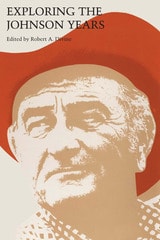
Exploring the Johnson Years
Edited by Robert A. Divine
University of Texas Press, 1981
More than a decade after LBJ left office, researchers began to open up the Johnson administration as an important area of scholarly study. Exploring the Johnson Years is an invaluable introduction to that administration and to the LBJ Library’s more than thirty million separate documents. The contributors cover every major aspect of the Johnson presidency, from Vietnam (George C. Herring) to the War on Poverty (Mark I. Gelfand), including coverage of Latin American policy (Walter LaFeber), education (Hugh Davis Graham), civil rights (Steven F. Lawson), the nature of the White House staff (Larry Berman), and Johnson’s stormy relationship with the media (David Culbert).
The essays illuminate some of the most important files and show how they can be used to further historical understanding of the Johnson years. As a result, scholars who plan to use the library will have a useful guide before they begin, while general readers will be able to discover the ways in which the library’s holdings relate to the existing body of literature on the Johnson administration.
Exploring the World of Human Practice
Readings in and about the Philosophy of Aurel KolnaiZoltán Balázs
Central European University Press, 2005

Exporting Japan
Politics of Emigration to Latin AmericaToake Endoh
University of Illinois Press, 2008
Exporting Japan examines the domestic origins of the Japanese government's policies to promote the emigration of approximately three hundred thousand native Japanese citizens to Latin America between the 1890s and the 1960s. This imperialist policy, spanning two world wars and encompassing both the pre-World War II authoritarian government and the postwar conservative regime, reveals strategic efforts by the Japanese state to control its populace while building an expansive nation beyond its territorial borders.
Toake Endoh compellingly argues that Japan's emigration policy embodied the state's anxieties over domestic political stability and its intention to remove marginalized and radicalized social groups by relocating them abroad. Documenting the disproportionate focus of the southwest region of Japan as a source of emigrants, Endoh considers the state's motivations in formulating emigration policies that selected certain elements of the Japanese population for "export." She also recounts the situations migrants encountered once they reached Latin America, where they were often met with distrust and violence in the "yellow scare" of the pre-World War II period.
Exposed Memories
Family Pictures in Private and Collective MemoryHedvig Turai
Central European University Press, 2010
Extended Play
Sounding Off from John Cage to Dr. FunkensteinJohn Corbett
Duke University Press, 1994
Using cultural critique and textual theory, Corbett addresses a broad spectrum of issues, such as the status of recorded music in postmodern culture, the politics of self-censorship, experimentation, and alternativism in the music industry, and the use of metaphors of space and madness in the work of African American musicians. He follows these more theoretically oriented essays with a series of extensive profiles and in-depth interviews that offer contrasting and complementary perspectives on some of the world’s most creative musicians and their work. Included here are more than twenty original photographs as well as a meticulously annotated discography. The result is one of the most thoughtful, and most entertaining, investigations of contemporary music available today.

Extra! Extra! Eat All About It!
Recipes and Culinary Curiosities from Historic Wisconsin NewspapersRandi Julia Ramsden
Wisconsin Historical Society Press, 2024
A blend of cookbook and bite-size history, Extra! Extra! Eat All About It! offers a unique glimpse into the culinary landscape of the late nineteenth and early twentieth centuries. Fifty recipes selected from Wisconsin newspapers are served alongside brief essays that dig into the stories behind the food trends of the time.
In lively prose, Jane Conway and Randi Julia Ramsden reveal how coconuts and oysters made their way to 1800s Wisconsin, how bakers gauged the temperatures of their wood-burning stoves, and how our predecessors really did slip on banana peels, among other flavorful facts. In addition to capturing quirky food fashions, like breakfast parties and paper-bag cooking, the recipes provide insights into regional cooking traditions.
Each original recipe appears alongside the authors’ easy-to-follow updated version. Mouthwatering modern photographs showcase the revived dishes for the first time in their long history, and newspaper clippings, ads, and illustrations give the book a charming vintage feel. Featuring a variety of recipes, ranging from trendy (Barbecued Ham with Bananas) and tempting (Pickled Walnuts) to traditional (Pumpernickel) and tantalizing (Apple de Luxe), Extra! Extra! Eat All About It! will satisfy the appetites of history lovers and home chefs alike.
“Such a fun and fascinating book! Extra! Extra! Eat All About It! deftly delves into Wisconsin’s long-ago food fads, evolutions, and absurdities. Don’t be surprised if this book inspires new trends that are riffs on some of these century-old ideas. Pickled walnuts, anyone? Or mock pumpkin pie, with prunes?” — Mary Bergin, author of Wisconsin Supper Club Cookbook
“Both cookbook and chronicle, Extra! Extra! Eat All About It! is an ingenious, illuminating tasting menu of our culinary past. Sourced from nineteenth and early twentieth century Wisconsin newspapers, its fifty vignettes serve up historical insights, forgotten fads and bygone recipes. From paper bag cookery and ‘oyster saloons’ to fire-baked eggs and maple taffy, I ate this book right up.” — Terese Allen, coauthor of The Flavor of Wisconsin
“This beautiful, fun, and informative book is a masterclass in how historical cooking opens a window onto wider historical themes, including mechanization, the impacts of war, immigration, globalization, and changing nutritional advice.” — Eleanor Barrett, author of Leftovers: A History of Food Waste and Preservation
“Conway and Ramsden do a great job of using historical documents to demonstrate what people were eating and how they entertained. They describe recipes as interaction and community, as well as how food trends change over time. The writing is smart and clever. A wonderful read.” — Kimberly Wilmot Voss, author of The Food Section: Newspaper Women and the Culinary Community
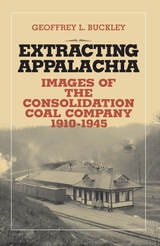
Extracting Appalachia
Images of the Consolidation Coal Company, 1910–1945Geoffrey L. Buckley
Ohio University Press, 2004
As a function of its corporate duties, the Consolidation Coal Company, one of the largest coal-mining operations in the United States during the first half of the twentieth century, had photographers take hundreds of pictures of nearly every facet of its operations. Whether for publicity images, safety procedures, or archival information, these photographs create a record that goes far beyond the purpose the company intended.
In Extracting Appalachia, geographer Geoffrey L. Buckley examines the company’s photograph collection housed at the Smithsonian Institution’s National Museum of American History. Included in the collection are images of mine openings, mining equipment, and mine accidents, as well as scenes of the company towns, including schools, churches, recreational facilities, holiday celebrations, and company stores.
Although the photographs in the collection provide us with valuable insights, they tell only part of the story. Using company records, state and federal government documents, contemporary newspaper accounts, and other archival materials, Professor Buckley shows that these photographs reveal much more than meets the eye.
Extracting Appalachia places these historic mining images in their social, cultural, and historical context, uncovering the true value and meaning of this rare documentary record.
Extraordinary Measures
Afrocentric Modernism and 20th-Century American PoetryLorenzo Thomas
University of Alabama Press, 2000
From early 20th-century writings to present-day poetry slams, African American poetry exhibits an impressive range of style and substance. Lorenzo Thomas has written an important new history of the genre that offers a critical reassessment of its development in the 20th century within the contexts of modernism and the troubled racial history of the United States.
Basing his study on literary history, cultural criticism, and close readings, Thomas revives and appraises the writings of a number of this century's most important African American poets, including Margaret Walker, Amiri Baraka, Askia M. Toure, Harryette Mullen, and Kalamu ya Salaam. Thomas analyzes the work of Fenton Johnson within the context of emerging race consciousness in Chicago, contributes to critical appraisals of William Stanley Braithwaite and Melvin B. Tolson, and examines the Black Arts Movement of the 1960s and 1970s. Throughout the book, Thomas demonstrates the continuity within the Afrocentric tradition while acknowledging the wide range of stylistic approaches and ideological stances that the tradition embraces.
By reassessing the African American poetry tradition, Thomas effectively reassesses the history of all 20th-century American literature by exploring avenues of debate that have not yet received sufficient attention. Written with intelligence and humor, his book is itself an extraordinary measure that reflects years of scholarship and opens up African American poetry to a wider audience.
Extraterritorial Dreams
European Citizenship, Sephardi Jews, and the Ottoman Twentieth CenturySarah Abrevaya Stein
University of Chicago Press, 2016
Sarah Abrevaya Stein traces the experiences of Mediterranean Jewish women, men, and families who lived through a tumultuous series of wars, border changes, genocides, and mass migrations, all in the shadow of the collapse of the Ottoman Empire and the ascendance of the modern passport regime. Moving across vast stretches of Europe, the Middle East, Asia, and the Americas, she tells the intimate stories of people struggling to find a legal place in a world ever more divided by political boundaries and competing nationalist sentiments. From a poor youth who reached France as a stowaway only to be hunted by the Parisian police as a spy to a wealthy Baghdadi-born man in Shanghai who willed his fortune to his Eurasian Buddhist wife, Stein tells stories that illuminate the intertwined nature of minority histories and global politics through the turbulence of the modern era.
Extreme-Occident
French Intellectuals and AmericaJean-Philippe Mathy
University of Chicago Press, 1993
Western site that gives historical reality to the utopias of the Renaissance and the Enlightenment?
Jean-Philippe Mathy offers the first systematic examination of French texts that address the question of America. He shows how prominent French intellectuals have represented America as myth and metaphor, covering the entire ideological spectrum from Maurras to Duhamel, and from Sartre to Aron. The texts themselves range from novels and poems to travel narratives and philosophical essays by Claudel, Sartre, de Beauvoir, Lyotard, Baudrillard, Kristeva, and many others.
Mathy deftly situates these discourses on America against the background of French intellectual and political history since 1789. The judgments on American culture that originate in France, he contends, are also statements about France itself. Widespread condemnation of American
materialism and pragmatism cuts across deep ideological and political divides in France, primarily because French intellectuals still operate within a framework of critical and aesthetic models born in the late Middle Ages and the Renaissance and elaborated in the age of French classicism.
Mathy engages issues central to interpreting the American experience, such as the current controversies over multiculturalism and Eurocentrism. Although Mathy deals mainly with French authors, he does not limit himself to them. Rather, he uses a comparative, cross-cultural approach that also takes in accounts of America by Nietzsche, Heidegger, Junger, Gramsci, and other Europeans, as well as American self-interpretations from Emerson and Dewey to Cornel West and Christopher Lasch.
Because debates on American modernity have played a crucial intellectual role in France, Extrême-Occident is a major contribution to modern French cultural
history. It will be essential reading for anyone wishing to understand the main currents of twentieth-century French thought.
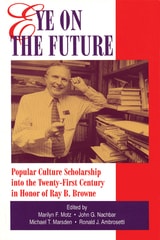
Eye on the Future
Popular Culture Scholarship into the Twenty-First Century in Honor of Ray B. BrowneMarilyn F. Motz
University of Wisconsin Press, 1994
This collection includes essays by scholars from around the world and five of Ray Browne's essays which he considers signal. The purpose of this book is to chart Popular Culture Studies into the next century.
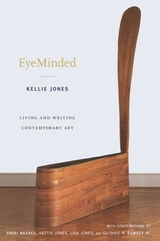
EyeMinded
Living and Writing Contemporary ArtKellie Jones
Duke University Press, 2011
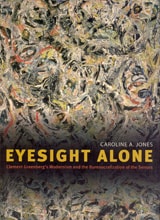
Eyesight Alone
Clement Greenberg's Modernism and the Bureaucratization of the SensesCaroline A. Jones
University of Chicago Press, 2006
Caroline Jones's magisterial study widens Greenberg's fundamental tenet of "opticality"-the idea that modernist art is apprehended through "eyesight alone"-to a broader arena, examining how the critic's emphasis on the specular resonated with a society increasingly invested in positivist approaches to the world. Greenberg's modernist discourse, Jones argues, developed in relation to the rationalized procedures that gained wide currency in the United States at midcentury, in fields ranging from the sense-data protocols theorized by scientific philosophy to the development of cultural forms, such as hi-fi, that targeted specific senses, one by one. Greenberg's attempt to isolate and celebrate the visual was one manifestation of a large-scale segmentation-or bureaucratization-of the body's senses. Working through these historical developments, Jones brings Greenberg's theories into contemporary philosophical debates about agency and subjectivity.
Eyesight Alone offers artists, art historians, philosophers, and all those interested in the arts a critical history of this generative figure, bringing his work fully into dialogue with the ideas that shape contemporary critical discourse and shedding light not only on Clement Greenberg but also on the contested history of modernism itself.

Ezra Pound and Margaret Cravens
A Tragic Friendship, 1910–1912Omar Pound and Robert Spoo, editors
Duke University Press, 1988
Pound was deeply affected by her death, as was the poet H. D., who had recently come to know her. Pound's letters to Cravens, extensively annotated, are published here for the first time; her suicide note to him is also included. Ezra Pound and Margaret Cravens contains photographs and previously unpublished material by Pound and H.D., as well as an excerpt from H.D.'s autobiographical novel Asphodel, in which Cravens figures prominently. This portrait of a friendship provides insight into the literary achievements of Pound and H.D. and tells the unknown story of Margaret Cravens's tragic life.
Ezra Pound's Confucian Translations
Mary Paterson Cheadle
University of Michigan Press, 1997