Results by title
18293 books match the query 'United States' and 472 start with e
Evangelicals and Democracy in America
Religion and SocietySteven G. Brint
Russell Sage Foundation, 2009

Even More Great Ideas for Libraries and Friends
Sally Gardner Reed
American Library Association, 2008
Ever the Winds of Chance
POEMSCarl Sandburg
University of Illinois Press, 1983
Ever the Winds of Chance opens in 1898 when the twenty-year-old Sandburg, recently returned from the Spanish-American war, enrolls at Lombard College in his native Galesburg, Illinois. Sandburg writes about his job at the fire station; his teachers, inspired or otherwise; his classmates and their camaraderie; his observations on great literary works and writers; and his own writings for the school newspaper, literary review, and yearbook and for the Galesburg Mail. But he also includes much about life between school years and after college, recounting his various brief careers as a fireman, salesman of stereoscopic views, advertising copywriter, vagabond, "jailbird," and budding poet and socialist. Together these reminiscences provide an intimate look at the formative years of a preeminent figure in American letters.
Every Catholic An Apostle
A Life of Thomas A. Judge, CM, 1868-1933William L. Portier
Catholic University of America Press, 2017
Every Child Ready for School
Helping Adults Inspire Young Children to LearnDorothy Stoltz
American Library Association, 2013
Every Day A Holiday
A storyteller's memoirElizabeth Ellis
Parkhurst Brothers, Inc., 2014
--Robin Bady, Storyteller, Arts Educator, Brooklyn, New York
Every Farm Tells a Story
A Tale of Family ValuesJerry Apps
Wisconsin Historical Society Press, 2018
“Do your chores without complaining. Show up on time. Do every job well. Always try to do better. Never stop learning. Next year will be better. Care for others, especially those who have less than you. Accept those who are different from you. Love the land.”
In this paperback edition of a beloved Jerry Apps classic, the rural historian captures the heart and soul of life in rural America. Inspired by his mother’s farm account books—in which she meticulously recorded every farm purchase—Jerry chronicles life on a small farm during and after World War II. Featuring a new introduction exclusive to this 2nd edition, Every Farm Tells a Story reminds us that, while our family farms are shrinking in number, the values learned there remain deeply woven in our cultural heritage.
Every Goddamn Day
A Highly Selective, Definitely Opinionated, and Alternatingly Humorous and Heartbreaking Historical Tour of ChicagoNeil Steinberg
University of Chicago Press, 2022
Every day in Chicago is a day to remember. In a city so rich with history, every day is the anniversary of some storied historical or cultural moment, whether it’s the dedication of the Pablo Picasso sculpture downtown on August 15, or the arrest of Rod Blagojevich at his Ravenswood home on December 9, or a fire that possibly involved a cow on October 8.
In Every Goddamn Day, acerbic Chicago Sun-Times columnist Neil Steinberg takes the story of the city, pares away the dull, eat-your-peas parts, and provides 366 captivating daily readings in what makes Chicago Chicago and America America. It calls upon a wide cast of characters, from Oscar Wilde to Muhammad Ali, from Emma Goldman to Teddy Roosevelt, and from Richard M. Daley to Fred Hampton, to create a compelling narrative that can be read at a sitting or in a yearlong series of daily doses.
From New Year’s Day to New Years’ Eve, Steinberg takes us on a vivid and entertaining tour, illuminating the famous, obscure, tragic, and hilarious elements that make each day in Chicago memorable.

Every Home a Fortress
Cold War Fatherhood and the Family Fallout ShelterThomas Bishop
University of Massachusetts Press, 2020

Every Last Tie
The Story of the Unabomber and His FamilyDavid Kaczynski
Duke University Press, 2016
Every Revolution Was First a Thought
The Civil War and Transcendentalism in Transatlantic ContextAren Lerner Craig
University of Massachusetts Press, 2025
Tracing the impact of transcendental philosophy on Union soldiers and their loved ones during the American Civil War
Scholars of the American Civil War have long wondered about the seemingly earnest and sincere sentimental commitment that most Northern soldiers had to their nation and the North’s cause. Unlike many others in other wars, Union soldiers appeared to embrace the war with an unusual conviction and sacrificed their lives with a rare nobility. Their grieving relatives were also buoyed up by their steadfast beliefs in the righteousness of the cause. What was so different about this war, and this period of American history, and what encouraged such an outlook?
In Every Revolution Was First a Thought, Aren Lerner Craig argues that in the Civil War era the American Transcendentalist movement provided a coherent worldview that fostered powerful idealism around issues of character, gender, race, and nationhood, even in the worst of times. Through an exploration of diaries, newspaper editorials, popular songs, and more, Craig demonstrates how Transcendentalist thought moved from elite intellectual circles to the public, providing people a firm belief in the power of individual agency to shape the world and a view of spirituality in which each person was divine, and thus beyond death and destruction. Transcendentalist tenets proved strong enough to withstand the devastation of war and inspired high levels of faith and optimism in soldiers and civilians alike throughout the conflict.
Craig traces the origins of Transcendentalism across the Atlantic, to ideas from Scottish Realism and German Idealism, and connects these philosophies to writings and speeches of major figures like Ralph Waldo Emerson, Henry David Thoreau, and Margaret Fuller. This intellectual history offers a new interpretation of Transcendental thought and its role in the Civil War.
Every Root an Anchor
Wisconsin's Famous and Historic TreesR. Bruce Allison
Wisconsin Historical Society Press, 2005
In Every Root an Anchor, writer and arborist R. Bruce Allison celebrates Wisconsin's most significant, unusual, and historic trees. More than one hundred tales introduce us to trees across the state, some remarkable for their size or age, others for their intriguing histories. From magnificent elms to beloved pines to Frank Lloyd Wright's oaks, these trees are woven into our history, contributing to our sense of place. They are anchors for time-honored customs, manifestations of our ideals, and reminders of our lives' most significant events.
For this updated edition, Allison revisits the trees' histories and tells us which of these unique landmarks are still standing. He sets forth an environmental message as well, reminding us to recognize our connectedness to trees and to manage our tree resources wisely. As early Wisconsin conservationist Increase Lapham said, "Tree histories increase our love of home and improve our hearts. They deserve to be told and remembered."
Every Sun That Rises
Wyatt Moore of Caddo LakeEdited by Thad Sitton and James H. Conrad
University of Texas Press, 1985
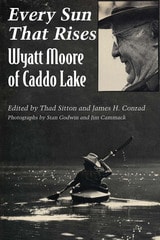
“What I done and what I been accused of covers everything, you put ’em both together.” Wyatt Moore of Caddo Lake exaggerates, but perhaps not very much. During his long life at Caddo Lake, Moore was at various times a boat operator, commercial fisherman, boat builder, farmer, fishing and hunting camp operator, guide, commercial hunter, trapper, raftsman, moonshiner, oil field worker, water well driller, and mechanical jack-of-all-trades. Still, he always found time for his lifelong study of the natural and human history of Caddo Lake. Here, in words as fresh and forceful as the day they were uttered, is his tale.
Moore, who was given the gift of a unique story to tell and great power to tell it, was the historical interpreter of his strange homeland of Caddo Lake. Twenty-three miles long, some forty thousand acres at high water, stretching across two Texas counties and one Louisiana parish, Caddo Lake’s fresh waters merge into a labyrinthine swamp punctuated by inlets, holes, and geological oddities like Goat Island, Whistleberry Slough, Whangdoodle Pass, and the Devil’s Elbow. Here among these lost reminders of steamboats and old bateau men is Moore’s world.
Born in 1901 at Karnack, Texas, Moore grew up in a time when kids wore button shoes and in a place where pigs and chickens roamed the backyard. He drank his first whiskey at age eight, gigged fish, trapped, and hunted for pearls as a boy, and grew up to an easy assurance on the lake that comes only to those long accustomed to its ways. A walking library of the history of Caddo Lake, Moore delved into almost every nook and corner of it, and wherever he went, whatever he did, he sought to learn more about his subect. Sought out by writers and journalists—among them James Michener and Bill Moyers—because of his laconic wit and remarkable command of the region’s story, Moore became known as a resource as precious as the lake itself. Moore’s story is eloquently introduced by Thad Sitton in an opening essay that chronicles the history of Caddo Lake. Striking photographs of Moore at home and at work on the lake beautifully amplify his life story, and an exuberant word-and-picture essay of Moore expertly building the traditional boat of the region, a bateau, reinforces the vivid image we have of this remarkable man.
Every Tub Must Sit on Its Own Bottom
The Philosophy and Politics of Zora Neale HurstonDeborah G. Plant
University of Illinois Press, 1995
needed at this point in the evolving critical assessment of Hurston. It
is a paradigm for the study of individual African American women writers."
-- Alice Deck, University of Illinois at Urbana-Champaign
In a ground-breaking study
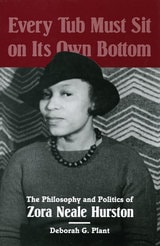
of Zora Neale Hurston, Deborah Plant takes issue with current notions
of Hurston as a feminist and earlier impressions of her as an intellectual
lightweight who disregarded serious issues of race in American culture.
Instead, Plant calls Hurston a "writer of resistance" who challenged
the politics of domination both in her life and in her work. One of the
great geniuses of the Harlem Renaissance, Hurston stands out as a strong
voice for African-American women. Her anthropological inquiries as well
as her evocative prose provide today's readers with a rich history of
African American folk culture, a folk culture through which Hurston expressed
her personal and political strategy of resistance and self-empowerment.
Through readings of Hurston's
fiction and autobiographical writings, Plant offers one of the first book-length
discussions of Hurston's personal philosophy of individualism and self-preservation.
From a discussion of Hurston's preacher father and influential mother,
whose guiding philosophy is reflected in the title of this book, to the
influence of Spinoza and Nietzsche, Plant puts into perspective the driving
forces behind Hurston's powerful prose.
This fresh look at one of
the most important writers of the twentieth century is sure to shape future
study of Hurston and her work.
Every Wrong Direction
An Emigré’s MemoirDan Burt
Rutgers University Press, 2023
Every Wrong Direction recreates and dissects the bitter education of Dan Burt, an American émigré who never found a home in America. It begins in the row homes of Jewish immigrants and working-class Italians on the mean streets of 1950s South Philadelphia. Every Wrong Direction follows the author from the rough, working-class childhood that groomed him to be a butcher or charter boat captain, through America, Britain and Saudi Arabia as student, lawyer, spy, culture warrior, and expatriate, ending with a photo of his college rooms at St John’s College, Cambridge. Between this beginning and end, through a Philadelphia commuter college, to Cambridge, then Yale Law School, across the working to upper classes, three countries, and seven cities over 43 years, it maps his pursuit of, realization, disillusionment with and abandonment of America and the American Dream.
Praise for Dan Burt's previous memoir, You Think It Strange:
“Burt’s early life was indeed a triumph of wit and will. He managed to escape a world filled with violence and a culture that valued street smarts over book smarts, all the while knowing that just about everyone around him thought little of his prospects. That he made it out at all is extraordinary. That he became a successful lawyer and writer is virtually unimaginable.” —Commonweal
“Dan Burt is a fine poet, and this memoir has all the sensitivity and vigilance you might expect from a writer with such a background. But his prose also has a robustness and documentary power that continually startles and engages. As it combines these things, You Think It Strange catches the strangeness of the world and makes it familiar.”
—Sir Andrew Motion, Poet Laureate of the United Kingdom, 1999-2009
Everybody In, Nobody Out
Inspiring Community at Michigan's University Musical SocietyKen Fischer with Robin Lea Pyle
University of Michigan Press, 2020
The approach not only deepened UMS’s engagement with the university and southeast Michigan communities, it led to exemplary partnerships with distinguished artists across the world. Under Fischer’s leadership, UMS hosted numerous breakthrough performances, including the Vienna Philharmonic’s final tour with Leonard Bernstein, appearances by then relatively unknown opera singer Cecilia Bartoli, a multiyear partnership with the Royal Shakespeare Company, and artists as diverse as Yo-Yo Ma, Jawole Willa Jo Zollar, Elizabeth Streb, and Nusrat Fateh Ali Khan.
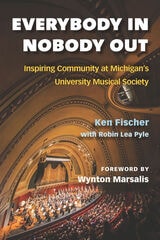
Though peppered with colorful anecdotes of how these successes came to be, this book is neither a history of UMS nor a memoir of Fischer’s significant accomplishments with the organization. Rather it is a reflection on the power of the performing arts to engage and enrich communities—not by handing down cultural enrichment from on high, but by meeting communities where they live and helping them preserve cultural heritage, incubate talent, and find ways to make community voices heard.
Everybody Knows
Cynicism in AmericaWilliam Chaloupka
University of Minnesota Press, 2001
A witty take on what’s wrong--and right--with cynicism today, now in paperback!
We are now living in the midst of the most cynical era in American history. Disaffection from government institutions is at an all-time high. Ordinary citizens perceive political leaders to be more manipulative and jaded than ever. Skepticism pervades our cultural and social attitudes and interactions, and is prominently featured in the films we see, the books we read, and the media we experience. In this biting and controversial analysis, William Chaloupka scrutinizes the cynicism that is our common condition, examining both its uses in the politics of backlash and resentment and its surprisingly positive aspects.
Everybody Knows traces cynicism from its classical origins but emphasizes its recent emergence in American culture and politics, following a trajectory from H. L. Mencken to Richard Nixon to Bill Clinton to Fargo. Cutting neatly across ideological divisions, Chaloupka discusses the ways in which cynicism is rooted in all democratic politics and analyzes the role of the media-in particular, television news, political ads and speeches, and books such as E. J. Dionne’s Why Americans Hate Politics and William Bennett’s The Book of Virtues-in dissecting and encouraging cynicism.Chaloupka describes mass cynicism, which permeates popular culture; outsider cynicism, capable of cranky, even violent disruption; and the cynicism of those in power. He argues that those who issue broad pleas for civility or a renewal of community spirit usually misunderstand the cynicism they wish to treat. He also discusses the value of a cheeky, subversive “kynicism” to evoke the lively democratic practice American society must foster.Early reviews call Everybody Knows “original and compelling,” “pithy, engaging, and funny,” and “the best book on American politics in quite a while.” Sure to be widely read and debated, this entertaining book will inspire readers to take a new look at the cynicism prevalent in contemporary American society.
Everybody's Autonomy
Connective Reading and Collective IdentityJuliana Spahr
University of Alabama Press, 2001
Contemporary avant garde writing has often been overlooked by those who study literature and identity. Such writing has been perceived as unrelated, as disrespectful of subjectivity. But Everybody's Autonomy instead locates within avant garde literature models of identity that are communal, connective, and racially concerned. Everybody's Autonomy, as it tackles literary criticism's central question of what sort of selves do works create, looks at works that encourage connection, works that present and engage with large, public worlds that are in turn shared with readers. With this intent, it aligns the iconoclastic work of Gertrude Stein with foreign, immigrant Englishes and their accompanying subjectivities. It examines the critique of white individualism and privilege in the work of language writers Lyn Hejinian and Bruce Andrews. It looks at how Harryette Mullen mixes language writing's open text with the distinctivesness of African-American culture to propose a communal, yet still racially conscious identity. And it examines Theresa Hak Kyung Cha's use of broken English and French to unsettle readers' fluencies and assimilating comprehensions, to decolonize reading. Such works, the book argues, well represent and expand changing notions of the public, of everybody.
Everybody's History
Indiana's Lincoln Inquiry and the Quest to Reclaim a President's PastKeith A. Erekson
University of Massachusetts Press, 2012
Revered by the public, respected by scholars, and imitated by politicians, Abraham Lincoln remains influential more than two hundred years after his birth. His memory has inspired books, monuments, and museums and also sparked controversies, rivalries, and forgeries. That so many people have been interested in Lincoln for so long makes him an ideal subject for exploring why history matters to ordinary Americans as well as to academic specialists.
In Everybody's History, Keith A. Erekson focuses on the Southwestern Indiana Historical Society—an organization composed of lawyers, historians, collectors, genealogists, teachers, college presidents, and newspaper editors—who joined together during the 1920s and 1930s to recover a part of Lincoln's life his biographers had long ignored: the years from age seven to twenty-one when he lived on the Indiana frontier. Participants in the “Lincoln Inquiry,” as it was commonly known, researched old records, interviewed aging witnesses, hosted pageants, built a historical village, and presented their findings in public and in print. Along the way they defended their methods and findings against competitors in the fields of public history and civic commemoration, and rescued some of Indiana's own history by correcting a forgotten chapter of Lincoln's.
Everybody's History traces the development of popular interest in Lincoln to uncover the story of an extensive network of nonprofessional historians who contested old authorities and advanced new interpretations. In so doing, the book invites all who are interested in the past to see history as both vital to public life and meaningful to everybody.
Everyday Democracy
Liberals, Conservatives, and Their Routine Political LivesJeffrey M. Berry, James M. Glaser and Deborah J. Schildkraut
University of Chicago Press, 2025
How the everyday habits and attitudes of ordinary liberals and conservatives shape the health of American democracy.
In Everyday Democracy, Jeffrey M. Berry, James M. Glaser, and Deborah J. Schildkraut study Americans’ views of several manifestations of “everyday democracy,” which they define as the attitudes, behaviors, and processes that people experience in daily life and their routine considerations of politics and community. Examples include engaging in dialogue with political opponents and giving politicians license to compromise. Ordinary political moments like these constitute much of politics, and they can lay the foundation that shapes if, when, and how crisis moments unfold.
Paying particular attention to the role of ideology in shaping how Americans emulate daily democratic ideals, this book considers such questions as: How do liberals and conservatives support different aspects of democratic practice, and are there ideological asymmetries between the two groups? If and when asymmetries emerge, what factors might explain them? The authors consider what their findings mean for the health of American democracy broadly.
Everyday Dirty Work
Invisibility, Communication, and Immigrant LaborWilfredo Alvarez
The Ohio State University Press, 2022
Winner, 2023 NCA Ethnography Division Best Book Award
Wilfredo Alvarez’s Everyday Dirty Work: Invisibility, Communication, and Immigrant Labor is an exploration into co-cultural communication practices within the workplace. Specifically, Alvarez investigates how Latin American immigrant janitors communicate from their marginalized standpoints in a predominantly White academic organization. He examines how custodial workers perceive, interpret, and thematize routine messages regarding race, ethnicity, social class, immigrant status, and occupation, and how those messages and overall communicative experiences affect both their work and personal lives.
A Latin American immigrant himself, Alvarez relates his own experiences to those of the research participants. His positionality informs and enhances his research as he demonstrates how everyday interpersonal encounters create discursive spaces that welcome or disqualify people based on symbolic and social capital. Alvarez offers valuable insights into the lived experiences of critical––but often undervalued and invisible––organizational members. Through theoretical insights and research data, he provides practical recommendations for organizational leaders to improve how they can relate to and support all stakeholders.
Everyday Genius
Self-Taught Art and the Culture of AuthenticityGary Alan Fine
University of Chicago Press, 2004
Fine considers the differences among folk art, outsider art, and self-taught art, explaining the economics of this distinctive art market and exploring the dimensions of its artistic production and distribution. Interviewing dealers, collectors, curators, and critics and venturing into the backwoods and inner-city homes of numerous self-taught artists, Fine describes how authenticity is central to the system in which artists—often poor, elderly, members of a minority group, or mentally ill—are seen as having an unfettered form of expression highly valued in the art world. Respected dealers, he shows, have a hand in burnishing biographies of the artists, and both dealers and collectors trade in identities as much as objects.
Revealing the inner workings of an elaborate and prestigious world in which money, personalities, and values affect one another, Fine speaks eloquently to both experts and general readers, and provides rare access to a world of creative invention-both by self-taught artists and by those who profit from their work.
Everyday HR
A Human Resources Handbook for Academic Library StaffGail Munde
American Library Association, 2013
Everyday Justice
A Legal Aid StoryAshley Wiltshire
Vanderbilt University Press, 2022
Those surviving on low incomes often see the legal system as an oppressive force stacked against them. Everyday Justice is about lawyers trying to make the law work for these people. This book traces the development and evolution of legal aid in Middle Tennessee from the late 1960s to the turn of the millennium, as told by Ashley Wiltshire, who worked for the Legal Aid Society of Middle Tennessee and the Cumberlands in all its incarnations for four decades, beginning a year after its inception.
Set in the context of the legal aid movement in the United States—beginning as a part of the social awakening in the post–Civil War era, continuing with volunteer efforts in the first part of the twentieth century, and coming to fruition beginning with the OEO Office of Legal Services grants of the 1960s as part of the War on Poverty—Everyday Justice is a story of Nashville, which levied an extended period of opposition because of prevailing cultural and religious views on race and poverty.

Everyday Justice
A Legal Aid StoryAshley Wiltshire
Vanderbilt University Press, 2022
Those surviving on low incomes often see the legal system as an oppressive force stacked against them. Everyday Justice is about lawyers trying to make the law work for these people. This book traces the development and evolution of legal aid in Middle Tennessee from the late 1960s to the turn of the millennium, as told by Ashley Wiltshire, who worked for the Legal Aid Society of Middle Tennessee and the Cumberlands in all its incarnations for four decades, beginning a year after its inception.
Set in the context of the legal aid movement in the United States—beginning as a part of the social awakening in the post–Civil War era, continuing with volunteer efforts in the first part of the twentieth century, and coming to fruition beginning with the OEO Office of Legal Services grants of the 1960s as part of the War on Poverty—Everyday Justice is a story of Nashville, which levied an extended period of opposition because of prevailing cultural and religious views on race and poverty.
Everyday Klansfolk
White Protestant Life and the KKK in 1920s MichiganCraig Fox
Michigan State University Press, 2011
In 1920s Middle America, the Ku Klux Klan gained popularity not by appealing to the fanatical fringes of society, but by attracting the interest of “average” citizens. During this period, the Klan recruited members through the same unexceptional channels as any other organization or club, becoming for many a respectable public presence, a vehicle for civic activism, or the source of varied social interaction. Its diverse membership included men and women of all ages, occupations, and socio-economic standings. Although surviving membership records of this clandestine organization have proved incredibly rare, Everyday Klansfolk uses newly available documents to reconstruct the life and social context of a single grassroots unit in Newaygo County, Michigan. A fascinating glimpse behind the mask of America’s most notorious secret order, this absorbing study sheds light on KKK activity and membership in Newaygo County, and in Michigan at large, during the brief and remarkable peak years of its mass popular appeal.

Everyday Mathematics for Parents
What You Need to Know to Help Your Child SucceedThe University of Chicago School Mathematics Project
University of Chicago Press, 2017
The Everyday Mathematics (EM) program was developed by the University of Chicago School Mathematics Project (UCSMP) and is now used in more than 185,000 classrooms by almost three million students. Its research-based learning delivers the kinds of results that all school districts aspire to. Yet despite that tremendous success, EMoften leaves parents perplexed. Learning is accomplished not through rote memorization, but by actually engaging in real-life math tasks. The curriculum isn’t linear, but rather spirals back and forth, weaving concepts in and out of lessons that build overall understanding and long-term retention. It’s no wonder that many parents have difficulty navigating this innovative mathematical and pedagogic terrain.
Now help is here. Inspired by UCSMP’s firsthand experiences with parents and teachers, Everyday Mathematics for Parents will equip parents with an understanding of EM and enable them to help their children with homework—the heart of the great parental adventure of ensuring that children become mathematically proficient.
Featuring accessible explanations of the research-based philosophy and design of the program, and insights into the strengths of EM, this little book provides the big-picture information that parents need. Clear descriptions of how and why this approach is different are paired with illustrative tables that underscore the unique attributes of EM. Detailed guidance for assisting students with homework includes explanations of the key EM concepts that underlie each assignment. Resources for helping students practice math more at home also provide an understanding of the long-term utility of EM. Easy to use, yet jam-packed with knowledge and helpful tips, Everyday Mathematics for Parents will become a pocket mentor to parents and teachers new to EM who are ready to step up and help children succeed. With this book in hand, you’ll finally understand that while this may not be the way that you learned math, it’s actually much better.
Everyday Nature
Knowledge of the Natural World in Colonial New YorkGronim, Sara S
Rutgers University Press, 2007
In the modern world, the public looks to scientists and scholars for their expertise on issues ranging from the effectiveness of vaccines to the causes of natural disasters. But for early Americans, whose relationship to nature was more intimate and perilous than our own, personal experience, political allegiances, and faith in God took precedence over the experiments of the learned.
In Everyday Nature, Sara Gronim shows how scientific advances were received in the early modern world, from the time Europeans settled in America until just before the American Revolution. Settlers approached a wide range of innovations, such as smallpox inoculation, maps and surveys, Copernican cosmology, and Ben Franklin’s experiments with electricity, with great skepticism. New Yorkers in particular were distrustful because of the chronic political and religious factionalism in the colony. Those discoveries that could be easily reconciled with existing beliefs about healing the sick, agricultural practices, and the revolution of the planets were more readily embraced.
A fascinating portrait of colonial life, this book traces a series of innovations that were disseminated throughout the Atlantic world during the Enlightenment, and shows how colonial New Yorkers integrated new knowledge into their lives.
Everyday People and the Stories of Freedom in the Sixties
Craig Werner
University of Massachusetts Press, 2027
Showing that the most important figures of the 1960s were not always the most famous ones
Just weeks back from Vietnam, guitarist Larry Lee stood on stage at Woodstock alongside Jimi Hendrix, but he isn’t given more than a glance in the festival’s documentary. In Selma, Alabama, in March 1965, an eight-year-old girl named Sheyann Webb wrote her own obituary before joining the march across the Edmund Pettus Bridge. She survived Bloody Sunday, swept off the bridge in the arms of Hosea Williams as state troopers on horseback swung bullwhips and clubs. These are just a couple of the regular people at the heart of Craig Werner’s sweeping, mosaic history of the 1960s; it is their stories, not those of the icons, that give the era its deeper meaning.
In Everyday People and the Stories of Freedom in the Sixties, Werner assembles a rich and kaleidoscopic portrait of a decade in which Americans across the entire political spectrum claimed freedom as their cause. Moving beyond familiar myths and simplified narratives, he reveals a period defined by three interlocking realities: everything was open to change, everything seemed to happen at once, and everyone believed their vision of freedom was the one worth fighting for.
Bringing together stories too often told in isolation—the Civil Rights Movement, Vietnam, the global Cold War, the women’s movement, and the intertwined worlds of sex, drugs, and rock 'n' roll—Werner integrates the experiences of African Americans, women, Native Americans, Latinx communities, LGBTQ people, and immigrants into a single, propulsive narrative. Music, film, art, and fashion are not treated as colorful backdrops but as central forces in the making of political and social change. This book illuminates the economic, political, technological, and cultural forces that shaped the 1960s and continue to influence the present. It is a history of a decade told not from the top down, but from the ground up, by the people who lived it.
Supplemental materials for readers, students, and instructors are available on the publisher’s website, including full citations, playlists, images, and thematic sections on the Global Sixties, science and technology, religion, literature, music, film, visual art, and major figures and events.
Everyman News
The Changing American Front PageMichele Weldon
University of Missouri Press, 2007
One need only look at the front pages of newspapers over the past few years to see that something has changed. Stories are more personal, more inclusive, less distant from readers’ experiences. Once called the first draft of history, news has become more of an anecdotal companion. The evidence is telling: stories use more unofficial sources than ever before; the “inverted pyramid” form of news writing is barely practiced; and, especially after 9/11, tragedy has become more humanized.
Scanning the crowded media landscape, Michele Weldon—a journalist passionate about her profession—takes a fresh look at how newspapers have carved out a narrative niche that reflects society’s fascination with personal stories and readers’ demands for diversity in content. Comparing some 850 stories, story approaches, and unofficial sourcing in twenty American newspapers for eight dates in 2001 and 2004—a total of 160 front pages—she shows a shift toward features over hard news, along with an increase in anecdotal or humanistic approaches to all stories.
Everyman News offers a provocative look at why American newspapers have become story papers, with their content and style saying as much about our culture as they do about the journalists and the readers. Weldon shows that a variety of forces both inside and outside journalism—blogs, citizen journalism, newsroom diversity, and other factors—have converged to remake the front page, and she unveils the content of “everyman news” as a commodity apart from the mode of delivery. Her assessment also incorporates more than fifty interviews with people connected to journalism about what these changes mean—revealing that not everyone in the industry believes they are for the better.
Is everyman news perhaps right for its time, or is it merely a symptom of what Weldon calls “Chicken Little journalism”? Weighing in on such matters as the New York Times’s “Portraits of Grief” series and the dangers of the blogosphere, she invites readers to make their own calls in this original and important contribution to the study of media. Everyman News is a book that will contribute to our understanding of newspapers in the new century—must reading for professionals and an eye-opener for anyone trying to comprehend the significant shifts in today’s front pages.
Everyman's Constitution
Historical Essays on the Fourteenth Amendment, the "Conspiracy Theory," and American ConstitutionalismHoward Jay Graham
Wisconsin Historical Society Press, 1968
Everyone Has Class
A Guide to Understanding American InequalityAllison L. Hurst
Oregon State University Press, 2026
Social class is a neglected, misunderstood, yet overwhelmingly powerful factor in the United States. In Everyone Has Class Allison L. Hurst and Sean McCloud draw on both personal stories and insights from recent studies to recount the many ways class influences American life. The authors explore the material conditions we live in, the social relationships we develop, and the unconscious and conscious psychological and physical habits we form based on our social class location. Each chapter reveals the profound presence and complex influence of social class—beyond that of money, education, and occupation—providing readers with an understanding of what social class is and how it operates in our everyday lives.
Starting with “what is class?” in chapter one, personal narratives alongside interviews with key researchers and scholars allow entrée for everyone to the meaning of the term class, the impact of class, and the broader applications and perspectives within the study of class. Can one overcome class? Does recognizing its effects allow us to navigate our own social standing? Through twelve stand-alone chapters, Hurst and McCloud show how class shapes and influences both individual and social lives in consequential ways.
Everyone Loves Live Music
A Theory of Performance InstitutionsFabian Holt
University of Chicago Press, 2020
For decades, millions of music fans have gathered every summer in parks and fields to hear their favorite bands at festivals such as Lollapalooza, Coachella, and Glastonbury. How did these and countless other festivals across the globe evolve into glamorous pop culture events, and how are they changing our relationship to music, leisure, and public culture? In Everyone Loves Live Music, Fabian Holt looks beyond the marketing hype to show how festivals and other institutions of musical performance have evolved in recent decades, as sites that were once meaningful sources of community and culture are increasingly subsumed by corporate giants.
Examining a diverse range of cases across Europe and the United States, Holt upends commonly-held ideas of live music and introduces a pioneering theory of performance institutions. He explores the fascinating history of the club and the festival in San Francisco and New York, as well as a number of European cities. This book also explores the social forces shaping live music as small, independent venues become corporatized and as festivals transform to promote mainstream Anglophone culture and its consumerist trappings. The book further provides insight into the broader relationship between culture and community in the twenty-first century. An engaging read for fans, industry professionals, and scholars alike, Everyone Loves Live Music reveals how our contemporary enthusiasm for live music is more fraught than we would like to think.
Everyone against Us
Public Defenders and the Making of American JusticeAllen Goodman
University of Chicago Press, 2023
As a public defender, Allen Goodman faced cross-examination from family and friends every day: How could he work to help criminals? How could he live with himself? Presumed guilty by association, Goodman quickly learned that people didn’t really want an answer; they wanted a justification, perhaps even an apology. Ever the idealist, Goodman answered anyway: Everyone deserves justice.
Everyone against Us is Goodman’s testimony of his life as a public defender. In it, he documents his efforts to defend clients, both guilty and innocent, against routine police abuse, prosecutorial misconduct, and unjust sentencing. To work in criminal justice, Goodman shows, is to confront and combat vivid human suffering, of both victims and perpetrators. From sex trafficking, murder, and abuse to false conviction, torture, and systemic racism, Goodman describes the daily experiences that both rattled his worldview and motivated him to work ever harder. Part memoir, part exposé, Everyone against Us is the moving story of an embattled civil servant who staves off the worst abuses of the criminal justice system, at great personal cost.
Everything I Never Wanted to Know
Christine Hume
The Ohio State University Press, 2023
In Everything I Never Wanted to Know, Christine Hume confronts the stigma and vulnerability of women’s bodies in the US. She explores bodily autonomy and sexual assault alongside the National Sex Offender Registry in order to invoke not solutions but a willingness to complicate our ideas of justice and defend every human’s right to be treated like a member of the community. Feminist autobiography threads into historical narrative and cultural criticism about the Victorian-era Frozen Charlotte doll; the Nylon Riots of the 1940s; the movie Halloween; Larry Nassar, who practiced in Hume’s home state of Michigan; and other material. In these reflections on sexuality, gender, criminality, and violence, Hume asks readers to reconsider what we have collectively normalized and how we are each complicit, writing through the darkness of what we don’t want to see, what we’d rather not believe, and what some of us have long tried to forget.
Everything Was Better in America
Print Culture in the Great DepressionDavid Welky
University of Illinois Press, 2007
Everything We Could Do
A NovelDavid McGlynn
Northwestern University Press, 2025
After a decade of miscarriages, Brooke Jensen is finally pregnant—with quadruplets. When she goes into labor after twenty-three weeks, Brooke and her husband rush to the hospital in the small town of Hanover, Wisconsin. For the 203 days that follow, they’re plunged into the terrifying and mysterious netherworld of the neonatal intensive care unit.
As the babies grow and struggle, fall turns to stark upper-Midwest winter. Brooke bonds with Dash, a senior nurse whose son, Landon, had been a patient in the NICU years earlier and is now straining his parents’ abilities to care for him. Both families bend and edge closer to breaking, and the questions mount: What does love look like? What does it mean to save a life?
A fiercely honest portrait of American parenthood, the American healthcare system, and Rust Belt communities, Everything We Could Do lays bare the ways that families are formed and remade in times of crisis.
Everything for Sale
The Virtues and Limits of MarketsRobert Kuttner
University of Chicago Press, 1999
"The best survey of the limits of free markets that we have. . . . A much needed plea for pragmatism: Take from free markets what is good and do not hesitate to recognize what is bad."—Jeff Madrick, Los Angeles Times
"It ought to be compulsory reading for all politicians—fortunately for them and us, it is an elegant read."—The Economist
"Demonstrating an impressive mastery of a vast range of material, Mr. Kuttner lays out the case for the market's insufficiency in field after field: employment, medicine, banking, securities, telecommunications, electric power."—Nicholas Lemann, New York Times Book Review
"A powerful empirical broadside. One by one, he lays on cases where governments have outdone markets, or at least performed well."—Michael Hirsh, Newsweek
"To understand the economic policy debates that will take place in the next few years, you can't do better than to read this book."—Suzanne Garment, Washington Post Book World
Everything to Gain
Making the Most of the Rest of Your LifeJimmy Carter
University of Arkansas Press, 1995
Evidence of Being
The Black Gay Cultural Renaissance and the Politics of ViolenceDarius Bost
University of Chicago Press, 2018
Evidence of My Existence
Jim Lo Scalzo
Ohio University Press, 2007
From a leper colony in India to an American research station on the Antarctic Peninsula, from the back rooms of the White House to the battlefields of Iraq and Afghanistan, Evidence of My Existence tells a unique and riveting story of seventeen years spent racing from one photo assignment to the next. It is also a story of photojournalism and theconsequences of obsessive wanderlust.
When the book opens, Jim Lo Scalzo is a blur to his wife, her remarkable tolerance wearing thin. She is heading to the hospital with her second miscarriage, and Jim is heading to Baghdad to cover the American invasion of Iraq. He hates himself for this—for not giving her a child, for deserting her when she soobviously needs him, for being consumed by his job—but how to stop moving? Sure, there have been some tough trips. He’s been spit on by Mennonites in Missouri, by heroin addicts in Pakistan, and by the KKK in South Carolina. He’s contracted hepatitis on the Navajo Nation, endured two bouts of amoebic dysentery in India and Burma and four cases of giardia in Nepal, Peru, Afghanistan, and Cuba. He’s been shot with rubber bullets in Seattle, knocked to the ground by a water cannon in Quebec, and sprayed with more teargas than he cares to recall. But photojournalism is his career, and travel is his compulsivecraving.
We follow Lo Scalzo through the maze of airports and crowds and countries as he chases the career he has always wanted, struggles with his family problems, and reveals the pleasures of a life singularly focused. For him, as for so many photojournalists, it is always about the going.
Evidence of the Law
Proving Legal ClaimsGary Lawson
University of Chicago Press, 2017
As Gary Lawson shows, legal claims are inherently objects of proof, and whether or not the law acknowledges the point openly, proof of legal claims is just a special case of the more general norms governing proof of any claim. As a result, similar principles of evidentiary admissibility, standards of proof, and burdens of proof operate, and must operate, in the background of claims about the law. This book brings these evidentiary principles for proving law out of the shadows so that they can be analyzed, clarified, and discussed. Viewing legal problems through this lens of proof illuminates debates about everything from constitutional interpretation to the role of stipulations in litigation. Rather than prescribe resolutions to any of those debates, Evidence of the Law instead provides a set of tools that can be used to make those debates more fruitful, whatever one’s substantive views may be. As lawyers, judges, and legal subjects confront uncertainty about what the law is, they can, should, and must, Lawson argues, be guided by the same kinds of abstract considerations, structures, and doctrines long used to make determinations about questions of fact.

Evil Arabs in American Popular Film
Orientalist FearBy Tim Jon Semmerling
University of Texas Press, 2006
2006 — Runner-up, Arab American National Museum Book Awards
The "evil" Arab has become a stock character in American popular films, playing the villain opposite American "good guys" who fight for "the American way." It's not surprising that this stereotype has entered American popular culture, given the real-world conflicts between the United States and Middle Eastern countries, particularly since the oil embargo of the 1970s and continuing through the Iranian hostage crisis, the first and second Gulf Wars, and the ongoing struggle against al-Qaeda. But when one compares the "evil" Arab of popular culture to real Arab people, the stereotype falls apart. In this thought-provoking book, Tim Jon Semmerling further dismantles the "evil" Arab stereotype by showing how American cultural fears, which stem from challenges to our national ideologies and myths, have driven us to create the "evil" Arab Other.
Semmerling bases his argument on close readings of six films (The Exorcist, Rollover, Black Sunday, Three Kings, Rules of Engagement, and South Park: Bigger, Longer & Uncut), as well as CNN's 9/11 documentary America Remembers. Looking at their narrative structures and visual tropes, he analyzes how the films portray Arabs as threatening to subvert American "truths" and mythic tales—and how the insecurity this engenders causes Americans to project evil character and intentions on Arab peoples, landscapes, and cultures. Semmerling also demonstrates how the "evil" Arab narrative has even crept into the documentary coverage of 9/11. Overall, Semmerling's probing analysis of America's Orientalist fears exposes how the "evil" Arab of American popular film is actually an illusion that reveals more about Americans than Arabs.
Evolution Made to Order
Plant Breeding and Technological Innovation in Twentieth-Century AmericaHelen Anne Curry
University of Chicago Press, 2016
In Evolution Made to Order, Helen Anne Curry traces the history of America’s pursuit of tools that could intervene in evolution. An immersive journey through the scientific and social worlds of midcentury genetics and plant breeding and a compelling exploration of American cultures of innovation, Evolution Made to Order provides vital historical context for current worldwide ethical and policy debates over genetic engineering.
Evolution of a Missouri Asylum
Fulton State Hospital, 1851-2006Richard L. Lael, Barbara Brazos, and Margot Ford McMillen
University of Missouri Press, 2007
This institutional history of the hospital traces the debates surrounding its creation (as the State Lunatic Asylum) in a time when mental illness was barely understood. Although the Fulton hospital was initially conceived as a treatment facility, it quickly transformed into a primarily custodial institution. It existed as a self-sufficient establishment until the mid-twentieth century, dependent on patient labor and even producing its own food. But for the most socially disadvantaged and for the severely delusional, life at Fulton was anything but therapeutic.
The book describes not only the lofty goals of professionals dedicated to treating the mentally ill but also an institution once clouded by overcrowding, financial mismanagement, political cronyism, and wrongful confinement. It considers segregation within the hospital, where the first black doctor was hired in 1960 and where racism nevertheless continued to flourish, and it describes how, even after the 1921 Eleemosynary Act, the patronage system continued to plague Fulton for two more decades.
The authors reveal changing attitudes toward new treatments in the mid-twentieth century as psychotherapy and drugs became common, and decisions at Fulton regarding patient care are described within the context of progress in Europe and the eastern United States. The book addresses the complexities facing the physician-superintendents who supervised both medical therapies and administrative matters, depicting ongoing tension between hospital finances and state support and showing the difficulties state institutions faced in a “low tax/low public service” environment.
As Fulton State Hospital enters the twenty-first century, clients have become active in the development of institutional policies—a far cry from the warehousing of patients a hundred years ago. In tracing these seismic shifts in mental health care, this book offers an eye-opening exploration of how one state has sought to care for its citizens.
Evolutionary Rhetoric
Sex, Science, and Free Love in Nineteenth-Century FeminismWendy Hayden
Southern Illinois University Press, 2013
In Evolutionary Rhetoric, scholar Wendy Hayden provides a comprehensive examination of the relationship between scientific and feminist rhetorics in free-love feminism, studying the movement from its inception in the 1850s to its dark turn toward eugenics in the early 1900s. Hayden organizes her provocative study by scientific discipline—evolution, physiology, bacteriology, embryology, and heredity. Each chapter explores how free-love feminists adopted the evidence of that discipline in their arguments for increased sex education, women’s sexual rights, reproductive freedom, and the abolition of a marriage system that repressed the rights and the sexuality of women.
Hayden takes our conventional understanding of the relationship between nineteenth-century feminism and science and expands it. The author provides examples of the powerful words of free-love feminists to show exactly how these exceptional women used science as a rhetorical platform to promote feminist, and often radical, social reforms.
Considering why the free-love movement has not yet been studied, Hayden also discusses how the recovery of this movement may impact larger goals in the recovery of women’s rhetoric. This important and timely study of a long-forgotten movement adds to our understanding of the complexities of the history of feminism.

Ex Ante
Power and Prediction in the Real-Time FutureJohn Cheney-Lippold
University of Chicago Press, 2027
An incisive framework for understanding how predictive AI has reshaped our relationship with time.
Ex Ante argues that AI systems draw us into a new experience of time, a continuous stream of machine-generated futures that reshapes our relationship to ourselves, to capitalism, and to infrastructure. Unlike other predictive tools that help us prepare for what might come, these projections—produced by algorithms and sourced by massive flows of data—calibrate our actions moment by moment, second by second.
In this book, John Cheney-Lippold offers a framework he calls the ex ante, Latin for “before the event,” as a way to consider how the future has become capitalism’s latest resource for exploitation. Through case studies spanning TikTok beauty filters that have fueled a surge in plastic surgery consultations, chess engines that redefine how the game is played, online sports betting platforms that commodify probability itself, hospital sepsis algorithms that transform the labor of nursing, and coordinated vehicle networks that collectively anticipate their surroundings to function, Ex Ante offers an exploration and powerful critique of our algorithmic present and the powers behind it.
Excavations at Wickliffe Mounds
Kit W. Wesler, with a foreword by Victoria G. Fortner
University of Alabama Press, 2001
Wesler provides an impressive and definitive compilation of more than 70 years of archaeological excavations at one of the most important
archaeological sites in Kentucky.
The Wickliffe Mounds site is located on a bluff overlooking the Mississippi River in Ballard County, Kentucky, about three miles south of the mouth of the Ohio River. Around A.D. 1100, Mississippian people--farmers and traders with a culture closely related to the historic cultures of the Southeast (Chickasaw, Choctaw, Creek, and others)—created a settlement there on which they lived for approximately 250 years before moving on.
In 1930 road construction cut a channel through the site, revealing archaeological deposits and bringing the area to the attention of Fain King, a local lumberman and entrepreneur. King bought the site in hopes of turning it into an attraction for the education and entertainment of the public, and not incidentally for his own profit. For more than 50 years the area was subjected to excavations ranging from looting to professional research efforts. In 1983, the site was finally turned over to Murray State University to be developed into an academic facility dedicated to research, student training, public education, and preservation of the site and its collections. Fortunately, the Wickliffe collections include all the early excavation records as well as more than 85,000 artifacts, 90% of which had been catalogued. Between 1984 and 1996 excavations were conducted specifically to affirm questionable data and/or fill in gaps in the Wickliffe archaeological record.
In this volume, Wesler and his colleagues have compiled data from almost seven decades of excavations at Wickliffe Mounds, providing the first comprehensive study of this important site. The paperback version of the book is accompanied by a CD-ROM that contains contributions from a wide range of archaeological specialists and includes archaeological data, site maps, database files, plats of excavations, artifact descriptions, and photographs, compiling in one place the entire archaeological record for this very important eastern North American site.
Excellence for All
How a New Breed of Reformers Is Transforming America's Public SchoolsJack Schneider
Vanderbilt University Press, 2011
"Excellence for all" might, at first glance, appear to be nothing more than a rhetorical flourish. Who, after all, would oppose the idea of a great education for every student? Yet it is hardly a throwaway phrase. Rather, it represents a surprising fusion of educational policy approaches that had been in tense opposition throughout the twentieth centurythose on the right favoring social efficiency, and those on the left supporting social justice.
This book seeks to understand why the "excellence for all" vision took hold at the time it did, unpacks the particular beliefs and assumptions embedded in it, and details the often informal coalition building that produced this period of consensus. Examining the nation's largest urban school districts (Los Angeles, Chicago, and New York), the author details three major reform efforts in chapters titled "The Right Space: The Small Schools Movement"; "The Right Teachers: Teach for America"; and "The Right Curriculum: Expanding Advanced Placement."
Excellent Books for Early and Eager Readers
Kathleen T. Isaacs
American Library Association, 2016