Results by title
342 books match the query '16th century' and 16 start with f

Fables of Power
Aesopian Writing and Political HistoryAnnabel Patterson
Duke University Press, 1991
Patterson begins with an analysis of the legendary Life of Aesop, its cultural history and philosophical implications, a topic that involves such widely separated figures as La Fontaine, Hegel, and Vygotsky. The myth’s origin is recovered here in the saving myth of Aesop the Ethiopian, black, ugly, who began as a slave but become both free and influential, a source of political wisdom. She then traces the early modern history of the fable from Caxton, Lydgate, and Henryson through the eighteenth century, focusing on such figures as Spenser, Sidney, Lyly, Shakespeare, and Milton, as well as the lesser-known John Ogilby, Sir Roger L’Estrange, and Samuel Croxall.
Patterson discusses the famous fable of The Belly and the Members, which, because it articulated in symbolic terms some of the most intransigent problems in political philosophy and practice, was still going strong as a symbolic text in the mid-nineteenth century, where it was focused on industrial relations by Karl Marx and by George Eliot against electoral reform.
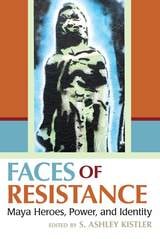
Faces of Resistance
Maya Heroes, Power, and IdentityEdited by S. Ashley Kistler
University of Alabama Press, 2018
In the sixteenth century, Q’eqchi’ Maya leader Aj Poop B’atz’ changed the course of Q’eqchi’ history by welcoming Spanish invaders to his community in peace to protect his people from almost certain violence. Today, he is revered as a powerful symbol of Q’eqchi’ identity. Aj Poop B’atz’ is only one of many indigenous heroes who has been recognized by Maya in Mexico and Guatemala throughout centuries of subjugation, oppression, and state-sponsored violence.
Faces of Resistance: Maya Heroes, Power, and Identity explores the importance of heroes through the analyses of heroic figures, some controversial and alternative, from the Maya area. Contributors examine stories of hero figures as a primary way through which Maya preserve public memory, fortify their identities, and legitimize their place in their country’s historical and political landscape. Leading anthropologists, linguists, historians, and others incorporate ethnographic, ethnohistoric, and archival material into their chapters, resulting in a uniquely interdisciplinary book for scholars as well as students.
The essays offer the first critical survey of the broad significance of these figures and their stories and the ways that they have been appropriated by national governments to impose repressive political agendas. Related themes include the role of heroic figures in the Maya resurgence movement in Guatemala, contemporary Maya concepts of “hero,” and why some assert that all contemporary Maya are heroes.

Faithful Translators
Authorship, Gender, and Religion in Early Modern EnglandJaime Goodrich
Northwestern University Press, 2014
Fashioning Femininity and English Renaissance Drama
Karen Newman
University of Chicago Press, 1991
Through the critical lens of poststructuralism, Newman reads anatomies, conduct and domesticity handbooks, sermons, homilies, ballads, and court cases to delineate the ideologies of femininity they represented and produced. Arguing that drama, as spectacle, provides a peculiarly useful locus for analyzing the management of femininity, Newman considers the culture of early modern London to reveal how female subjectivity was fashioned and staged in the plays of Shakespeare, Jonson, and others.
Fictions of God
English Renaissance Literature and the Invention of the Biblical NarratorRaphael Magarik
University of Chicago Press, 2025
We often identify secularization's characteristic literary form as the modern novel: out with divine scripture, in with human fictions. In Fictions of God, Raphael Magarik argues that this story overlooks the cultural upheavals of the Protestant Reformation. Early reformers imagined a Bible that was neither infallible nor inerrant but fictional, composed by a divine counterfactual: God crafted the text, they said, as if it had been written by the prophets. Early modern Protestants now found in their Bibles not a source of foundational truths but a model for unreliable narration, even fiction.
Fictions of God traces how this approach to literature passed from biblical commentators to poets like Abraham Cowley, John Milton, and Lucy Hutchinson amid the violent emergence of a new religious and political order—long before the eighteenth-century rise of the English novel. The result is a transformative account of the Reformation’s effect on imaginative literature and the secularization of the Bible itself.

Figurations of France
Literary Nation-Building in Times of Crisis (1550-1650)Marcus Keller
University of Delaware Press, 2011
In Figurations of France: Literary Nation-Building in Times of Crisis (1550-1650), Marcus Keller explores the often indirect and subtle ways in which key texts of early modern French literature, from Joachim Du Bellay’s Défense et illustration de la langue française to Corneille’s Le Cid, contribute to the fiction of France as a nation. Through his fresh take on these and other classics, he shows that they not only create the French as an imaginary community but also provide venues for an incisive critique of the political and cultural construct that underpins the modern nation-state.
Current theories of nationhood, in particular the concepts of the nation form and fictive ethnicity (Étienne Balibar), inform the close readings of Du Bellay’s Défense, Ronsard’s Discours, d’Aubigné’s Tragiques, Montaigne’s Essays, Malherbe’s odes, and Corneille’s Le Cid and Horace. They reveal the imaginary power and unifying force of early modern figurations of France that come to bear in this heteregoneous corpus of French literature, with texts ranging from manifesto and epic poem to essay and tragedy. Situating each author and text in their particular historical context, the study suggests that the literary invention of France in the sixteenth and seventeenth centuries is as abundant as it is conceptually innovative: Du Bellay, for example, develops an idea of France by portraying the French language as a pruned and grafted tree while d’Aubigné proposes to think of the French as a nuclear but fatherless family. Blood functions as a highly charged metaphor of nationhood in all texts.
Opening up new perspectives on these canonical works, the focus on literary nation-building also puts them into unexpected and thought-provoking relationships to each other. Figurations of France deliberately crosses the fictive boundary between the sixteenth and the seventeenth centuries and argues that, in terms of imaginary nation-building, the contours that delineate the early modern period and separate it from what we call the modern era quickly begin to dissolve. Ultimately, the book makes the case for early modern literature as a creative and critical discourse, able to nourish and nuance our thinking about the nation as the postmodern nation-state is increasingly called into question by the economical, political, and cultural effects of globalization.
Published by University of Delaware Press. Distributed worldwide by Rutgers University Press.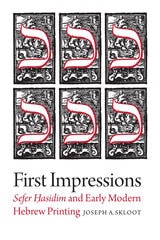
First Impressions
Sefer Hasidim and Early Modern Hebrew PrintingJoseph A. Skloot
Brandeis University Press, 2023
In 1538, a partnership of Jewish silk makers in the city of Bologna published a book entitled Sefer Hasidim, a compendium of rituals, stories, and religious instruction that primarily originated in medieval Franco-Germany. How these men, of Italian and Spanish descent, came to produce a book that would come to shape Ashkenazic culture, and Jewish culture more broadly, over the next four centuries is the basis of this kaleidoscopic study of the history of Hebrew printing in the sixteenth century.
During these early years of printing, the classic works of ancient and medieval Hebrew and Jewish literature became widely available to Jewish (and non-Jewish) readers for the first time. Printing, though, was not merely the duplication and distribution of pre-existing manuscripts, it was the creative adaptation and transformation of those manuscripts by printers. Ranging from Catholic Bologna to Protestant Basel to the Jewish heartland of the Polish-Lithuanian Commonwealth, Joseph A. Skloot uncovers the history of that creativity by examining the first two print editions of Sefer Hasidim. Along the way, he demonstrates how volumes that were long thought to be eternal and unchanging were in fact artifacts of historical agency and contingency, created by and for human beings.
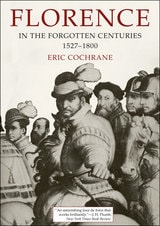
Florence in the Forgotten Centuries, 1527-1800
A History of Florence and the Florentines in the Age of the Grand DukesEric Cochrane
University of Chicago Press, 1976
Eric Cochrane shows that the Florentines maintained their creativity long after they had lost their position as the cultural leaders of Europe. When their political philosophy and historiography ran dry, they turned to the practical problems of civil administration. When their artists finally yielded to outside influence, they turned to music and the natural sciences. Even during the darkest days of the great economic depression of the late seventeenth and early eighteenth centuries, they succeeded in preserving—almost alone in Europe—the blessings of external peace and domestic tranquility.
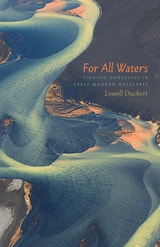
For All Waters
Finding Ourselves in Early Modern WetscapesLowell Duckert
University of Minnesota Press, 2017
Recent years have witnessed a surge in early modern ecostudies, many devoted to Shakespearean drama. Yet in this burgeoning discipline, travel writing appears moored in historicization, inorganic subjects are far less prevalent than organic ones, and freshwater sites are hardly visited. For All Waters explores these uncharted wetscapes.
Lowell Duckert shows that when playwrights and travel writers such as Sir Walter Raleigh physically interacted with rivers, glaciers, monsoons, and swamps, they composed “hydrographies,” or bodily and textual assemblages of human and nonhuman things that dissolved notions of human autonomy and its singular narrativity. With a playful, punning touch woven deftly into its theoretical rigor, For All Waters disputes fantasies of ecological solitude that would keep our selves high and dry and that would try to sustain a political ecology excluding water and the poor. The lives of both humans and waterscapes can be improved simultaneously through direct engagement with wetness.
For All Waters concludes by investigating waterscapes in peril today—West Virginia’s chemical rivers and Iceland’s vanishing glaciers—and outlining what we can learn from early moderns’ eco-ontological lessons. By taking their soggy and storied matters to heart, and arriving at a greater realization of our shared wetness, we can conceive new directions to take within the hydropolitical crises afflicting us today.
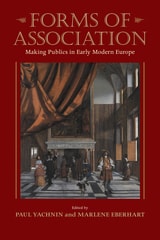
Forms of Association
Making Publics in Early Modern EuropePaul Yachnin
University of Massachusetts Press, 2015
In today's connected and interactive world, it is hard to imagine a time when cultural and intellectual interests did not lead people to associate with others who shared similar views and preoccupations. In this volume of essays, fifteen scholars explore how these kinds of relationships began to transform early modern European culture.
Forms of Association grows out of the “Making Publics: Media, Markets, and Association in Early Modern Europe” (MaPs) project, funded by the Social Sciences and Humanities Research Council of Canada. This scholarly initiative convened an interdisciplinary research team to consider how “publics”—new forms of association built on the shared interests of individuals—developed in Europe from 1500 to 1700. Drawing on a wide array of texts and histories, including the plays of Shakespeare, the legend of Robin Hood, paintings, and music as well as English gossip about France, the contributors develop a historical account of what publics were in early modern Europe. This collaborative study provides a dynamic way of understanding the political dimensions of artistic and intellectual works and opens the way toward a new history of early modernity.
Until his death in 2008, the great Renaissance scholar Richard Helgerson was a key participant in the MaPs project. The scholars featured in this volume originally met in Montreal to engage in a critical, commemorative conversation about Helgerson's work, the issues and questions coming out of the MaPs project, and how Helgerson's thinking advanced and could in turn be advanced by MaPs. This collection represents the fruits of that conversation.
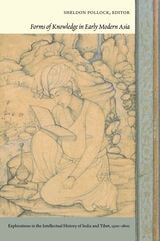
Forms of Knowledge in Early Modern Asia
Explorations in the Intellectual History of India and Tibet, 1500-1800Sheldon Pollock, ed.
Duke University Press, 2011
Contributors. Muzaffar Alam, Imre Bangha, Aditya Behl, Allison Busch, Sumit Guha, Janet Gyatso, Matthew T. Kapstein, Françoise Mallison, Sheldon Pollock, Velcheru Narayana Rao, Kurtis R. Schaeffer, Sunil Sharma, David Shulman, Sanjay Subrahmanyam, Mohamad Tavakoli-Targhi
Forms of Nationhood
The Elizabethan Writing of EnglandRichard Helgerson
University of Chicago Press, 1992
Foundational Arts
Mural Painting and Missionary Theater in New SpainMichael K. Schuessler
University of Arizona Press, 2013
In Foundational Arts Michael K. Schuessler asserts that the literature of New Spain begins with missionary theater and its intimate relationship to mural painting. In particular, he examines the relationships between texts and visual images that emerged in Mexico at two Augustinian monasteries in Hidalgo, Mexico, during the century following the Spanish Conquest. The forced combination of the ideographical tradition of Nahuatl with Latin-based language alphabets led to a fascinating array of new cultural expressions.
Missionary theater was organized by ingenious friars with the intent to convert and catechize indigenous populations. Often performed in Nahuatl or other local languages, the actors combined Latin-based language texts with visual contexts that corresponded to indigenous ways of knowing: murals, architectural ornamentation, statuary, altars, and other modes of visual representation. By concentrating on the interrelationship between mural painting and missionary theater, Foundational Arts explores the artistic and ideological origins of Mexican plastic arts and literature.

Four Years in Izumi
Village Japan in the Early Sixteenth CenturyLee Butler
University of Michigan Press, 2026
Four Years in Izumi takes an in-depth and critical approach to understanding Japanese village life through analysis of the diary of Kujō Masamoto, the former chancellor of the imperial court who resided briefly in one of his provincial estates from 1501 to 1504. For a high ranking courtier to travel to the countryside and manage a family estate was unheard of during the era of Sengoku, the “country at war.” The diary Masamoto kept offers a remarkably rich and vivid portrait of village Japan, which has seen no significant study in English-language scholarship.
Through extensive examination of the diary and close and critical reading of it and complementary sources, Lee Butler provides a window into the inner workings of late-medieval village life that challenges typical portrayals of the period. In Four Years in Izumi, we see the complexity of relations between commoners and elites in action. We also see the ways in which an estate functioned in practice at the heart of the medieval economy and local social structure.
Francesca Caccini at the Medici Court
Music and the Circulation of PowerSuzanne G. Cusick
University of Chicago Press, 2009
Suzanne G. Cusick argues that Caccini’s career depended on the usefulness of her talents to the political agenda of Grand Duchess Christine de Lorraine, Tuscany’s de facto regent from 1606 to 1636. Drawing on Classical and feminist theory, Cusick shows how the music Caccini made for the Medici court sustained the culture that enabled Christine’s power, thereby also supporting the sexual and political aims of its women.
In bringing Caccini’s surprising story so vividly to life, Cusick ultimately illuminates how music making functioned in early modern Italy as a significant medium for the circulation of power.
Fêting the Queen
Civic Entertainments and the Elizabethan ProgressJohn M Adrian
University of Massachusetts Press, 2021
While previous scholars have studied Elizabeth I and her visits to the homes of influential courtiers, Fêting the Queen places a new emphasis on the civic communities that hosted the monarch and their efforts to secure much needed support. Case studies of the cities of Oxford, Canterbury, Sandwich, Bristol, Worcester, and Norwich focus on the concepts of hospitality and space—including the intimate details of the built environment.