Results by title
101 books match the query '1933-1945' and 6 start with f

F. D. R. and the Press
Graham J. White
University of Chicago Press, 1979
White challenges and disproves Roosevelt's contention that the press was unusually severe and slanted in its treatment of the Roosevelt years. His original work traces FDR's hostile assessment of the press to his own political philosophy: an ideology that ordained him a champion of the people, whose task it was to preserve American democracy against the recurring attempt by Hamiltonian minorities (newspaper publishers and captive reporters) to wrest control of their destiny from the masses.
White recounts Roosevelt's initial victory over the press corps, and the effect his wily manipulations had on press coverage of his administrations and on his own public image. He believes Roosevelt's denunciation of the press was less an accurate description of the press's behavior towards his administrations than a product of his own preconceptions about the nature of the Presidency. White concludes that Roosevelt's plan was to disarm those he saw as the foes of democracy by accusing them of unfairly maligning him.
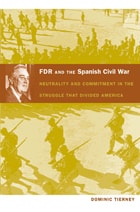
FDR and the Spanish Civil War
Neutrality and Commitment in the Struggle that Divided AmericaDominic Tierney
Duke University Press, 2007
Between 1936 and 1939, Roosevelt’s perceptions of the Spanish Civil War were transformed. Initially indifferent toward which side won, FDR became an increasingly committed supporter of the leftist government. He believed that German and Italian intervention in Spain was part of a broader program of fascist aggression, and he worried that the Spanish Civil War would inspire fascist revolutions in Latin America. In response, Roosevelt tried to send food to Spain as well as illegal covert aid to the Spanish government, and to mediate a compromise solution to the civil war. However unsuccessful these initiatives proved in the end, they represented an important stage in Roosevelt’s emerging strategy to aid democracy in Europe.
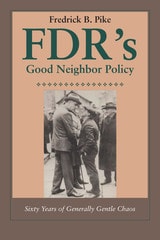
FDR's Good Neighbor Policy
Sixty Years of Generally Gentle ChaosBy Fredrick B. Pike
University of Texas Press, 1995
During the 1930s, the United States began to look more favorably on its southern neighbors. Latin America offered expanded markets to an economy crippled by the Great Depression, while threats of war abroad nurtured in many Americans isolationist tendencies and a desire for improved hemispheric relations.
One of these Americans was Franklin Delano Roosevelt, the primary author of America's Good Neighbor Policy. In this thought-provoking book, Fredrick Pike takes a wide-ranging look at FDR's motives for pursuing the Good Neighbor Policy, at how he implemented it, and at how its themes have played out up to the mid-1990s.
Pike's investigation goes far beyond standard studies of foreign and economic policy. He explores how FDR's personality and Eleanor Roosevelt's social activism made them uniquely simpático to Latin Americans. He also demonstrates how Latin culture flowed north to influence U.S. literature, film, and opera. The book will be essential reading for everyone interested in hemispheric relations.
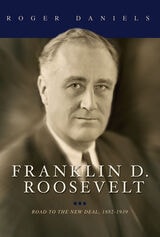
Franklin D. Roosevelt
Road to the New Deal, 1882-1939Roger Daniels
University of Illinois Press, 2015
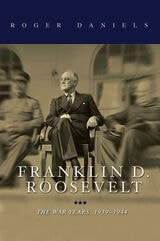
Franklin D. Roosevelt
The War Years, 1939-1945Roger Daniels
University of Illinois Press, 2016

From Racism to Genocide
Anthropology in the Third ReichGretchen E. Schafft
University of Illinois Press, 2007
In paperback for the first time, From Racism to Genocide is an explosive, richly detailed account of how Nazi anthropologists justified racism, developed practical applications of racist theory, and eventually participated in every phase of the Holocaust.
Using original sources and previously unpublished documentation, Gretchen E. Schafft shows the total range of anti-human activity from within the confines of a particular discipline. Based on seven years of archival research in the United States and abroad, the work includes many original photos and documents, most of which have never before been published. It uses primary data and original texts whenever possible, including correspondence written by perpetrators. The book also reveals that the United States was not merely a bystander in this research, but instead contributed professional and financial support to early racial research that continued through the first five years of Hitler’s regime.