193 books match the query '1945-' and 9 start with f
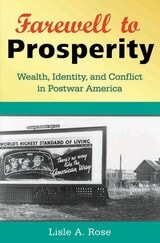
cover of Farewell to Prosperity: Wealth, Identity, and Conflict in Postwar America

Farewell to Prosperity

Wealth, Identity, and Conflict in Postwar America

Lisle A. Rose

University of Missouri Press, 2014
Farewell to Prosperity is a provocative, in-depth study of the Liberal and Conservative forces that fought each other to shape American political culture and character during the nation’s most prosperous years. The tome’s central theme is the bitter struggle to fashion post–World War II society between a historic Protestant Ethic that equated free-market economics and money-making with Godliness and a new, secular Liberal temperament that emerged from the twin ordeals of depression and world war to stress social justice and security.


Liberal policies and programs after 1945 proved key to the creation of mass affluence while encouraging disadvantaged racial, ethnic, and social groups to seek equal access to power. But liberalism proved a zero-sum game to millions of others who felt their sense of place and self progressively unhinged. Where it did not overturn traditional social relationships and assumptions, liberalism threatened and, in the late sixties and early seventies, fostered new forces of expression at radical odds with the mindset and customs that had previously defined the nation without much question.


When the forces of liberalism overreached, the Protestant Ethic and its millions of estranged religious and economic proponents staged a massive comeback under the aegis of Ronald Reagan and a revived Republican Party. The financial hubris, miscalculations, and follies that followed ultimately created a conservative overreach from which the nation is still recovering. Post–World War II America was thus marked by what writer Salman Rushdie labeled in another context “thin-skinned years of rage-defined identity politics.” This “politics” and its meaning form the core of the narrative.


Farewell to Prosperity is no partisan screed enlisting recent history to support one side or another. Although absurdity abounds, it knows no home, affecting Conservative and Liberal actors and thinkers alike.
[more]
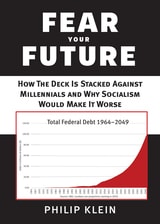
cover of Fear Your Future: How the Deck Is Stacked against Millennials and Why Socialism Would Make It Worse

Fear Your Future

How the Deck Is Stacked against Millennials and Why Socialism Would Make It Worse

Philip Klein

Templeton Press, 2019

It’s become fashionable to demean millennials as the “snowflake” generation. Raised during the peace and prosperity of the ‘90s, they’re often perceived as carrying an entitlement mentality and being incapable of handling adversity. But Philip Klein sees them differently. Given the economic headwinds they faced at the start of their working lives, millennials have shown commendable fortitude.  And as Klein argues, they will need to maintain this character strength going forward because further challenges loom in their future.  

The aftershocks of the Great Recession, the skyrocketing cost of living, and the titanic weight of student loan debt have made the American Dream seem to be forever retreating toward the horizon. As if that weren’t enough, millennials will face the largest federal debt in history as boomers retire and extract trillions of dollars from Social Security and Medicare—far more than they contributed.  

In this concise, data-driven book, Klein begins the work of brightening the future for millennials by analyzing the problem compassionately yet objectively. There are real reasons to worry about what lies ahead if nothing changes. But the facts laid out in Klein’s book can steer the conversation to realistic solutions.


[more]
cover of Flash Effect: Science and the Rhetorical Origins of Cold War America

Flash Effect

Science and the Rhetorical Origins of Cold War America

David J. Tietge

Ohio University Press, 2002

The ways science and technology are portrayed in advertising, in the news, in our politics, and in the culture at large inform the way we respond to these particular facts of life. The better we are at recognizing the rhetorical intentions of the purveyors of information and promoters of mass culture, the more adept we become at responding intelligently to them.

Flash Effect, a startling book by David J. Tietge, documents the manner in which those at the highest levels of our political and cultural institutions conflated the rhetoric of science and technology with the rhetorics of religion and patriotism to express their policies for governance at the onset of the Cold War and to explain them to the American public.

Professor Tietge details our cultural attitudes about science in the early years of the Cold War, when on the heels of a great technological victory Americans were faced with the possibility of destruction by the very weapons that had saved them.

In Flash Effect we learn how, by symbolizing the scientist as both a father figure and a savior—and by celebrating the technological objects of his labor—the campaign to promote science took hold in the American consciousness. The products of that attitude are with us today more than ever.
[more]
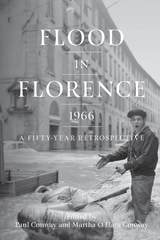
cover of Flood in Florence, 1966: A Fifty-Year Retrospective

Flood in Florence, 1966

A Fifty-Year Retrospective

Paul Conway and Martha O’Hara Conway

Michigan Publishing Services, 2018
On November 4, 1966, the Arno River in Florence, Italy, flooded its banks, breaching the basements and first floors of museums, libraries, and private residences and burying centuries of books, manuscripts, and works of art in muck and muddy water. Flood in Florence, 1966documents a symposium held to mark the 50th anniversary of a natural disaster that served as an impetus for the modern library and museum conservation professions. The proceedings feature illustrated, first-person remembrances of the flood; papers on book conservation, the conservation of works of art, disaster preparedness and response, and the continuing needs for education and training; and a keynote that points toward a future where original artifacts and digital technologies intersect. Providing new insights on a touchstone event by three generations of preservation and conservation professionals, the proceedings deepen our understanding of major advances in conservation practice and shed light on some of the most important lessons from those advances for future generations and the digital age.
[more]
cover of Flowers in the Dustbin: Culture, Anarchy, and Postwar England

Flowers in the Dustbin

Culture, Anarchy, and Postwar England

Neil Nehring

University of Michigan Press, 1993
Flowers in the Dustbin looks at the volatile relations between literature, rock music, and youth subcultures in postwar England. Neil Nehring traces the continuities between the original avant-garde of the twenties and thirties and the postwar youth culture, arguing that anarchism never really disappeared from the world. The author shows that British youth groups like the Mods, the Rockers, Punks, and Teddy Boys and the music that inspired them appear increasingly more acute than their literary counterparts, belying conventional assumptions about the relative powers of "high" and "low" culture. By examining literary texts as part of a larger sampling of cultural forms and their uses in everyday life, Flowers in the Dustbin provides a striking illustration of the significance the field of cultural studies holds for studies in English.
[more]
cover of Follow Your Conscience: The Catholic Church and the Spirit of the Sixties

Follow Your Conscience

The Catholic Church and the Spirit of the Sixties

Peter Cajka

University of Chicago Press, 2021

Peter Cajka’s erudite book shows how even staunch Catholics were transformed by the maelstrom of the American Sixties, turning away from powerful and corrupt institutions and toward the inner moral compass provided by their own consciences.

What is your conscience? Is it, as Peter Cajka asks in this provocative book, “A small, still voice? A cricket perched on your shoulder? An angel and devil who compete for your attention?” Going back at least to the thirteenth century, Catholics viewed their personal conscience as a powerful and meaningful guide to align their conduct with worldly laws. But, as Cajka shows in Follow Your Conscience, during the national cultural tumult of the 1960s, the divide between the demands of conscience and the demands of the law, society, and even the church itself grew increasingly perilous. As growing numbers of Catholics started to consider formerly stout institutions to be morally hollow—especially in light of the Vietnam War and the church’s refusal to sanction birth control—they increasingly turned to their own consciences as guides for action and belief. This abandonment of higher authority had radical effects on American society, influencing not only the broader world of Christianity, but also such disparate arenas as government, law, health care, and the very vocabulary of American culture. As this book astutely reveals, today’s debates over political power, religious freedom, gay rights, and more are all deeply infused by the language and concepts outlined by these pioneers of personal conscience.

[more]
cover of For Might and Right: Cold War Defense Spending and the Remaking of American Democracy

For Might and Right

Cold War Defense Spending and the Remaking of American Democracy

Michael Brenes

University of Massachusetts Press, 2020

How did the global Cold War influence American politics at home? For Might and Right traces the story of how Cold War defense spending remade participatory politics, producing a powerful and dynamic political coalition that reached across party lines. This “Cold War coalition” favored massive defense spending over social welfare programs, bringing together a diverse array of actors from across the nation, including defense workers, community boosters, military contractors, current and retired members of the armed services, activists, and politicians. Faced with neoliberal austerity and uncertainty surrounding America's foreign policy after the 1960s, increased military spending became a bipartisan solution to create jobs and stimulate economic growth, even in the absence of national security threats.

Using a rich array of archival sources, Michael Brenes draws important connections between economic inequality and American militarism that enhance our understanding of the Cold War's continued impact on American democracy and the resilience of the military-industrial complex, up to the age of Donald Trump.
[more]
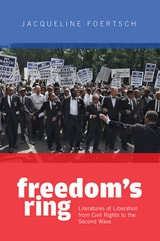
cover of Freedom’s Ring: Literatures of Liberation from Civil Rights to the Second Wave

Freedom’s Ring

Literatures of Liberation from Civil Rights to the Second Wave

Jacqueline Foertsch

Rutgers University Press, 2021

Freedom’s Ring begins with the question of how the American ideal of freedom, which so effectively defends a conservative agenda today, from globally exploitative free trade to anti-French “freedom fries” during the War in Iraq, once bolstered the progressive causes of Freedom Summer, the Free Speech Movement, and more militant Black Power and Women’s Liberation movements with equal efficacy. Focused as it is on the faring of freedom throughout the liberation era, this book also explores attempts made by rights movements to achieve the often competitive or cross-canceling American ideal of equality–economic, professional, and otherwise. Although many struggled and died for it in the civil rights era, freedoms such as the vote, integrated bus rides, and sex without consequences via the Pill, are ultimately free–costing officialdom little if anything to fully implement—while equality with respect to jobs, salaries, education, housing, and health care, will forever be the much more expensive nut to crack. Freedom’s Ring regards the politics of freedom, and politics in general, as a low-cost substitute for and engrossing distraction from substantive economic problem-solving from the liberation era to the present day.
[more]
cover of From Walden Pond to Jurassic Park: Activism, Culture, and American Studies

From Walden Pond to Jurassic Park

Activism, Culture, and American Studies

Paul Lauter

Duke University Press, 2001

Paul Lauter, an icon of American Studies who has been a primary agent in its transformation and its chief ambassador abroad, offers a wide-ranging collection of essays that demonstrate and reflect on this important and often highly politicized discipline. While American Studies was formerly seen as a wholly subsidiary academic program that loosely combined the study of American history, literature, and art, From Walden Pond to Jurassic Park reveals the evolution of an independent, highly interdisciplinary program with distinctive subjects, methods, and goals that are much different than the traditional academic departments that nurtured it.

With anecdote peppered discussions ranging from specific literary texts and movies to the future of higher education and the efficacy of unions, From Walden Pond to Jurassic Park entertains even as it offers a twenty-first century account of how and why Americanists at home and abroad now do what they do. Drawing on his forty-five years of teaching and research as well as his experience as a political activist and a cultural radical, Lauter shows how a multifaceted increase in the United States’ global dominion has infused a particular political urgency into American Studies. With its military and economic influence, its cultural and linguistic reach, the United States is—for better or for worse—too formidable and potent not to be understood clearly and critically.
[more]