Results by title
187 books match the query '1951-' and 11 start with f
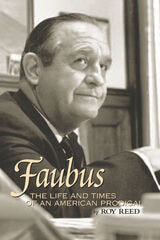
Faubus
The Life and Times of an American ProdigalRoy Reed
University of Arkansas Press, 1999
New York Times Book Review Notable Book for 1997
1998 Certificate of Commendation, American Association for State and Local History

Fawn Island
Douglas Wood
University of Minnesota Press, 2018
Fawn Island is a place where crows serve as alarm clocks, white-throated sparrows leave the tracks of their songs upon the evening hush, and chickadees help a woodsman learn to whistle. The island is also a jumping-off place for journeys large and small, earthly and spiritual-to nearby Mallard Island, Gull Island, or Bald Rock, by sea kayak into the wild recesses of sprawling Voyageurs National Park, or on a midnight paddle in which the paddler can reach the silent wilderness of the stars themselves. In his latest book, best-selling author Douglas Wood guides the reader on a deep journey into the heart of the North Woods.
For Wood, Fawn Island is not merely a charming wilderness hideaway; it is the entry to realms of thought and meaning as well. From its pine-clad shores he probes for insights into the nature of neighborliness and independence, of community and solitude. Out of an ancient Ojibwe legend comes an exploration of personal loss and life after death. Wood questions the notion of being a “force of nature” and the concept of the passage of time in the context of seemingly eternal trees, lakes, rock ledges, and stars. From beneath the ascending trunks of pines comes an inquiry into the principles of optimism and, finally, a personal response to the eternal question: Is the universe a friendly place?
Embedded in the text like roots of the island’s pines is Wood’s gentle, self-effacing humor and the author’s own original pen-and-ink drawings that superbly evoke the poetry and mystery of this “small bit of rock and tree,” this “lucky place” in the wilderness.
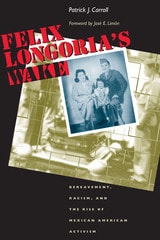
Felix Longoria's Wake
Bereavement, Racism, and the Rise of Mexican American ActivismBy Patrick Carroll
University of Texas Press, 2003
Winner, Tullis Prize, Texas State Historical Association, 2004
Private First Class Felix Longoria earned a Bronze Service Star, a Purple Heart, a Good Conduct Medal, and a Combat Infantryman's badge for service in the Philippines during World War II. Yet the only funeral parlor in his hometown of Three Rivers, Texas, refused to hold a wake for the slain soldier because "the whites would not like it." Almost overnight, this act of discrimination became a defining moment in the rise of Mexican American activism. It launched Dr. Héctor P. García and his newly formed American G.I. Forum into the vanguard of the Mexican civil rights movement, while simultaneously endangering and advancing the career of Senator Lyndon B. Johnson, who arranged for Longoria's burial with full military honors in Arlington National Cemetery.
In this book, Patrick Carroll provides the first fully researched account of the Longoria controversy and its far-reaching consequences. Drawing on extensive documentary evidence and interviews with many key figures, including Dr. García and Mrs. Longoria, Carroll convincingly explains why the Longoria incident, though less severe than other acts of discrimination against Mexican Americans, ignited the activism of a whole range of interest groups from Argentina to Minneapolis. By putting Longoria's wake in a national and international context, he also clarifies why it became such a flash point for conflicting understandings of bereavement, nationalism, reason, and emotion between two powerful cultures—Mexicanidad and Americanism.
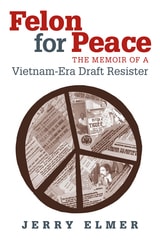
Felon for Peace
The Memoir of a Vietnam-Era Draft ResisterJerry Elmer
Vanderbilt University Press, 2005
This book is a blend of personal memoir, contemporary history, and astute political analysis. Elmer draws on a variety of sources, including never-before-released FBI files, and argues passionately for the practice of nonviolence. He describes the range of actions he took—from draft card burning to organizing draft board raids with Father Phil Berrigan; from vigils on the Capitol steps inside "tiger cages" used to torture Vietnamese political prisoners to jail time for protesting nuclear power plants; from a tour of the killing fields of Cambodia to meetings with Corazon Aquino in the Philippines.
A Vietnamese-language edition of Felon for Peace has also been published.
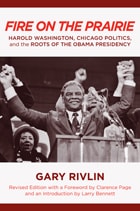
Fire on the Prairie
Harold Washington, Chicago Politics, and the Roots of the Obama PresidencyGary Rivlin
Temple University Press, 2012
Harold Washington’s historic and improbable victory over the vaunted Chicago political machine shook up American politics. The election of the enigmatic yet engaging Washington led to his serving five tumultuous years as the city’s first black mayor. He fashioned an uneasy but potent multiracial coalition that today still stands as a model for political change.
In this revised edition of Fire on the Prairie, acclaimed reporter Gary Rivlin chronicles Washington’s legacy—a tale rich in character and intrigue. He reveals the cronyism of Daley’s government and Washington’s rivalry with Jesse Jackson. Rivlin also shows how Washington’s success inspired a young community organizer named Barack Obama to turn to the electoral arena as a vehicle for change. While the story of a single city, , this political biography is anything but parochial.
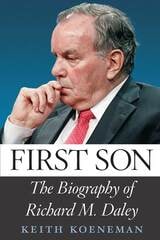
First Son
The Biography of Richard M. DaleyKeith Koeneman
University of Chicago Press, 2013
"Mayor Richard M. Daley dropped the bomb at a routine news conference at City Hall on Tuesday. With no prelude or fanfare, Mr. Daley announced that he would not seek re-election when his term expires next year. 'Simply put, it's time,' he said." New York Times, September 7, 2010
With those four words, an era ended. After twenty-two years, the longest-serving and most powerful mayor in the history of Chicago—and, arguably, America—stepped down, leaving behind a city that was utterly transformed, and a complicated legacy we are only beginning to evaluate.
With Koeneman as our guide, we follow young Daley from his beginnings as an average Bridgeport kid thought to lack his father's talent and charisma to his unlikely transformation into an iron-fisted leader. Daley not only escaped the giant shadow of his father but also transformed Chicago from a gritty, post-industrial Midwestern capital into a beautiful, sophisticated global city widely recognized as a model for innovative metropolises throughout the world.
But in spite of his many accomplishments, Richard M. Daley's record is far from flawless. First Son sets the dramatic improvement of certain parts of the city against the persistent realities of crime, financial stress , failing public housing, and dysfunctional schools. And it reveals that while in many ways Daley broke with the machine politics of his father, he continued to reward loyalty with favors, use the resources of city government to overwhelm opponents, and tolerate political corruption.
A nuanced portrait of a complex man, First Son shows Daley to be sensitive yet tough, impatient yet persistent, a street-smart fighter and detail-driven policy expert who not only ran Chicago, but was Chicago.
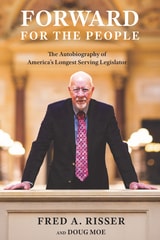
Forward for the People
The Autobiography of America's Longest Serving LegislatorFred A. Risser and Doug Moe
Wisconsin Historical Society Press, 2025
When Fred Risser retired from the Wisconsin Senate in 2021, his sixty-four years in state government made him the longest serving legislator in US history. Now, in this candid and illuminating autobiography, Risser shares his singular perspective on events that transformed the state and the nation over the course of his remarkable career. From his role in the “Joe Must Go” drive to recall US Senator Joseph McCarthy in the 1950s to his position as the senior senator among the “Fab Fourteen” Wisconsin Democrats who opposed Governor Scott Walker’s Act 10 legislation against collective bargaining in 2011, Risser was a leader in state politics for decades, always maintaining an unwavering belief that political action can change people’s lives for the better.
Forward for the People provides a unique peek behind the political curtain from the viewpoint of someone who saw it all. Risser worked with thirteen governors and authored more than 240 bills that became law, championing public health and safety, environmental protection, women’s and reproductive rights, organized labor, civil rights, and social justice, among many other causes. Risser also recounts interactions with prominent national politicians, including Robert La Follette Jr., Hubert Humphrey, Jimmy Carter, and Bill Clinton. More than forty photographs from Risser’s personal collection and the Wisconsin Senate paint a vivid picture of his six-decade journey through Wisconsin politics.
Forward for the People details Risser’s experiences out of state, from a stint in the Panama Canal Zone as a navy hospital corpsman to his undergraduate debate-team days at Minnesota’s Carleton College to his years studying law at the University of Oregon and his travels to all seven continents. The book also depicts the quirky habits that made Risser a memorable and beloved politician: biking his age in miles every birthday and never taking the elevator in his sixty-four years at the Wisconsin State Capitol. Enhanced with details sourced from correspondence, personal notes, newspaper accounts, and recollections from friends and former colleagues, Risser and coauthor Doug Moe have crafted an engaging account of an extraordinary life in public service.
Free Labor
Workfare and the Contested Language of NeoliberalismJohn Krinsky
University of Chicago Press, 2008
At times the fight over workfare unfolded as an argument over who had the authority to define these terms, and in Free Labor, John Krinsky focuses on changes in the language and organization of the political coalitions on either side of the debate. Krinsky’s broadly interdisciplinary analysis draws from interviews, official documents, and media reports to pursue new directions in the study of the cultural and cognitive aspects of political activism. Free Labor will instigate a lively dialogue among students of culture, labor and social movements, welfare policy, and urban political economy.
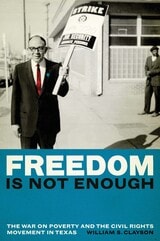
Freedom Is Not Enough
The War on Poverty and the Civil Rights Movement in TexasBy William S. Clayson
University of Texas Press, 2010
Led by the Office of Economic Opportunity, Lyndon Johnson's War on Poverty reflected the president's belief that, just as the civil rights movement and federal law tore down legalized segregation, progressive government and grassroots activism could eradicate poverty in the United States. Yet few have attempted to evaluate the relationship between the OEO and the freedom struggles of the 1960s. Focusing on the unique situation presented by Texas, Freedom Is Not Enough examines how the War on Poverty manifested itself in a state marked by racial division and diversity—and by endemic poverty.
Though the War on Poverty did not eradicate destitution in the United States, the history of the effort provides a unique window to examine the politics of race and social justice in the 1960s. William S. Clayson traces the rise and fall of postwar liberalism in the Lone Star State against a backdrop of dissent among Chicano militants and black nationalists who rejected Johnson's brand of liberalism. The conservative backlash that followed is another result of the dramatic political shifts revealed in the history of the OEO, completing this study of a unique facet in Texas's historical identity.
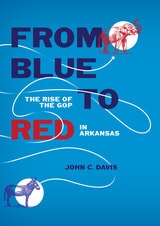
From Blue to Red
The Rise of the GOP in ArkansasJohn C. Davis
University of Arkansas Press, 2024
John C. Davis’s From Blue to Red: The Rise of the GOP in Arkansas provides a rigorous yet accessible study of this partisan shift, tracking changes in voter preference at the top of the ticket in the 1960s, generational replacement in Arkansas’ political power structure in the 1990s, and the emergence of a more nationalized and polarized electorate in the 2000s, among other developments. From Blue to Red is a fascinating look at how Arkansas went from being one of the country’s most solidly Democratic states to one of its most ardently Republican in just a few years.
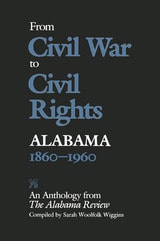
From Civil War to Civil Rights, Alabama 1860–1960
An Anthology from The Alabama ReviewSarah Woolfolk Wiggins
University of Alabama Press, 1987
To understand Alabama history one must appreciate the impact of the failure of secession of the state in the subsequent half century as well as the causes for the success of the Civil Rights Movement in the state in the mid-twentieth century. The prophet of the first revolution was William Lowndes Yancey and the prophet of the second was Martin Luther King, Jr., two Southerners who set in motion forces that shaped American history beyond the borders of the state and region. In the years between their two lives Alabama changed dramatically.
In the new century, progressives had a distinct sense that they could take on outside forces larger than themselves. National currents swept Alabama into movements for the regulation of railroads, women’s suffrage, child labor reform, and welfare capitalism. Still, progressive reform coexisted with the most frightening political and social movement of early twentieth-century Alabama, the Ku Klux Klan, whose blessing or curse made or broke the careers of powerful politicians.