Results by title
1713 books match the query '21st century' and 76 start with f
FUTURE/PRESENT
Arts in a Changing AmericaDaniela Alvarez, Roberta Uno, and Elizabeth M. Webb, editors
Duke University Press, 2024
Selected contributors. Dahlak Brathwaite, adrienne maree brown, Jeff Chang, Tameca Cole, Ofelia Esparza, Antoine Hunter, Nobuko Miyamoto, Wendy Red Star, Spel, Jose Antonio Vargas, Carrie Mae Weems, Hinaleimoana Kwai Kong Wong-Kalu
Failed States and Fragile Societies
A New World Disorder?Ingo Trauschweizer
Ohio University Press, 2014
Since the end of the Cold War, a new dynamic has arisen within the international system, one that does not conform to established notions of the state’s monopoly on war. In this changing environment, the global community must decide how to respond to the challenges posed to the state by military threats, political and economic decline, and social fragmentation. This insightful work considers the phenomenon of state failure and asks how the international community might better detect signs of state decay at an early stage and devise legally and politically legitimate responses.
This collection of essays brings military and social historians into conversation with political and social scientists and former military officers. In case studies from the former Yugoslavia, Somalia, Iraq, and Colombia, the distinguished contributors argue that early intervention to stabilize social, economic, and political systems offers the greatest promise, whereas military intervention at a later stage is both costlier and less likely to succeed.
Contributors: David Carment, Yiagadeesen Samy, David Curp, Jonathan House, James Carter, Vanda Felbab-Brown, Robert Rotberg, and Ken Menkhaus.

Fair Copy
Rebecca Hazelton
The Ohio State University Press, 2012
False Black Power?
Jason L. Riley
Templeton Press, 2017
Black civil rights leaders have long supported ethnic identity politics and prioritized the integration of political institutions, and seldom has that strategy been questioned. In False Black Power?, Jason L. Riley takes an honest, factual look at why increased black political power has not paid off in the ways that civil rights leadership has promised.
Recent decades have witnessed a proliferation of black elected officials, culminating in the historic presidency of Barack Obama. However, racial gaps in employment, income, homeownership, academic achievement, and other measures not only continue but in some cases have even widened. While other racial and ethnic groups in America have made economic advancement a priority, the focus on political capital for blacks has been a disadvantage, blocking them from the fiscal capital that helped power upward mobility among other groups.
Riley explains why the political strategy of civil rights leaders has left so many blacks behind. The key to black economic advancement today is overcoming cultural handicaps, not attaining more political power. The book closes with thoughtful responses from key thought leaders Glenn Loury and John McWhorter.
False Front
The Failed Promise of Presidential Power in a Polarized AgeKenneth Lowande
University of Chicago Press, 2024
A provocative new perspective on presidential power.
Border walls, school bathrooms, student loans, gun control, diversity, abortion, climate change—today, nothing seems out of reach for the president's pen. But after all the press releases, ceremonies, and speeches, shockingly little gets done. The American presidency promises to solve America's problems, but presidents' unilateral solutions are often weak, even empty.
Kenneth Lowande argues this is no accident. The US political system is not set up to allow presidents to solve major policy problems, yet it lays these problems at their doorstep, and there is no other elected official better positioned to attract attention by appearing to govern. Like any politician, presidents are strategic actors who seek symbolic wins. They pursue executive actions, even when they know that these will fail, because doing so allows them to put on a compelling show for key constituencies. But these empty presidential actions are not without their costs: they divert energy from effective government—and, over time, undermine public trust. Drawing on thousands of executive actions, news coverage, interviews, and presidential archives, False Front shows that the real root of presidential power is in what presidents can get away with not doing.

Fang-tastic Fiction
Patricia American Library Association
American Library Association, 2011

Farewell Tangier
Salma El Moumni
Seagull Books, 2026
For Alia, being a teenager in Tangier means constantly facing a gauntlet of unwanted encounters by men in the streets who look her over, grab her, or make comments about her body. At night, in the privacy of her bedroom, Alia begins to take photos of her body in order to understand what those men see when they look at her, becoming her own voyeur. When Alia’s photos somehow end up on the internet, she decides to flee the country, as the photos violate Moroccan law. She seeks refuge in Lyon, France, but is unable to escape the past.
Farewell Tangier is a searing exploration of the male gaze and its potential to shatter a young woman’s life, exploring themes of desire, dissociation, and exile. It is both a feminist critique of the policing of female bodies and an affecting narrative of one young woman’s struggle with her identity.
Fascism Comes to America
A Century of Obsession in Politics and CultureBruce Kuklick
University of Chicago Press, 2022
From the time Mussolini took power in Italy in 1922, Americans have been obsessed with and brooded over the meaning of fascism and how it might migrate to the United States. Fascism Comes to America examines how we have viewed fascism overseas and its implications for our own country. Bruce Kuklick explores the rhetoric of politicians, who have used the language of fascism to smear opponents, and he looks at the discussions of pundits, the analyses of academics, and the displays of fascism in popular culture, including fiction, radio, TV, theater, and film. Kuklick argues that fascism has little informational meaning in the United States, but instead, it is used to denigrate or insult. For example, every political position has been besmirched as fascist. As a result, the term does not describe a phenomenon so much as it denounces what one does not like. Finally, in displaying fascism for most Americans, entertainment—and most importantly film—has been crucial in conveying to citizens what fascism is about. Fascism Comes to America has been enhanced by many illustrations that exhibit how fascism was absorbed into the US public consciousness.
Fast and Furious Franchising
How the Serialized Blockbuster Remade HollywoodDan Hassler-Forest
University of Minnesota Press, 2026
What the popularity of the Fast and Furious film franchise says about Hollywood blockbusters and media production
Fast and Furious Franchising charts the transformation of Hollywood through the story of one of its most successful cinematic universes. Released in 2001, The Fast and the Furious became an unexpected hit, developing into a seven-billion-dollar media franchise with nine direct sequels (so far), one “sidequel,” copious spin-offs, and licensing deals from board games to theme park rides.
Dan Hassler-Forest shows how Fast and Furious paved the way for a new form of serialized storytelling that balanced new distribution practices and expansion into international markets with a savvy awareness of representational politics. By following the series’s development over the past twenty-five years, Fast and Furious Franchising reveals distinct phases that reflect larger media-industrial trends: the postclassical blockbuster era of the early 2000s; the emergence of the megafranchise between 2008 and 2014; the franchise’s “imperial” era, from 2015 through 2019; and the postpandemic crisis era of media saturation and franchise fatigue.
While examining this rapidly changing media landscape, Hassler-Forest offers lively, insightful analyses of the films as they have embraced ever-more-ludicrous plots and unlikely character turns while always maintaining their signature faith in the power of family. As he illuminates the role of the Fast and Furious movies in the global entertainment industry, Hassler-Forest shows how the films’ improbable success proves Dominic Toretto’s adage that, whether “you win by an inch or a mile . . . winning’s winning.”
Retail e-book files for this title are screen-reader friendly with images accompanied by short alt text and/or extended descriptions.
Fast, Easy, and In Cash
Artisan Hardship and Hope in the Global EconomyJason Antrosio and Rudi Colloredo-Mansfeld
University of Chicago Press, 2015
Antrosio and Colloredo-Mansfeld demonstrate how artisan trades evolve in modern Latin American communities. In uncertain economies, small manufacturers have adapted to excel at home-based production, design, technological efficiency, and investments. Vivid case studies illuminate this process: peasant farmers in Túquerres, Otavalo weavers, Tigua painters, and the t-shirt industry of Atuntaqui. Fast, Easy, and In Cash exposes how these ambitious artisans, far from being holdovers from the past, are crucial for capitalist innovation in their communities and provide indispensable lessons in how we should understand and cultivate local economies in this era of globalization.
Fatal Isolation
The Devastating Paris Heat Wave of 2003Richard C. Keller
University of Chicago Press, 2015
Fatal Isolation tells the stories of these victims and the catastrophe that took their lives. It explores the multiple narratives of disaster--the official story of the crisis and its aftermath, as presented by the media and the state; the life stories of the individual victims, which both illuminate and challenge the ways we typically perceive natural disasters; and the scientific understandings of disaster and its management. Fatal Isolation is both a social history of risk and vulnerability in the urban landscape and a story of how a city copes with emerging threats and sudden, dramatic change.

Fear Icons
EssaysKisha Lewellyn Schlegel
The Ohio State University Press, 2018
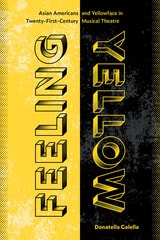
Feeling Yellow
Asian Americans and Yellowface in Twenty-First-Century Musical TheatreDonatella Galella
University of Michigan Press, 2026
Feeling Yellow examines how yellowface has persisted on the contemporary musical stage and how Asian Americans have contested yellowface, as they stake their own claim to the theatrical stage and nation state. Donatella Galella boldly argues that the pleasures of musical theatre and the disavowal of systemic anti-Asian racism enable the ongoing portrayal of Asian and Asian American characters by non-Asian actors. Galella offers two concepts to understand these phenomena: feeling yellow and yellowface without yellowed faces. Feeling yellow encapsulates the racialized anger, despair, and alienation of Asian American artists and audiences. Yellowface without yellowed faces denotes subtle ways of conveying Asianness, such as performing Asianness with exaggerated irony, using racialized costumes rather than yellow skin and slanted eye makeup, and setting musicals in fantasy Asian lands populated by multiracial casts.
Galella utilizes musicals such as Thoroughly Modern Millie, Anything Goes, The Mikado, and Soft Power, to understand how Asian and Asian American representation is connected to larger questions: How does racial identity shape emotional reactions to musical theatre? Why does yellowface and anti-Asian racism persist? What are the terms for Asian Americans belonging in the United States? Using a range of approaches from dramaturgy to auto-ethnography and materials from interviews to Reddit posts, Feeling Yellow spotlights Asian American affect, artistry, and activism.
Feeling the Future at Christian End-Time Performances
Jill Stevenson
University of Michigan Press, 2022
The book’s main focus is contemporary Christian End-Time performances and how they theatrically construct encounters with future time—not just images or ideas of a future, but viscerally and immediately real experiences of future time. Author Jill Stevenson’s examples are Hell Houses and Judgement Houses; Rapture House, a similarly styled “walk through drama” in North Carolina; Hell’s Gates, an “outdoor reality drama” in Dawsonville, Georgia; Ark Encounter, a full-size recreation of Noah’s Ark; and Tribulation Trail, an immersive thirteen-scene drama ministry based on the Book of Revelation. The book’s coda considers similarities between these Christian performances and secular survivalist prepper events, especially with respect to constructions of and language about time. In doing so, the author situates these performances within a larger tradition that challenges traditional secular/sacred distinctions and illuminates how the End Times has been employed in our current social and political moment.
Feminist Post-Liberalism
Judith A. Baer
Temple University Press, 2020
Feminism and liberalism need each other, argues Judith Baer. Her provocative book, Feminist Post-Liberalism, refutes both conservative and radical critiques. To make her case, she rejects classical liberalism in favor of a welfare—and possibly socialist—post-liberalism that will prevent capitalism and a concentration of power that reinforces male supremacy. Together, feminism and liberalism can better elucidate controversies in American politics, law, and society.
Baer emphasizes that tolerance and self-examination are virtues, but within both feminist and liberal thought these virtues have been carried to extremes. Feminist theory needs liberalism's respect for reason, while liberal theory needs to incorporate emotion. Liberalism focuses too narrowly on the individual, while feminism needs a dose of individualism.
Feminist Post-Liberalism includes anthropological foundations of male dominance to explore topics ranging from crime to cultural appropriation. Baer develops a theory that is true to the principles of both feminist and liberal ideologies.
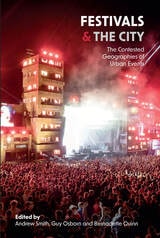
Festivals and the City
The Contested Geographies of Urban EventsAndrew Smith, Guy Osborn, Bernadette Quinn, Andrew Smith, Guy Osborn and Bernadette Quinn
University of Westminster Press, 2022
This book explores how festivals and events affect urban places and public spaces, with a particular focus on their role in fostering inclusion. The ‘festivalisation’ of culture, politics and space in cities is often regarded as problematic, but this book examines the positive and negative ways that festivals affect cities by examining festive spaces as contested spaces. The book focuses on Western European cities, a particularly interesting context given the social and cultural pressures associated with high levels of in-migration and concerns over the commercialisation and privatisation of public spaces.
The key themes of this book are the quest for more inclusive urban spaces and the contested geographies of festival spaces and places. Festivals are often used by municipal authorities to break down symbolic barriers that restrict who uses public spaces and what those spaces are used for. However, the rise of commercial festivals and ticketed events means that they are also responsible for imposing physical and financial obstacles that reduce the accessibility of city parks, streets and squares.
Alongside addressing the contested effects of urban festivals on the character and inclusivity of public spaces, the book addresses more general themes including the role of festivals in culture-led regeneration. Several chapters analyse festivals and events as economic development tools, and the book also covers contested representations of festival cities and the ways related images and stories are used in place marketing.
A range of cases from Western Europe are used to explore these issues, including chapters on some of the world’s most significant and contested festival cities: Venice, Edinburgh, London and Barcelona. The book covers a wide range of festivals, including those dedicated to music and the arts, but also events celebrating particular histories, identities and pastimes. A series of fascinating cases are discussed - from the Venice Biennale and Dublin Festival of History, to Rotterdam’s music festivals and craft beer festivals in Manchester. The diverse and innovative qualities of the book are also evident in the range of urban spaces covered: obvious examples of public spaces – such as parks, streets, squares and piazzas – are addressed, but the book includes chapters on enclosed public spaces (e.g., libraries) and urban blue spaces (waterways) too. This reflects the interpretation of public spaces as socio-material entities: they are produced informally through their use (including for festivals and events), as well as through their formal design and management.

Fi-Sci
Avatars of Science in FictionRhona Trauvitch
The Ohio State University Press, 2026
In Fi-Sci, Rhona Trauvitch melds literary and scientific thought to advance a theory of how narrative, and specifically fictionality, is one of the most powerful tools we have for understanding science, particularly those concepts that defy imagination. Centering her argument on a rhetorical approach to fictionality, she proposes that fiction uniquely offers a means of conceptualizing and understanding perplexing and counterintuitive scientific phenomena, such as recombinant DNA or quantum superposition: Through finding analogous patterns in fiction, we can open up new pathways to understanding. Put another way, our abilities to perceive strange and confounding science phenomena are bolstered and even enabled by our experiences with fiction.
Drawing on a range of theorists such as James Phelan, Gérard Genette, Erwin Schrödinger, and others in her analysis of texts by Jorge Luis Borges, Julio Cortázar, Ursula K. Le Guin, Richard Powers, and many more, Trauvitch shows how literary forms—such as metafiction, metalepsis, and recursion—mirror and clarify complex scientific concepts including genetics, spacetime curvature, and quantum mechanics. In this way, she shows us how fiction is key to unlocking conceptual access to the indiscernible and inconceivable.

Fiction Beyond Secularism
Justin Neuman
Northwestern University Press, 2014
Modernist thinkers once presumed a progressive secularity, with the novel replacing religious texts as society’s moral epics. Yet religion—beginning with the Iranian revolution of 1979, through the collapse of communism, and culminating in the singular rupture of September 11, 2001—has not retreated quietly out of sight.
In Fiction Beyond Secularism, Justin Neuman argues that contemporary novelists who are most commonly identified as antireligious—among them Orhan Pamuk, Salman Rushdie, Ian McEwan, Margaret Atwood, Nadine Gordimer, Haruki Murakami, and J. M. Coetzee—have defied assumptions and have instead written some of the most trenchant critiques of secular ideologies, as well as the most exciting and rigorous inquiries into the legacies of the religious imagination. As a result, many readers (or nonreaders) on either side of the religious divide neglect the insights of works like The Satanic Verses, Disgrace, and Snow. Fiction Beyond Secularism serves as a timely corrective.

Fictions of the Real
Synergies Between Screen and Stage in Argentine PerformanceBrenda Werth
University of Michigan Press, 2026
Brenda Werth’s Fictions of the Real traces the transformation of “the real” and its transnational conceptualization by Argentine artists in the twenty-first century, focusing on artists who engage in both documentary theater and filmmaking. Werth places the work of Lola Arias, Romina Paula, Federico León, Mariano Pensotti, and Grupo Krapp in dialogue with the distinct but intertwined lineages of theater and film, exploring the intermedial dimensions of these artists’ theatrical work, resonances in their documentary films, and the transmedial relationships between their documentary plays and films. Focusing on the dynamic and shifting context of Argentina between 1998 and 2023, a period roughly bookmarked by the economic crisis of 2001 and the COVID-19 pandemic, this book explores how these artists disrupt the relations of power and counter political manipulation with their own evocative fictions of the real as they engage in the roles of translators, curators, researchers, archivists, and collaborators.
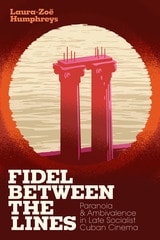
Fidel between the Lines
Paranoia and Ambivalence in Late Socialist Cuban CinemaLaura-Zoë Humphreys
Duke University Press, 2019

Fighting Invisibility
Asian Americans in the MidwestMonica Mong Trieu
Rutgers University Press, 2023
Drawing from in-depth interviews, census data, and cultural productions from Asian Americans in Ohio, Wisconsin, Nebraska, Minnesota, Illinois, Iowa, Indiana, and Michigan, this interdisciplinary research examines how post-1950s Midwest Asian Americans navigate identity and belonging, racism, educational settings, resources within co-ethnic communities, and pan-ethnic cultural community. Their experiences and life narratives are heavily framed by three pervasive themes of spatially defined isolation, invisibility, and racialized visibility.
Fighting Invisibility makes an important contribution to racialization literature, while also highlighting the necessity to further expand the scope of Asian American history-telling and knowledge production.
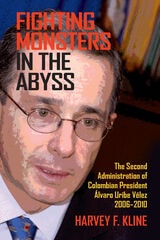
Fighting Monsters in the Abyss
The Second Administration of Colombian President Álvaro Uribe Vélez, 2006–2010Harvey F. Kline
University of Alabama Press, 2015
Studies the complex constraints and trade-offs the second administration of Colombian President Uribe (2006–2010) encountered as it attempted to resolve that nation’s violent Marxist insurrection and to have a more efficient judicial system
Fighting Monsters in the Abyss offers a deeply insightful analysis of the efforts by the second administration of Colombian President Álvaro Uribe Vélez (2006–2010) to resolve a decades-long Marxist insurgency in one of Latin America’s most important nations. Continuing work from his prior books about earlier Colombian presidents and yet written as a stand-alone study, Colombia expert Harvey F. Kline illuminates the surprising successes and setbacks in Uribe’s response to this existential threat.
In State Building and Conflict Resolution in Colombia, 1986–1994, Kline documented and explained the limited successes of Presidents Virgilio Barco and César Gaviria in putting down the revolutionaries while also confronting challenges from drug dealers and paramilitary groups. The following president Andrés Pastrana then boldly changed course and attempted resolution through negotiations, an effort whose failure Kline examines in Chronicle of a Failure Foretold. In his third book, Showing Teeth to the Dragons, Kline shows how in his first term President Álvaro Uribe Vélez more successfully quelled the insurrection through a combination of negotiated demobilization of paramilitary groups and using US backing to mount more effective military campaigns.
Kline opens Fighting Monsters in the Abyss with a recap of Colombia’s complex political history, the development of Marxist rebels and paramilitary groups and their respective relationships to the narcotics trade, and the attempts of successive Colombian presidents to resolve the crisis. Kline next examines the ability of the Colombian government to reimpose rule in rebel-controlled territories as well as the challenges of administering justice. He recounts the difficulties in the enforcement of the landmark Law of Justice and Peace as well as two significant government scandals, that of the “false positives” (“falsos positivos”) in which innocent civilians were killed by the military to inflate the body counts of dead insurgents and a second scandal related to illegal wiretapping.
In tracing Uribe’s choices, strategies, successes, and failures, Kline also uses the example of Colombia to explore a dimension quite unique in the literature about state building: what happens when some members of a government resort to breaking rules or betraying their societies’ values in well-intentioned efforts to build a stronger state?
Fighting Over There
U.S. War Making and Contemporary Refugee LiteratureAlaina Kaus
University of Massachusetts Press, 2023
U.S. foreign policy has long been built on a dichotomy of an irreplaceable “here” and an expendable “there.” In his 2003 announcement of the military campaign in Iraq, George W. Bush declared that we would fight in the Middle East so we wouldn’t have to fight “on the streets of our cities.” But what do the millions of people who live over “there” have to say about U.S. interventions and the displacement they provoke?
In this pathbreaking study, Alaina Kaus analyzes literature by and about refugees who fled Southeast Asia, Central America, the Caribbean, North Africa, and the Middle East, in the wake of U.S. military occupation and economic intervention. Narratives by authors such as Lan Cao, Viet Thanh Nguyen, Demetria Martínez, Héctor Tobar, Dave Eggers, Mohsin Hamid, and Riverbend reveal contradictions in the human rights pledges that undergird U.S. foreign policy, which promote freedom while authorizing intervention and displacement, and favor market-based solutions over social justice and racial equality.

Filipinos Represent
DJs, Racial Authenticity, and the Hip-hop NationAntonio T. Tiongson Jr.
University of Minnesota Press, 2013
The “Hip-hop Nation” has been scouted, staked out, and settled by journalists and scholars alike. Antonio T. Tiongson Jr. steps into this well-mapped territory with questions aimed at interrogating how nation is conceptualized within the context of hip-hop. What happens, Tiongson asks, to notions of authenticity based on hip-hop’s apparent blackness when Filipino youth make hip-hop their own?
Tiongson draws on interviews with Bay Area–based Filipino American DJs to explore the authenticating strategies they rely on to carve out a niche within DJ culture. He shows how Filipino American youth involvement in DJing reconfigures the normal boundaries of Filipinoness predicated on nostalgia and cultural links with an idealized homeland. Filipinos Represent makes the case that while the engagement of Filipino youth with DJ culture speaks to the broadening racial scope of hip-hop—and of what it means to be Filipino—such involvement is also problematic in that it upholds deracialized accounts of hip-hop and renders difference benign.
Looking at the ways in which Filipino DJs legitimize their place in an expressive form historically associated with African Americans, Tiongson examines what these complex forms of identification reveal about the contours and trajectory of contemporary U.S. racial formations and discourses in the post–civil rights era.

Film Nation
Hollywood Looks at U.S. History, Revised EditionRobert Burgoyne
University of Minnesota Press, 2010
Film and Television After 9/11
Edited by Wheeler Winston Dixon
Southern Illinois University Press, 2004
In Film and Television After 9/11, editor Wheeler Winston Dixon and eleven other distinguished film scholars discuss the production, reception, and distribution of Hollywood and foreign films after the terrorist attacks of September 11, 2001, and examine how moviemaking has changed to reflect the new world climate.
While some contemporary films offer escapism, much of mainstream American cinema since 9/11 is centered on the desire for a “just war” in which military reprisals and escalation of warfare appear to be both inevitable and justified. Films of 2002 such as Black Hawk Down, Collateral Damage, and We Were Soldiers demonstrate a renewed audience appetite for narratives of conflict, reminiscent of the wave of filmmaking that surrounded American involvement in World War II.
The attacks on the World Trade Center and the Pentagon galvanized the American public initially, yet film critics wonder how this will play out over time. Film and Television After 9/11 is the first book to provide original insights into topics ranging from the international reception of post-9/11 American cinema, re-viewing films of our shared cinematic past in light of the attacks, and exploring parallels between post-9/11 cinema and World War II-era productions.
Finance in America
An Unfinished StoryKevin R. Brine and Mary Poovey
University of Chicago Press, 2017
To understand finance, however, we have to learn its history, and this book fills that need. Kevin R. Brine, an industry veteran, and Mary Poovey, an acclaimed historian, show that finance as we know it today emerged gradually in the late nineteenth century and only coalesced after World War II, becoming ever more complicated—and ever more central to the American economy. The authors explain the models, regulations, and institutions at the heart of modern finance and uncover the complex and sometimes surprising origins of its critical features, such as corporate accounting standards, the Federal Reserve System, risk management practices, and American Keynesian and New Classic monetary economics. This book sees finance through its highs and lows, from pre-Depression to post-Recession, exploring the myriad ways in which the practices of finance and the realities of the economy influenced one another through the years.
A masterwork of collaboration, Finance in America lays bare the theories and practices that constitute finance, opening up the discussion of its role and risks to a broad range of scholars and citizens.
Finding England
An Auslander's Guide to Perfidious AlbionHolger Ehling
Haus Publishing, 2013
Finding Mecca in America
How Islam Is Becoming an American ReligionMucahit Bilici
University of Chicago Press, 2012

Finding Querencia
Essays from In-BetweenHarrison Candelaria Fletcher
The Ohio State University Press, 2022
With its roots in the Spanish verb querer—“to want, to love”—the term querencia has been called untranslatable but has come to mean a place of safety and belonging, that which we yearn for when we yearn for home. In this striking essay collection, Harrison Candelaria Fletcher shows that querencia is also a state of being: the peace that arises when we reconcile who we are. A New Mexican of mixed Latinx and white ethnicity, Candelaria Fletcher ventures into the fault lines of culture, landscape, and spirit to discover the source of his lifelong hauntings. Writing in the persona of coyote, New Mexican slang for “mixed,” he explores the hyphenated elements within himself, including his whiteness. Blending memory, imagination, form, and language, each essay spirals outward to investigate, accept, and embrace hybridity. Ultimately, Finding Querencia offers a new vocabulary of mixed-ness, a way to reconcile the crosscurrents of self and soul.

Finding the Movement
Sexuality, Contested Space, and Feminist ActivismFinn Enke
Duke University Press, 2007
By considering the development of feminism through an analysis of public space, Enke expands and revises the historiography of second-wave feminism. She suggests that the movement was so widespread because it was built by people who did not identify themselves as feminists as well as by those who did. Her focus on claims to public space helps to explain why sexuality, lesbianism, and gender expression were so central to feminist activism. Her spatial analysis also sheds light on hierarchies within the movement. As women turned commercial, civic, and institutional spaces into sites of activism, they produced, as well as resisted, exclusionary dynamics.
Fire and Ink
An Anthology of Social Action WritingEdited by Frances Payne Adler, Debra Busman, and Diana García
University of Arizona Press, 2009
Fire and Ink brings together, for the first time in one volume, politically engaged writing by poets, fiction writers, and essayists. Including many of our finest writers—Martín Espada, Adrienne Rich, June Jordan, Patricia Smith, Gloria Anzaldúa, Sharon Olds, Arundhati Roy, Sonia Sanchez, Carolyn Forche, Chitra Banerjee Divakaruni, Alice Walker, Linda Hogan, Gary Soto, Kim Blaeser, Minnie Bruce Pratt, Li-Young Lee, and Jimmy Santiago Baca, among others—this is an indispensable collection.
This groundbreaking anthology marks the emergence of social action writing as a distinct field within creative writing and literature. Featuring never-before-published pieces, as well as reprinted material, Fire and Ink is divided into ten sections focused on significant social issues, including identity, sexuality and gender, the environment, social justice, work, war, and peace. The pieces can often be gripping, such as “Frame,” in which Adrienne Rich confronts government and police brutality, or Chris Abani’s “Ode to Joy,” which documents great courage in the face of mortal danger.
Fire and Ink serves as a wonderful reader for a wide range of courses, from composition and rhetoric classes to courses in ethnic studies, gender studies, American studies, and even political science, by facing a past that was often accompanied by injustice and suffering. But beyond that, this collection teaches us that we all have the power to create a more equitable and just future.
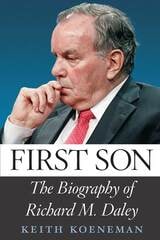
First Son
The Biography of Richard M. DaleyKeith Koeneman
University of Chicago Press, 2013
"Mayor Richard M. Daley dropped the bomb at a routine news conference at City Hall on Tuesday. With no prelude or fanfare, Mr. Daley announced that he would not seek re-election when his term expires next year. 'Simply put, it's time,' he said." New York Times, September 7, 2010
With those four words, an era ended. After twenty-two years, the longest-serving and most powerful mayor in the history of Chicago—and, arguably, America—stepped down, leaving behind a city that was utterly transformed, and a complicated legacy we are only beginning to evaluate.
With Koeneman as our guide, we follow young Daley from his beginnings as an average Bridgeport kid thought to lack his father's talent and charisma to his unlikely transformation into an iron-fisted leader. Daley not only escaped the giant shadow of his father but also transformed Chicago from a gritty, post-industrial Midwestern capital into a beautiful, sophisticated global city widely recognized as a model for innovative metropolises throughout the world.
But in spite of his many accomplishments, Richard M. Daley's record is far from flawless. First Son sets the dramatic improvement of certain parts of the city against the persistent realities of crime, financial stress , failing public housing, and dysfunctional schools. And it reveals that while in many ways Daley broke with the machine politics of his father, he continued to reward loyalty with favors, use the resources of city government to overwhelm opponents, and tolerate political corruption.
A nuanced portrait of a complex man, First Son shows Daley to be sensitive yet tough, impatient yet persistent, a street-smart fighter and detail-driven policy expert who not only ran Chicago, but was Chicago.
First Timers and Old Timers
Kenneth L. Untiedt
University of North Texas Press, 2012
Fistula Politics
Birthing Injuries and the Quest for Continence in NigerHeller, Alison
Rutgers University Press, 2019

Flamboyant Fictions
The Failed Art of PassingIan Fleishman
Northwestern University Press, 2025
Exposes a stylistic tradition of flamboyantly failed passing in queer literature and film
This book posits formal experimentation as an index for evolving expressions of male homosexuality from literary modernism to the German New Wave and the present day. Ian Fleishman exposes a tradition of flamingly failed passing that is itself a surreptitious mode of passing: the flaunting of queer style as an intentionally unconvincing cover for queer content. Exploring a corpus of films and novels by André Gide, Jean Genet, Rainer Werner Fassbinder, Werner Schroeter, François Ozon, and Xavier Dolan, among others, Flamboyant Fictions: The Failed Art of Passing intervenes in trenchant debates about queer agency, visibility, negativity, and disidentification. Mapping queer strategies of storytelling onto queer practices of self-invention, Flamboyant Fictions wagers that it is precisely in instances of conflict between these auteurs and their inventions that narrative becomes a laboratory for testing the sovereignty and self-determination of queer identity.

Flatfish
Poems, A Bilingual EditionMoon Tae-jun
Rutgers University Press, 2026
While Korea is certainly the setting of these poems, the works remain largely free of cultural-specific imagery and are, instead, naturalistic or universal. This first bilingual edition is a critical resource for students, poets, translators, and general readers alike.
English-Korean Bilingual Edition
영-한 이중언어판
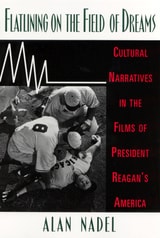
Flatlining on the Field of Dreams
Cultural Narratives in the Films of President Reagan's AmericaNadel, Alan
Rutgers University Press, 1997
-Film Quarterly
"From Back to the Future to Forrest Gump, Nadel shows not only how notions of cinematic time re-script political change but how our very conceptualizations of change are thematized by our experiences of watching movies. This is not simply film history, or film as history, but film affirming "history" in the same way that Ronald Reagan affirmed film narratives."
-Susan Jeffords, University of Washington
"Flatlining on the Field of Dreams brilliantly restages the cultural narratives associated with Reaganism within a neo-imperialist cinematic space and reveals the heretofore unexamined role class played in the reproduction of those narratives."
-Donald E. Pease, Dartmouth College
Flatlining on the Field of Dreams demonstrates, with witty prose and careful analysis, how the overindulgent, image-conscious years of the Reagan administration are reflected in sundry aspects of American films produced during that era. Discussing dozens of films, including Home Alone, Beetlejuice, Ghost, The Little Mermaid, Working Girl, Who Framed Roger Rabbit?, and Trading Places, Alan Nadel identifies narratives about credit, deregulation, gender, race, and masculinity that defined "President Reagan's America." Linking the way Hollywood films work to the stories they tell, he explains how the ideas and values of Reaganism became the symbolic food of a hyper-consumptive society. The book provides hard-to-ignore demonstrations of the extensive synergy between politics, history, and popular culture.
Flood of Images
Media, Memory, and Hurricane KatrinaBy Bernie Cook
University of Texas Press, 2015
Anyone who was not in New Orleans during Hurricane Katrina and the subsequent flooding of the city experienced the disaster as a media event, a flood of images pouring across television and computer screens. The twenty-four-hour news cycle created a surplus of representation that overwhelmed viewers and complicated understandings of the storm, the flood, and the aftermath. As time passed, documentary and fictional filmmakers took up the challenge of explaining what had happened in New Orleans, reaching beyond news reports to portray the lived experiences of survivors of Katrina. But while these narratives presented alternative understandings and more opportunities for empathy than TV news, Katrina remained a mediated experience.
In Flood of Images, Bernie Cook offers the most in-depth, wide-ranging, and carefully argued analysis of the mediation and meanings of Katrina. He engages in innovative, close, and comparative visual readings of news coverage on CNN, Fox News, and NBC; documentaries including Spike Lee’s When the Levees Broke and If God Is Willing and Da Creek Don’t Rise, Tia Lessin and Carl Deal’s Trouble the Water, and Dawn Logsdon and Lolis Elie’s Faubourg Treme; and the HBO drama Treme. Cook examines the production practices that shaped Katrina-as-media-event, exploring how those choices structured the possible memories and meanings of Katrina and how the media’s memory-making has been contested. In Flood of Images, Cook intervenes in the ongoing process of remembering and understanding Katrina.

Flourish
Dora Malech
Carnegie Mellon University Press, 2020
Here, the lens zooms in and out to micro and macro levels, asking us to see the familiar with new eyes. The collection engages with the materials of the worlds we inhabit—natural worlds and those of our own making—and a full spectrum of poetry’s own materials, building worlds of words and illuminating the shadowed terrain of our interior landscapes as well.

Flows of Violence
Water, Infrastructures, and the State in Buenaventura, ColombiaFelipe Fernández
University of Arizona Press, 2025
Flows of Violence offers a profound ethnographic exploration of the intricate relationship between violence and water infrastructure in one of Colombia’s most marginalized cities. This groundbreaking work engages with the concept of “infrastructural violence,” revealing how the Colombian state’s neglect and inadequate provision of water services perpetuate inequality and suffering among Buenaventura’s residents. Through extensive fieldwork, Fernández provides rich empirical data and firsthand accounts that bring to light the daily struggles and resilience of the city’s inhabitants.
The book critically examines how everyday crime and state neglect intersect, altering the improvised practices of water storage and access among the population. It also highlights the innovative mechanisms employed by social movements and ordinary citizens to cope with and resist these challenges.
Flows of Violence is an essential read for scholars in anthropology, geography, and Latin American studies, offering valuable insights into the sociopolitical impacts of infrastructure. This timely contribution underscores the urgent need for equitable infrastructure development and social justice, making it a pivotal text for understanding urban poverty and state dynamics in Latin America and beyond.
Fluid New York
Cosmopolitan Urbanism and the Green ImaginationMay Joseph
Duke University Press, 2013
Joseph considers New York's relation to the water that surrounds and defines it. Her reflections reach back to the city's heyday as a world-class port—a past embodied in a Dutch East India Company cannon recently unearthed from the rubble at the World Trade Center site—and they encompass the devastation caused by Hurricane Sandy in 2012. They suggest that New York's future lies in the reclamation of its great water resources—for artistic creativity, civic engagement, and ecological sustainability.
Folklore in the Public Square
How the Study of Traditional Culture Can Solve Contemporary Social ProblemsAndrea Kitta
Utah State University Press, 2026
Folklore is often positioned at the center of critical social issues. While folklorists have acknowledged this power and explored how folklore has been used for political ends, far less attention has been paid to the role folklorists and folklore scholarship can play in addressing contemporary social issues in public discourse. Folklore in the Public Square explores how folklorists apply their research to engage general audiences and address the challenging issues we face daily.
Folklore in the Public Square brings together folklorists working in the humanities and the social sciences committed to applying their research to help solve contemporary social challenges, formalizing an undercurrent of thought that has gained growing attention. Case studies apply ethical research to address pervasive questions about the environment, poverty, health and healthcare, political partisanship, war, tourism, stigma, racism, and conspiracy theories, among others. Building on conversations raised by folklorists who have contributed to public programming or conducted collaborative research in local communities, this book appeals to anyone interested in contemporary social issues, applied research, or collaborative and ethical fieldwork.
For Money and Elders
Ritual, Sovereignty, and the Sacred in KenyaRobert W. Blunt
University of Chicago Press, 2019
In For Money and Elders, Robert W. Blunt addresses these questions by turning to the political, economic, and religious signs in circulation in Kenya today. He examines how Kenyans attempt to make sense of political instability caused by the uncertainty of authority behind everything from currency to title deeds. When the symbolic order of a society is up for grabs, he shows, violence may seem like an expedient way to enforce the authority of signs. Drawing on fertile concepts of sovereignty, elderhood, counterfeiting, acephaly, and more, Blunt explores phenomena as diverse as the destabilization of ritual “oaths,” public anxieties about Satanism with the advent of democratic reform, and mistrust of official signs. The result is a fascinating glimpse into Kenya’s past and present and a penetrating reflection on meanings of violence in African politics.
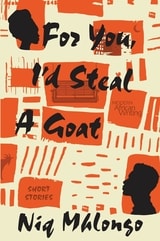
For You, I'd Steal a Goat
Short StoriesNiq Mhlongo
Ohio University Press, 2025
For You, I’d Steal a Goat is a vibrant collection of short stories filled with memorable characters, intriguing plots, and twist endings. It explores a wide range of themes, such as corruption, racial bias, family troubles, and lovers’ spats, to name a few. In his stories about queer relationships, Niq Mhlongo surfaces the complexities of a community whose narratives have been silenced. With his keen observations and insights into human nature, Mhlongo explores the things that people do for each other, but also to each other, including acts of injustice and exploitation as well as of love and desire. Mhlongo’s stories are critical, erudite, and masterfully crafted using satire and careful deliberation to connect to the quotidian lived experiences of readers. With a sense of humor, Mhlongo reflects on some of the greatest transformations South Africans have faced in recent times and engages with crucial matters in the present.
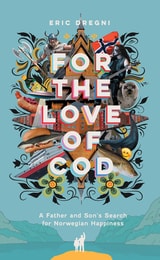
For the Love of Cod
A Father and Son's Search for Norwegian HappinessEric Dregni
University of Minnesota Press, 2021
A journey to find Norway’s supposed bliss makes for a comic travelogue that asks, seriously, what makes Norwegians so damn happy—and does it translate?
Norway is usually near or at the top of the World Happiness Report. But is it really one of the happiest countries on Earth? Eric Dregni had his doubts. Years ago he and his wife had lived in this country his great-great-grandfather once fled. When their son Eilif was born there, the Norwegian government paid for the birth, gave them $5,000, and deposited $150 into their bank account every month, but surely happiness was more than a generous health care system. What about all those grim months without sun? When Eilif turned fifteen, father and son decided to go back together and investigate. For the Love of Cod is their droll report on the state of purported Norwegian bliss.
Arriving in May, a month of festivals and eternal sun, the Dregnis are thrust into Norway at its merriest—and into the reality of the astronomical cost of living, which forces them to find lodging with friends and relatives. But this gives them an inside look at the secrets to a better life. It’s not the massive amounts of money flowing from the North Sea oil fields but how these funds are distributed that fuels the Norwegian version of democratic socialism—resulting in miniscule differences between rich and poor. Locals introduce them to the principles underlying their avowed contentment, from an active environmentalism that translates into flyskam (flight shame), which keeps Norwegians in the family cabin for the long vacations prescribed by law and charges a 150 percent tax on gas guzzlers (which, Eilif observes, means more Teslas seen in one hour than in a year in Minnesota!).
From a passion for dugnad or community volunteerism and sakte or “slow,” a rejection of the mad pace of modernity, to the commodification of Viking history and the dark side of Black Metal music that turns the idea of quaint, traditional Norway upside down, this idiosyncratic father and son tour lets readers, free of flyskam, see how, or whether, Norwegian happiness translates.
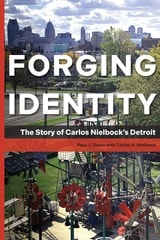
Forging Identity
The Story of Carlos Nielbock's DetroitPaul J Draus
Michigan State University Press, 2025
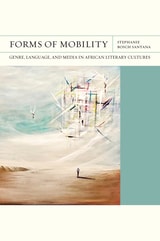
Forms of Mobility
Genre, Language, and Media in African Literary CulturesStephanie Bosch Santana
Northwestern University Press, 2025
Presents alternative categories of fiction through which to examine how contemporary writers have envisaged Africa’s changing literary terrains
Stephanie Bosch Santana analyzes southern African writers’ experimentations with literary form in periodical print and digital media since the mid-twentieth century in order to offer an alternative account of contemporary African imaginations of mobility. Based on an understudied archive of texts in English and Chichewa/Nyanja from Malawi, South Africa, Zimbabwe, and Zambia, Forms of Mobility: Genre, Language, and Media in African Literary Cultures examines new, noncanonical categories of fiction, including migrant forms, township tales, weekend stories, and digital diaries. These generically, linguistically, and geographically mobile forms map changing ideas of interconnection and belonging. By reading them “in motion,” as they travel across space, time, genre, and language and between publications and platforms, Bosch Santana limns multiple centers of literary influence and relation across southern African and Black diasporas, revealing forms of literary mobility and space making that are occluded by current models of world literature.

Four Quartets
Poetry in the PandemicEdited by Jeffrey Levine and Kristina Marie Darling
Tupelo Press, 2020
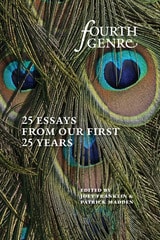
Fourth Genre
Twenty-Five Essays from Our First Twenty-Five YearsJoey Franklin
Michigan State University Press, 2025