Results by title
57 books match the query 'AIDS & HIV' and 3 start with f

Fatal Advice
How Safe-Sex Education Went WrongCindy Patton
Duke University Press, 1996
There is the official story, and then there is another, involving local groups and AIDS activists. Going back to early government and activist attempts to spread information, Patton traces a slow separation between official advice and that provided by those on the front lines in the battle against AIDS. She shows how American anxieties about teen sex played into the nation’s inadequate education and protection of its young people, and chronicles the media’s attempts to encourage compassion without broaching the touchy subject of sex or disrupting the notion that AIDS was a disease of social and sexual outcasts. Her overview of the relationship between shifting medical perceptions and safe-sex advice reveals why radical safe-sex educators eventually turned to sexually explicit, including pornographic, representations to spread their message—and why even these extreme tactics could not overcome the misguided national teaching on AIDS.
Patton closes with a stirring manifesto, an urgent call to action for all those who do not want to see the hard lessons of AIDS education and activism wasted, or, with these lessons, the loss of so many more lives.
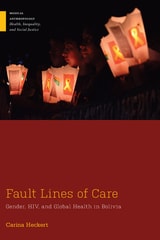
Fault Lines of Care
Gender, HIV, and Global Health in BoliviaHeckert, Carina
Rutgers University Press, 2018
The HIV epidemic in Bolivia has received little attention on a global scale in light of the country’s low HIV prevalence rate. However, by profiling the largest city in this land-locked Latin American country, Carina Heckert shows how global health-funded HIV care programs at times clash with local realities, which can have catastrophic effects for people living with HIV who must rely on global health resources to survive. These ethnographic insights, as a result, can be applied to AIDS programs across the globe.
In Fault Lines of Care, Heckert provides a detailed examination of the effects of global health and governmental policy decisions on the everyday lives of people living with HIV in Santa Cruz. She focuses on the gendered dynamics that play a role in the development and implementation of HIV care programs and shows how decisions made from above impact what happens on the ground.

Forget Burial
HIV Kinship, Disability, and Queer/Trans Narratives of CareMarty Fink
Rutgers University Press, 2021
Queers and trans people in the 1980s and early ‘90s were dying of AIDS and the government failed to care. Lovers, strangers, artists, and community activists came together take care of each other in the face of state violence. In revisiting these histories alongside ongoing queer and trans movements, this book uncovers how early HIV care-giving narratives actually shape how we continue to understand our genders and our disabilities. The queer and trans care-giving kinships that formed in response to HIV continue to inspire how we have sex and build chosen families in the present. In unearthing HIV community newsletters, media, zines, porn, literature, and even vampires, Forget Burial bridges early HIV care-giving activisms with contemporary disability movements. In refusing to bury the legacies of long-term survivors and of those we have lost, this book brings early HIV kinships together with ongoing movements for queer and trans body self-determination.