313 books match the query 'Administration' and 9 start with f
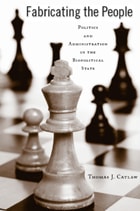
cover of Fabricating the People: Politics and Administration in the Biopolitical State

Fabricating the People

Politics and Administration in the Biopolitical State

Thomas J. Catlaw

University of Alabama Press, 2012

Fabricating the People boldly proposes post-representational governance that reframes the practice of modern democracy and reinvents the role of public administration.
Since the 1960s, hostility and mistrust toward the U.S. government has risen precipitously. At the same time, the field of public administration has wrestled with its own crisis of legitimacy. What is at the root of current antigovernment sentiment? Conventionally, two explanations for this problem persist. Some see it primarily in moral terms, a deficit of Constitutional or democratic values in government. Others emphasize government’s performance failures and managerial inefficiency.

Thomas J. Catlaw departs from both explanations in this groundbreaking study and demonstrates that the current crisis of government originates in the uncritical manner in which we have accepted the idea of “the People.” He contends that this unifying, foundational concept—and the notion of political representation it entails—have failed. While illuminating some of our most pressing social and political problems, Catlaw shows how the idea of the People, far from serving to unify, relies in fact on a distinctive logic of exclusion. True political power is the power to determine what constitutes the normal, natural life of the electorate. Today, the exclusionary practices that once made up or fabricated the People are increasingly contested. In turn, government and political power now appear more invasive, less legitimate, and our shared reality appears more fragmented and disconnected.

In order to address this crisis and reinvigorate democracy, Catlaw argues, we must accept as bankrupt the premise of the People and the idea of representation itself. Fabricating the People boldly proposes post-representational governance that reframes the practice of modern democracy and reinvents the role of public administration.

[more]
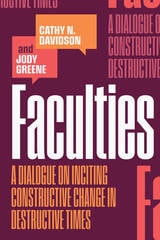
cover of Faculties: A Dialogue on Inciting Constructive Change in Destructive Times

Faculties

A Dialogue on Inciting Constructive Change in Destructive Times

Cathy N. Davidson and Jody Greene

Duke University Press, 2026

Faculties is a call to action, a sourcebook, and a how-to guide for academic colleagues who want to contribute to the administrative and educational decisions being made about the future of our institutions. There is no going back to the version of US higher education that existed a couple of decades or even a couple of years ago. Cathy N. Davidson and Jody Greene encourage faculty and allies to incite and participate in change, offering models of successful, constructive collaboration at a destructive and demoralizing time for higher education. Presented in the form of dialogues between Davidson and Greene, two of higher education’s most innovative leaders, Faculties focuses on the urgency of coalition building, providing data and analyses of the structural, financial, ideological, and organizational circumstances that can support or inhibit productive change in colleges, universities, and research institutions. Faculties retains a welcoming, conversational tone while incorporating extensive references and citations and addressing drastic changes to higher education, offering the evidence and inspiration needed to enact institutional transformation now.
[more]
cover of Failing the Future: A Dean Looks at Higher Education in the Twenty-first Century

Failing the Future

A Dean Looks at Higher Education in the Twenty-first Century

Annette Kolodny

Duke University Press, 1998

Both revealing and compelling, Annette Kolodny’s Failing the Future: A Dean Looks at Higher Education in the Twenty-first Century is drawn from the author’s experience as a distinguished teacher, a prize-winning scholar of American literature, a feminist thinker, and an innovative administrator at a major public university. In chapters that range from the changing structure of the American family and its impact on both curriculum and university benefits policies to recommendations for overhauling the culture of decision making on campus, this former Dean of the College of Humanities at the University of Arizona explores the present state of higher education and offers a sobering view of what lies ahead.
In this volume Kolodny explains the reasons for the financial crisis in higher education today and boldly addresses the challenges that remain ignored, including rising birthrates, changing demographics both on campus and across the country, the accelerating globalization of higher education and advanced research, and the necessity for greater interdisciplinarity in undergraduate education. Moreover, while sensitive to the complex burdens placed on faculty today, Kolodny nonetheless reveals how the professoriate has allowed itself to become vulnerable to public misperceptions and to lampooning by the media.
Not simply a book about current problems and future challenges, Failing the Future is rich with practical solutions and workable programs for change. Among her many insights, Kolodny offers a thorough defense of the role of tenure and outlines a new set of procedures to ensure its effective implementation; she proposes a structure for an “Antifeminist Intellectual Harassment Policy”; and she provides a checklist of family-sensitive policies universities can offer their staff, faculty, and administrators. Kolodny calls on union leaders, campus communities, policymakers, and the general public to work together in unprecedented partnerships. Her goal, as she states in a closing coda, is to initiate a revitalized conversation about public education.
This book should be required reading for all those concerned with the future of higher education in this country—from college trustees to graduate students entering the professoriate, from faculty to university administrators, from officers of campus-based unions to education policymakers.

[more]
cover of Feeding the Future: School Lunch Programs as Global Social Policy

Feeding the Future

School Lunch Programs as Global Social Policy

Rutledge, Jennifer Geist

Rutgers University Press, 2016

A century ago, only local charities existed to feed children. Today 368 million children receive school lunches in 151 countries, in programs supported by state and national governments. In Feeding the Future, Jennifer Geist Rutledge investigates how and why states have assumed responsibility for feeding children, chronicling the origins and spread of school lunch programs around the world, starting with the adoption of these programs in the United States and some Western European nations, and then tracing their growth through the efforts of the World Food Program.
 
The primary focus of Feeding the Future is on social policy formation: how and why did school lunch programs emerge? Given that all countries developed education systems, why do some countries have these programs and others do not? Rutledge draws on a wealth of information—including archival resources, interviews with national policymakers in several countries, United Nations data, and agricultural statistics—to underscore the ways in which a combination of ideological and material factors led to the creation of these enduringly popular policies. She shows that, in many ways, these programs emerged largely as an unintended effect of agricultural policy that rewarded farmers for producing surpluses. School lunches provided a ready outlet for this surplus. She also describes how, in each of the cases of school lunch creation, policy entrepreneurs, motivated by a commitment to alleviate childhood malnutrition, harnessed different ideas that were relevant to their state or organization in order to funnel these agricultural surpluses into school lunch programs.  
 
The public debate over how we feed our children is becoming more and more politically charged. Feeding the Future provides vital background to these debates, illuminating the history of food policies and the ways our food system is shaped by global social policy.  
 
[more]
cover of Football U.: Spectator Sports in the Life of the American University

Football U.

Spectator Sports in the Life of the American University

J. Douglas Toma

University of Michigan Press, 2003

The Big Ten . . . the SEC . . . the Final Four . . . sometimes it seems that American higher education is more about sports than studies. Not so, says this well-researched, evenhanded study of athletics in university life. Sports--particularly football--play a key role in defining institutions that might otherwise be indistinguishable and are an indispensable tool in building a sense of community on campus, as well as an important factor in mustering alumni and political support. While abuses exist, the "football school" is not only a legitimate member of the academic community but an inevitable one as well--and football provides much-needed identity at every level from the local to the national scale. Pointing out that universities compete as much academically as athletically, J. Douglas Toma argues that fielding a winning sports team is a quick, effective way to win recognition and that doing so pays dividends across the board, by raising public awareness (thereby making a school more attractive to potential students and faculty) and by creating a wider constituency of "fans" whose loyalties pay off in increased contributions and appropriations that support academic programs as well. He notes that universities like Harvard and Yale, now eclipsed on the gridiron, were "football powers" in the era when America's westward expansion spawned new schools unable to challenge older institutions academically but able to win acclaim through sports. This fosters a campus and alumni culture based on "football Saturday"--a bonding experience that helped forge a larger community whose support, both personal and financial, has become integral to the life of the institution. Football U. brings welcome impartiality to a subject all too often riven by controversy, pitting football boosters against critics who complain that academic achievement takes second place to athletic success. But as a tool for creating "brand awareness" as well as local loyalty and widespread support, high-profile athletic programs meet a variety of institutional needs in ways no other aspect of university life can. This, Toma observes, is a two-edged sword, for even as it fosters collegiality, it discourages reform when the pendulum swings too far in the direction of athletic dominance. Nevertheless, Football U. is here to stay. J. Douglas Toma is Director and Senior Fellow, The Executive Doctorate and Penn Center for Higher Education Management, the University of Pennsylvania's Graduate School of Education.
[more]
cover of From Class to Identity: The politics of education reforms in former Yugoslavia

From Class to Identity

The politics of education reforms in former Yugoslavia

Jana Bacevic

Central European University Press, 2014

Jana Bacevic provides an innovative analysis of education policy-making in the processes of social transformation and post-conflict development in the Western Balkans. Based on case studies of educational reform in the former Yugoslavia - from the decade before its violent breakup to contemporary efforts in post-conflict reconstruction - From Class to Identity tells the story of the political processes and motivations underlying each reform.The book moves away from technical-rational or prescriptive approaches that dominate the literature on education policy-making during social transformation, and offers an example on how to include the social, political and cultural context in the understanding of policy reforms. It connects education policy at a particular time in a particular place with broader questions such as: What is the role of education in society? What kind of education is needed for a 'good' society? Who are the 'targets' of education policies (individuals/citizens, ethnic/religious/linguistic groups, societies)? Bacevic shows how different answers to these questions influence the contents and outcomes of policies.
[more]
cover of From Vermont to Michigan: Correspondence of James Burrill Angell: 1869-1871

From Vermont to Michigan

Correspondence of James Burrill Angell: 1869-1871

Edited by Wilfred B. Shaw

University of Michigan Press, 1936
From Vermont to Michigan: Correspondence of James Burrill Angell 1869-1871 is a collection of letters edited by Wilfred B. Shaw and published by the University of Michigan Press in 1936. The book provides a detailed account of James Burrill Angell's decision-making process before accepting the presidency of the University of Michigan. It includes correspondence with various individuals, including insights from his son James Rowland Angell in a foreword, capturing Angell's qualities, the consideration of educational standards, and the influence of the New England perspective on the Western frontier. The letters reveal the intricate process and diverse opinions surrounding Angell's eventual acceptance, as well as the initial hesitations and the search for the right candidate. Illustrated and meticulously edited, this compilation serves as a significant historical document, shedding light on the educational landscape of the time and Angell's pivotal role in shaping the future of the University of Michigan.
[more]
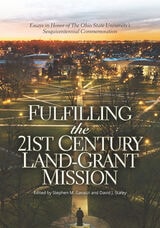
cover of Fulfilling the 21st Century Land-Grant Mission: Essays in Honor of The Ohio State University’s Sesquicentennial Commemoration

Fulfilling the 21st Century Land-Grant Mission

Essays in Honor of The Ohio State University’s Sesquicentennial Commemoration

Edited by Stephen M. Gavazzi and David J. Staley

The Ohio State University Press, 2020

Over the past 150 years, land-grant universities—America’s first public institutions of higher learning—have had a profound impact on the well-being of our nation. Founded by the 1862 Morrill Land Grant Act and signed into law by President Abraham Lincoln, land-grant universities were given a three-part mission: to teach, to conduct research, and to engage communities across each state in order to meet their localized needs.
Gathered in honor of The Ohio State University’s sesquicentennial celebration, this collection of essays highlights the significant contributions that Ohio State continues to make as part of its twenty-first-century land-grant mission. Authors from across the university—representing fields as various as agriculture, dance, English, engineering, family science, geography, medicine, social work, and veterinary science—provide contributions that highlight the preeminent status of The Ohio State University. In addition, the perspectives of alumni, staff members, and senior administrators (both present and former) round out the picture of Ohio State as the first among equals regarding its land-grant peers. Overall, contributors draw on rich and varied institutional backgrounds to offer invaluable insights for higher education administrators and scholars across the US.
 
[more]
cover of Fundamentals of School Library Media Management

Fundamentals of School Library Media Management

Barbara Stein Martin

American Library Association, 2009

[more]