Results by title
312 books match the query 'African American authors' and 17 start with f
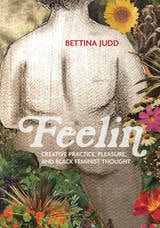
Feelin
Creative Practice, Pleasure, and Black Feminist ThoughtBettina Judd
Northwestern University Press, 2023
How creativity makes its way through feeling—and what we can know and feel through the artistic work of Black women
Feeling is not feelin. As the poet, artist, and scholar Bettina Judd argues, feelin, in African American Vernacular English, is how Black women artists approach and produce knowledge as sensation: internal and complex, entangled with pleasure, pain, anger, and joy, and manifesting artistic production itself as the meaning of the work. Through interviews, close readings, and archival research, Judd draws on the fields of affect studies and Black studies to analyze the creative processes and contributions of Black women—from poet Lucille Clifton and musician Avery*Sunshine to visual artists Betye Saar, Joyce J. Scott, and Deana Lawson.
Feelin: Creative Practice, Pleasure, and Black Feminist Thought makes a bold and vital intervention in critical theory’s trend toward disembodying feeling as knowledge. Instead, Judd revitalizes current debates in Black studies about the concept of the human and about Black life by considering how discourses on emotion as they are explored by Black women artists offer alternatives to the concept of the human. Judd expands the notions of Black women’s pleasure politics in Black feminist studies that include the erotic, the sexual, the painful, the joyful, the shameful, and the sensations and emotions that yet have no name. In its richly multidisciplinary approach, Feelin calls for the development of research methods that acknowledge creative and emotionally rigorous work as productive by incorporating visual art, narrative, and poetry.
Fictions of Land and Flesh
Blackness, Indigeneity, SpeculationMark Rifkin
Duke University Press, 2019
Flight Lines
A Poetics of Black SpaceElleza Kelley
Duke University Press, 2026
Folklore in New World Black Fiction
Writing and the Oral Traditional AestheticsChiji Akoma
The Ohio State University Press, 2007
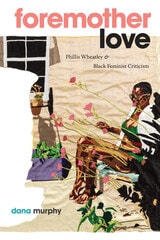
Foremother Love
Phillis Wheatley and Black Feminist CriticismDana Murphy
Duke University Press, 2025
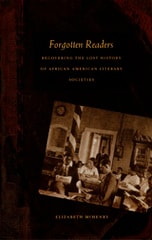
Forgotten Readers
Recovering the Lost History of African American Literary SocietiesElizabeth McHenry
Duke University Press, 2002
Forgotten Readers expands our definition of literacy and urges us to think of literature as broadly as it was conceived of in the nineteenth century. Elizabeth McHenry delves into archival sources, including the records of past literary societies and the unpublished writings of their members. She examines particular literary associations, including the Saturday Nighters of Washington, D.C., whose members included Jean Toomer and Georgia Douglas Johnson. She shows how black literary societies developed, their relationship to the black press, and the ways that African American women’s clubs—which flourished during the 1890s—encouraged literary activity. In an epilogue, McHenry connects this rich tradition of African American interest in books, reading, and literary conversation to contemporary literary phenomena such as Oprah Winfrey’s book club.
Frames of Friction
Black Genealogies, White Hegemony, and the Essay as Critical InterventionCarsten Junker
Campus Verlag, 2010
In Frames of Friction, Carsten Junker maps out a dazzling panorama of critical cultural debatesfrom the twentieth century to explore the ways in which African American speakers and writers established their authority and gained recognition. Taking into account the latest ideas from gender studies and African American studies, as well as current essay theory, Junker juxtaposes the ways in which African American authors and speakers from the 1920s to the 1970s debated critical topics with their white and Jewish contemporaries in order to emphasize the dialogic nature of the essay form. Ultimately, Junker hones in on the genre of essay itself, arguing that it is repeatedly questioned and reconstituted during times of social change.

Freedom with Violence
Race, Sexuality, and the US StateChandan Reddy
Duke University Press, 2011
Freud Upside Down
African American Literature and Psychoanalytic CultureBadia Sahar Ahad
University of Illinois Press, 2010

From Behind the Veil
A STUDY OF AFRO-AMERICAN NARRATIVERobert B. Stepto
University of Illinois Press, 1991

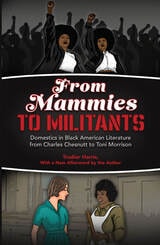
From Mammies to Militants
Domestics in Black American Literature from Charles Chesnutt to Toni MorrisonTrudier Harris
University of Alabama Press, 2023
From Charles Chesnutt’s The Marrow of Tradition to Toni Morrison’s The Bluest Eye, Black writers, some of whom worked as maids themselves, have manipulated the stereotype in a strategic way as a figure to comment on Black-white relations or to dramatize the conflicts of the Black protagonists. In fact, the characters themselves, like real-life maids, often use the stereotype to their advantage or to trick their oppressors.
Harris combines folkloristic, sociological, historical, and psychological analyses with literary ones, drawing on her own interviews with Black women who worked as domestics. She explores the differences between Northern and Southern maids and between “mammy” and “militant.” Her invaluable book provides a sweeping exploration of Black American writers of the twentieth century, with extended discussion of works by Charles Chesnutt, Kristin Hunter, Toni Morrison, Richard Wright, Ann Petry, William Melvin Kelley, Alice Childress, John A. Williams, Douglas Turner Ward, Barbara Woods, Ted Shine, and Ed Bullins. Often privileging political statements over realistic characterization in the design of their texts, the authors in Harris’s study urged Black Americans to take action to change their powerless conditions, politely if possible, violently if necessary. Through their commitment to improving the conditions of Black people in America, these writers demonstrate the connectedness of art and politics.
In her new afterword, “From Militants to Movie Stars,” Harris looks at domestic workers in African American literature after the original publication of her book in 1982. Exploring five subsequent literary treatments of Black domestic workers from Ernest J. Gaines’s A Lesson Before Dying to Lynn Nottage’s By the Way, Meet Vera Stark, Harris tracks how the landscape of representation of domestic workers has broken with tradition and continues to transform into something entirely new.
From Mammies to Militants
Domestics in Black American Literature from Charles Chesnutt to Toni MorrisonTrudier Harris
University of Alabama Press, 2023
Unmasking stereotypes and reclaiming identity of Black Womanhood in American Culture.
Welfare queen, hot momma, unwed mother: these stereotypes of Black women share their historical conception in the image of the Black woman as domestic. Focusing on the issue of stereotypes, the new edition of Trudier Harris’s classic 1982 study From Mammies to Militants examines the position of the domestic in Black American literature with a new afterword bringing her analysis into the present.
From Charles Chesnutt’s The Marrow of Tradition to Toni Morrison’s The Bluest Eye, Black writers, some of whom worked as maids themselves, have manipulated the stereotype in a strategic way as a figure to comment on Black-white relations or to dramatize the conflicts of the Black protagonists. In fact, the characters themselves, like real-life maids, often use the stereotype to their advantage or to trick their oppressors.
Harris combines folkloristic, sociological, historical, and psychological analyses with literary ones, drawing on her own interviews with Black women who worked as domestics. She explores the differences between Northern and Southern maids and between “mammy” and “militant.” Her invaluable book provides a sweeping exploration of Black American writers of the twentieth century, with extended discussion of works by Charles Chesnutt, Kristin Hunter, Toni Morrison, Richard Wright, Ann Petry, William Melvin Kelley, Alice Childress, John A. Williams, Douglas Turner Ward, Barbara Woods, Ted Shine, and Ed Bullins. Often privileging political statements over realistic characterization in the design of their texts, the authors in Harris’s study urged Black Americans to take action to change their powerless conditions, politely if possible, violently if necessary. Through their commitment to improving the conditions of Black people in America, these writers demonstrate the connectedness of art and politics.
In her new afterword, “From Militants to Movie Stars,” Harris looks at domestic workers in African American literature after the original publication of her book in 1982. Exploring five subsequent literary treatments of Black domestic workers from Ernest J. Gaines’s A Lesson Before Dying to Lynn Nottage’s By the Way, Meet Vera Stark, Harris tracks how the landscape of representation of domestic workers has broken with tradition and continues to transform into something entirely new.
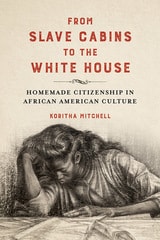
From Slave Cabins to the White House
Homemade Citizenship in African American CultureKoritha Mitchell
University of Illinois Press, 2021
Koritha Mitchell analyzes canonical texts by and about African American women to lay bare the hostility these women face as they invest in traditional domesticity. Instead of the respectability and safety granted white homemakers, black women endure pejorative labels, racist governmental policies, attacks on their citizenship, and aggression meant to keep them in "their place."
Tracing how African Americans define and redefine success in a nation determined to deprive them of it, Mitchell plumbs the works of Frances Harper, Zora Neale Hurston, Lorraine Hansberry, Toni Morrison, Michelle Obama, and others. These artists honor black homes from slavery and post-emancipation through the Civil Rights era to "post-racial" America. Mitchell follows black families asserting their citizenship in domestic settings while the larger society and culture marginalize and attack them, not because they are deviants or failures but because they meet American standards.
Powerful and provocative, From Slave Cabins to the White House illuminates the links between African American women's homemaking and citizenship in history and across literature.
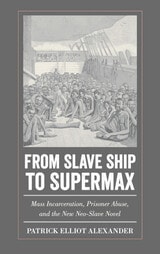
From Slave Ship to Supermax
Mass Incarceration, Prisoner Abuse, and the New Neo-Slave NovelPatrick Elliot Alexander
Temple University Press, 2017
In his cogent and groundbreaking book, From Slave Ship to Supermax, Patrick Elliot Alexander argues that the disciplinary logic and violence of slavery haunt depictions of the contemporary U.S. prison in late twentieth-century Black fiction. Alexander links representations of prison life in James Baldwin’s novel If Beale Street Could Talk to his engagements with imprisoned intellectuals like George Jackson, who exposed historical continuities between slavery and mass incarceration. Likewise, Alexander reveals how Toni Morrison’s Beloved was informed by Angela Y. Davis’s jail writings on slavery-reminiscent practices in contemporary women’s facilities. Alexander also examines recurring associations between slave ships and prisons in Charles Johnson’s Middle Passage, and connects slavery’s logic of racialized premature death to scenes of death row imprisonment in Ernest Gaines’ A Lesson Before Dying.
Alexander ultimately makes the case that contemporary Black novelists depict racial terror as a centuries-spanning social control practice that structured carceral life on slave ships and slave plantations—and that mass-produces prisoners and prisoner abuse in post–Civil Rights America. These authors expand free society’s view of torment confronted and combated in the prison industrial complex, where discriminatory laws and the institutionalization of secrecy have reinstated slavery’s system of dehumanization.
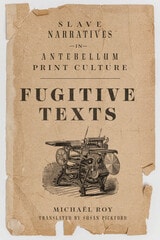
Fugitive Texts
Slave Narratives in Antebellum Print CultureMichaël Roy, translated by Susan Pickford
University of Wisconsin Press, 2024
In Fugitive Texts, Michaël Roy offers the first book-length study of the slave narrative as a material artifact. Drawing on a wide range of sources, he reconstructs the publication histories of a number of famous and lesser-known narratives, placing them against the changing backdrop of antebellum print culture. Slave narratives, he shows, were produced through a variety of print networks. Remarkably few were published under the full control of white-led antislavery societies; most were self-published and distributed by the authors, while some were issued by commercial publishers who hoped to capitalize on the success of Harriet Beecher Stowe’s Uncle Tom’s Cabin. The material lives of these texts, Roy argues, did not end within the pages. Antebellum slave narratives were “fugitive texts” apt to be embodied in various written, oral, and visual forms.
Published to rave reviews in French, Fugitive Texts illuminates the heterogeneous nature of a genre often described in monolithic terms and ultimately paves the way for a redefinition of the literary form we have come to recognize as “the slave narrative.”
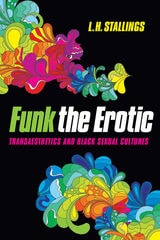
Funk the Erotic
Transaesthetics and Black Sexual CulturesL.H. Stallings
University of Illinois Press, 2015
Stallings uses funk to highlight the importance of the erotic and eroticism in Black cultural and political movements, debunking "the truth of sex" and its histories. Brandishing funk as a theoretical tool, Stallings argues that Western theories of the erotic fail as universally applicable terms or philosophies, and thus lack utility in discussions of black bodies, subjects, and culture. In considering the Victorian concept of freak in black funk, Stallings proposes that black artists across all media have fashioned a tradition that embraces the superfreak, sexual guerrilla, sexual magic, mama's porn, black trans narratives, and sex work in a post-human subject position. Their goal: to ensure survival and evolution in a world that exploits black bodies in capitalist endeavors, imperialism, and colonization.
Revitalizing and wide-ranging, Funk the Erotic offers a needed examination of black sexual cultures, a discursive evolution of black ideas about eroticism, a critique of work society, a reexamination of love, and an articulation of the body in black movements.
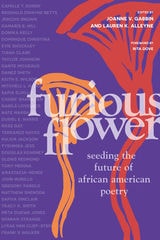
Furious Flower
Seeding the Future of African American PoetryEdited by Joanne V. Gabbin and Lauren K. Alleyne; Foreword by Rita Dove
Northwestern University Press, 2020