157 books match the query 'African Americans in literature' and 5 start with f
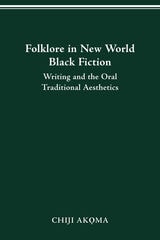
cover of Folklore in New World Black Fiction: Writing and the Oral Traditional Aesthetics

Folklore in New World Black Fiction

Writing and the Oral Traditional Aesthetics

Chiji Akoma

The Ohio State University Press, 2007
For a while, tracing African roots in the artistic creations of blacks in the New World tended to generate much attention as if to suggest that the New World does not have profound impact on their creative spirit. In addition, few studies have tried to construct an interpretive model through which an array of works by New World writers could be meaningfully explored on the basis of their African Diasporic identity.
 
In Folklore in New World Black Fiction, Chiji Akọma offers an interpretive model for the reading of the African New World novel focusing on folklore, not as an ingredient, but as the basis for the narratives. The works examined do not contain folklore materials; they are folklore, constituted by the intersections of African oral narrative aesthetics, New World sensibility, and the written tradition. Specifically Akọma looks at four African Caribbean and African American novelists, Roy A.K. Heath, Wilson Harris, Toni Morrison, and Jean Toomer.
 
The book seeks to expand the understanding of the forms of folklore as it pertains to black texts. For one, it broadens the dimensions of folklore by looking beyond the oral world of the “simple folk” to the kinds of narrative sophistication associated with writing; it also asserts the importance of performance art in folklore analysis. The study demonstrates the durability of the black aesthetic over artistic forms.
[more]
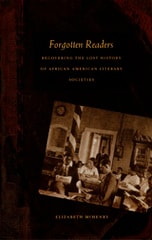
cover of Forgotten Readers: Recovering the Lost History of African American Literary Societies

Forgotten Readers

Recovering the Lost History of African American Literary Societies

Elizabeth McHenry

Duke University Press, 2002

Over the past decade the popularity of black writers including E. Lynn Harris and Terry McMillan has been hailed as an indication that an active African American reading public has come into being. Yet this is not a new trend; there is a vibrant history of African American literacy, literary associations, and book clubs. Forgotten Readers reveals that neglected past, looking at the reading practices of free blacks in the antebellum north and among African Americans following the Civil War. It places the black upper and middle classes within American literary history, illustrating how they used reading and literary conversation as a means to assert their civic identities and intervene in the political and literary cultures of the United States from which they were otherwise excluded.

Forgotten Readers expands our definition of literacy and urges us to think of literature as broadly as it was conceived of in the nineteenth century. Elizabeth McHenry delves into archival sources, including the records of past literary societies and the unpublished writings of their members. She examines particular literary associations, including the Saturday Nighters of Washington, D.C., whose members included Jean Toomer and Georgia Douglas Johnson. She shows how black literary societies developed, their relationship to the black press, and the ways that African American women’s clubs—which flourished during the 1890s—encouraged literary activity. In an epilogue, McHenry connects this rich tradition of African American interest in books, reading, and literary conversation to contemporary literary phenomena such as Oprah Winfrey’s book club.
[more]
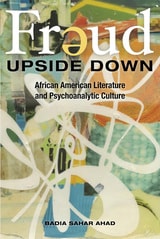
cover of Freud Upside Down: African American Literature and Psychoanalytic Culture

Freud Upside Down

African American Literature and Psychoanalytic Culture

Badia Sahar Ahad

University of Illinois Press, 2010

This thought-provoking cultural history explores how psychoanalytic theories shaped the works of important African American literary figures. Badia Sahar Ahad details how Nella Larsen, Richard Wright, Jean Toomer, Ralph Ellison, Adrienne Kennedy, and Danzy Senna employed psychoanalytic terms and conceptual models to challenge notions of race and racism in twentieth-century America. Freud Upside Down explores the relationship between these authors and intellectuals and the psychoanalytic movement emerging in the United States over the course of the twentieth century. Examining how psychoanalysis has functioned as a cultural phenomenon within African American literary intellectual communities since the 1920s, Ahad lays out the historiography of the intersections between African American literature and psychoanalysis and considers the creative approaches of African American writers to psychological thought in their work and their personal lives.
[more]
cover of From Behind the Veil: A STUDY OF AFRO-AMERICAN NARRATIVE

From Behind the Veil

A STUDY OF AFRO-AMERICAN NARRATIVE

Robert B. Stepto

University of Illinois Press, 1991
This pioneering study of Afro-American narrative is far more critical, historical, and textual than biographical, chronological, and atextual. Robert Stepto asserts that Afro-American culture has its store of canonical stories or pregeneric myths, the primary one being the quest for freedom and literacy. This second edition includes a new preface and an afterward entitled "Distrust of the Reader in Afro-American Narratives."
 
[more]
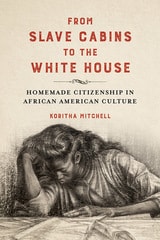
cover of From Slave Cabins to the White House: Homemade Citizenship in African American Culture

From Slave Cabins to the White House

Homemade Citizenship in African American Culture

Koritha Mitchell

University of Illinois Press, 2021

Koritha Mitchell analyzes canonical texts by and about African American women to lay bare the hostility these women face as they invest in traditional domesticity. Instead of the respectability and safety granted white homemakers, black women endure pejorative labels, racist governmental policies, attacks on their citizenship, and aggression meant to keep them in "their place."

Tracing how African Americans define and redefine success in a nation determined to deprive them of it, Mitchell plumbs the works of Frances Harper, Zora Neale Hurston, Lorraine Hansberry, Toni Morrison, Michelle Obama, and others. These artists honor black homes from slavery and post-emancipation through the Civil Rights era to "post-racial" America. Mitchell follows black families asserting their citizenship in domestic settings while the larger society and culture marginalize and attack them, not because they are deviants or failures but because they meet American standards.

Powerful and provocative, From Slave Cabins to the White House illuminates the links between African American women's homemaking and citizenship in history and across literature.

[more]