Results by title
85 books match the query 'Americas' and 3 start with f
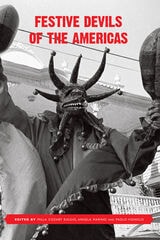
Festive Devils of the Americas
Edited by Milla Cozart Riggio, Angela Marino, and Paolo Vignolo
Seagull Books, 2015
The devil is a defiant, nefarious figure, the emblem of evil, and harbinger of the damned. However, the festive devil—the devil that dances—turns the most hideous acts into playful transgressions. Festive Devils of the Americas is the first volume to present a transnational and performance-centered approach to this fascinating, feared, and revered character of fiestas, street festivals, and carnivals in North, Central, and South America. As produced and performed in both rural and urban communities and among neighborhood groups and councils, festive devils challenge the principles of colonialism and nation-states reliant on the straight and narrow opposition between good and evil, black and white, and us and them.
Each section of this volume opens with regional maps ranging from the Andes, Afro-Atlantic, and Caribbean, to Central and North America. However, festive devils defy geographical as well as moral boundaries. From Brazil’s Candomblé to New Mexico’s dance halls, festive devils and their stories sustain and transform ancestral memory, recast historical narratives, and present political, social, and cultural alternatives in many guises. Within economic, political, and religious cross-currents, these paradoxical figures affirm the spirit of community within the framework of subversion and inversion found at the heart of the festival world.
Each section of this volume opens with regional maps ranging from the Andes, Afro-Atlantic, and Caribbean, to Central and North America. However, festive devils defy geographical as well as moral boundaries. From Brazil’s Candomblé to New Mexico’s dance halls, festive devils and their stories sustain and transform ancestral memory, recast historical narratives, and present political, social, and cultural alternatives in many guises. Within economic, political, and religious cross-currents, these paradoxical figures affirm the spirit of community within the framework of subversion and inversion found at the heart of the festival world.
[more]
Food and Work in the Americas
Susan Levine and Steve Striffler, special issue editors
Duke University Press, 0
This special issue challenges historians to think about food and labor by considering how not only producing but acquiring, preparing, eating, and enjoying food are central to working-class life and capitalist transformation. Its essays bring labor history into closer conversation with the interdisciplinary perspectives of food studies to explore how broadly and deeply food experiences and working lives shape one another. Contributors trace this relationship through a series of case studies from across the Americas, including discussions of Native American life during the seventeenth and nineteenth centuries, African American food workers in the early twentieth century, Puerto Rican sugarcane workers under US imperialism, and the politics of fair trade.
Susan Levine is Professor of History and Director of the Institute for the Humanities at the University of Illinois at Chicago. She is the author of School Lunch Politics: The Surprising History of America’s Favorite Welfare Program. Steve Striffler is the Doris Zemurray Stone Chair in Latin American Studies and Professor of Anthropology at the University of New Orleans. He is the author of In the Shadows of State and Capital: The United Fruit Company, Popular Struggle, and Agrarian Restructuring in Ecuador, 1900–1995, also published by Duke University Press.
Contributors: William Bauer, Sarah Besky, Sandy Brown, Rachel Herrmann, Felicia Kornbluh, Susan Levine, Sarah Lyon, Vanessa May, April Merleaux, Liesl Orenic, Sara Ries, Steve Striffler
[more]

Football in the Americas
FayTbol, Futebol, SoccerEdited by Rory M. Miller and Liz Crolley
University of London Press, 2007
Football (soccer in the United States) has a long history in the Americas, but it currently displays many signs of crisis. In South America the combination of spectator violence, poor business management, and the emigration of players is undermining professional football. In the United States, in contrast, a professional league (Major League Soccer) has taken root in the last decade, and the U.S. women's team has gained international success. Football has always provided its players and fans with identity and belonging, whether to a nation or to a particular social group. It has been both a vehicle for the politically ambitious and an arena in which citizens can make sense of national failings and contest existing power structures. This volume explores many of these themes. The fifteen essays range widely, with theoretical and empirical contributions on the region as whole, as well as chapters specifically on Argentina, Brazil, Peru, Mexico, and the United States.
[more]