76 books match the query 'Animal rights' and 3 start with f
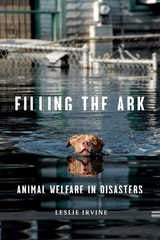
cover of Filling the Ark: Animal Welfare in Disasters

Filling the Ark

Animal Welfare in Disasters

Leslie Irvine

Temple University Press, 2009

When disasters strike, people are not the only victims. Hurricane Katrina raised public attention about how disasters affect dogs, cats, and other animals considered members of the human family. In this short but powerful book, noted sociologist Leslie Irvine goes beyond Katrina to examine how disasters like oil spills, fires, and other calamities affect various animal populations—on factory farms, in research facilities, and in the wild.

Filling the Ark argues that humans cause most of the risks faced by animals and urges for better decisions about the treatment of animals in disasters. Furthermore, it makes a broad appeal for the ethical necessity of better planning to keep animals out of jeopardy. Irvine not only offers policy recommendations and practical advice for evacuating animals, she also makes a strong case for rethinking our use of animals, suggesting ways to create more secure conditions.
[more]
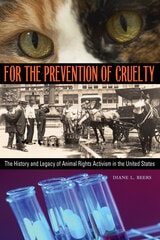
cover of For the Prevention of Cruelty: The History and Legacy of Animal Rights Activism in the United States

For the Prevention of Cruelty

The History and Legacy of Animal Rights Activism in the United States

Diane L. Beers

Ohio University Press, 2006

Animal rights. Those two words conjure diverse but powerful images and reactions. Some nod in agreement, while others roll their eyes in contempt. Most people fall somewhat uncomfortably in the middle, between endorsement and rejection, as they struggle with the profound moral, philosophical, and legal questions provoked by the debate. Today, thousands of organizations lobby, agitate, and educate the public on issues concerning the rights and treatment of nonhumans. For the Prevention of Cruelty is the first history of organized advocacy on behalf of animals in the United States to appear in nearly a half century. Diane Beers demonstrates how the cause has shaped and reshaped itself as it has evolved within the broader social context of the shift from an industrial to a postindustrial society. Until now, the legacy of the movement in the United States has not been examined. Few Americans today perceive either the companionship or the consumption of animals in the same manner as did earlier generations. Moreover, powerful and lingering bonds connect the seemingly disparate American Society for the Prevention of Cruelty to Animals of the nineteenth century and the People for the Ethical Treatment of Animals of today. For the Prevention of Cruelty tells an intriguing and important story that reveals society’s often changing relationship with animals through the lens of those who struggled to shepherd the public toward a greater compassion.
[more]
cover of From Property to Family: American Dog Rescue and the Discourse of Compassion

From Property to Family

American Dog Rescue and the Discourse of Compassion

Andrei S. Markovits and Katherine N. Crosby

University of Michigan Press, 2014

In the wake of the considerable cultural changes and social shifts that the United States and all advanced industrial democracies have experienced since the late 1960s and early 1970s, social discourse around the disempowered has changed in demonstrable ways. In From Property to Family: American Dog Rescue and the Discourse of Compassion, Andrei Markovits and Katherine Crosby describe a “discourse of compassion” that actually alters the way we treat persons and ideas once scorned by the social mainstream. This “culture turn” has also affected our treatment of animals inaugurating an accompanying “animal turn”. In the case of dogs, this shift has increasingly transformed the discursive category of the animal from human companion to human family member. One of the new institutions created by this attitudinal and behavioral change towards dogs has been the breed specific canine rescue organization, examples of which have arisen all over the United States beginning in the early 1980s and massively proliferating in the 1990s and subsequent years.  While the growing scholarship on the changed dimension of the human-animal relationship attests to its social, political, moral and intellectual salience to our contemporary world, the work presented in Markovits and Crosby’s book constitutes the first academic research on the particularly important institution of breed specific dog rescue.
[more]