58 books match the query 'Antislavery movements' and 6 start with f
cover of Fanatical Schemes: Proslavery Rhetoric and the Tragedy of Consensus

Fanatical Schemes

Proslavery Rhetoric and the Tragedy of Consensus

Patricia Roberts-Miller

University of Alabama Press, 2009
What was the relationship between rhetoric and slavery, and how did rhetoric fail as an alternative to violence, becoming instead its precursor?
 
Fanatical Schemes is a study of proslavery rhetoric in the 1830s. A common understanding of the antebellum slavery debate is that the increased stridency of abolitionists in the 1830s, particularly the abolitionist pamphlet campaign of 1835, provoked proslavery politicians into greater intransigence and inflammatory rhetoric. Patricia Roberts-Miller argues that, on the contrary, inflammatory rhetoric was inherent to proslavery ideology and predated any shift in abolitionist practices.
 
She examines novels, speeches, and defenses of slavery written after the pamphlet controversy to underscore the tenets of proslavery ideology and the qualities that made proslavery rhetoric effective. She also examines anti-abolitionist rhetoric in newspapers from the spring of 1835 and the history of slave codes (especially anti-literacy laws) to show that anti-abolitionism and extremist rhetoric long preceded more strident abolitionist activity in the 1830s.
 
The consensus that was achieved by proslavery advocates, argues Roberts-Miller, was not just about slavery, nor even simply about race. It was also about manhood, honor, authority, education, and political action. In the end, proslavery activists worked to keep the realm of public discourse from being a place in which dominant points of view could be criticized--an achievement that was, paradoxically, both a rhetorical success and a tragedy.
[more]
cover of Fighting for a Free Missouri: German Immigrants, African Americans, and the Issue of Slavery

Fighting for a Free Missouri

German Immigrants, African Americans, and the Issue of Slavery

Sydney J. Norton

University of Missouri Press, 2023
Missouri is well-known for its German American heritage, but the story of nineteenth-century German immigrant abolitionists is often neglected in discussions of the state’s history. This collection of ten original essays (with a foreword by renowned Missouri historian Gary Kremer), relates what unfolded when idealistic Germans, many of whom were highly educated and devoted to the ideals of freedom and democracy, left their homeland and settled in a pre–Civil War slave state. Fleeing political persecution during the 1830s and 1840s, immigrants such as Friedrich Münch, Eduard Mühl, Heinrich Boernstein, and Arnold Krekel arrived in the area now known as the Missouri German Heritage Corridor in hopes of finding a land more congenial to their democratic ideals. When they witnessed the state of enslaved Blacks, many of them became abolitionist activists and fervent supporters of Abraham Lincoln and the Union in the emerging Civil War. Editor Sydney Norton and the other contributing authors to Fighting for a Free Missouri explore the Germans’ abolitionist mission, their relationships with African Americans, and their activity in the radical wing of the Republican Party.

 
[more]
cover of Finding Freedom: The Untold Story of Joshua Glover, Runaway Slave

Finding Freedom

The Untold Story of Joshua Glover, Runaway Slave

Walter T. McDonald

Wisconsin Historical Society Press, 2007

"Shall a man be dragged back to Slavery from our Free Soil, without an open trial of his right to Liberty?" —Handbill circulated in Milwaukee on March 11, 1854

In Finding Freedom, Ruby West Jackson and Walter T. McDonald provide readers with the first narrative account of the life of Joshua Glover, the runaway slave who was famously broken out of jail by thousands of Wisconsin abolitionists in 1854. Employing original research, the authors chronicle Glover's days as a slave in St. Louis, his violent capture and thrilling escape in Milwaukee, his journey on the Underground Railroad, and his 33 years of freedom in rural Canada.

While Jackson and McDonald demonstrate how the catalytic "Glover incident" captured national attention—pitting the proud state of Wisconsin against the Supreme Court and adding fuel to the pre-Civil War fire—their primary focus is on the ordinary citizens, both black and white, with whom Joshua Glover interacted. A bittersweet story of bravery and compassion, Finding Freedom provides the first full picture of the man for whom so many fought, and around whom so much history was made.
[more]
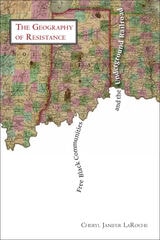
cover of Free Black Communities and the Underground Railroad: The Geography of Resistance

Free Black Communities and the Underground Railroad

The Geography of Resistance

Cheryl Janifer LaRoche

University of Illinois Press, 2013
This enlightening study employs the tools of archaeology to uncover a new historical perspective on the Underground Railroad. Unlike previous histories of the Underground Railroad, which have focused on frightened fugitive slaves and their benevolent abolitionist accomplices, Cheryl LaRoche focuses instead on free African American communities, the crucial help they provided to individuals fleeing slavery, and the terrain where those flights to freedom occurred.
 
This study foregrounds several small, rural hamlets on the treacherous southern edge of the free North in Illinois, Indiana, and Ohio. LaRoche demonstrates how landscape features such as waterways, iron forges, and caves played a key role in the conduct and effectiveness of the Underground Railroad. Rich in oral histories, maps, memoirs, and archaeological investigations, this examination of the "geography of resistance" tells the new powerful and inspiring story of African Americans ensuring their own liberation in the midst of oppression.
[more]
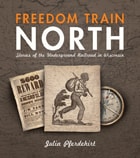
cover of Freedom Train North: Stories of the Underground Railroad in Wisconsin

Freedom Train North

Stories of the Underground Railroad in Wisconsin

Julia Pferdehirt

Wisconsin Historical Society Press, 2011

People running from slavery made many hard journeys to find freedom—on steamboats and in carriages, across rivers and in hay-covered wagons. Some were shot at. Many were chased by slave catchers. Others hid in tunnels and secret rooms. But these troubles were worth it for the men, women, and children who eventually reached freedom. Freedom Train North tells the stories of fugitive slaves who found help in Wisconsin. Young readers (ages 7 to 12) will meet people like Joshua Glover, who was broken out of jail by a mob of freedom workers in Milwaukee, and Jacob Green, who escaped five times before he finally made it to freedom.

This compelling book also introduces stories of the strangers who hid fugitive slaves and helped them on their way, brave men and women who broke the law to do what was right. As both a historian and a storyteller, author Julia Pferdehirt shares these exciting and important stories of a dangerous time in Wisconsin’s past. Using manuscripts, letters, and artifacts from the period, as well as stories passed down from one generation to another, Pferdehirt takes us deep into our state’s past, challenging and inspiring us with accounts of courage and survival.
[more]
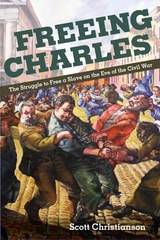
cover of Freeing Charles: The Struggle to Free a Slave on the Eve of the Civil War

Freeing Charles

The Struggle to Free a Slave on the Eve of the Civil War

Scott Christianson

University of Illinois Press, 2010

Freeing Charles recounts the life and epic rescue of captured fugitive slave Charles Nalle of Culpeper, Virginia, who was forcibly liberated by Harriet Tubman and others in Troy, New York, on April 27, 1860. Scott Christianson follows Nalle from his enslavement by the Hansborough family in Virginia through his escape by the Underground Railroad and his experiences in the North on the eve of the Civil War. This engaging narrative represents the first in-depth historical study of this crucial incident, one of the fiercest anti-slavery riots after Harpers Ferry. Christianson also presents a richly detailed look at slavery culture in antebellum Virginia and probes the deepest political and psychological aspects of this epic tale. His account underscores fundamental questions about racial inequality, the rule of law, civil disobedience, and violent resistance to slavery in the antebellum North and South.
[more]