Results by title
109 books match the query 'Astronomy' and 5 start with f

For the Love of Mars
A Human History of the Red PlanetMatthew Shindell
University of Chicago Press, 2023
Mars and its secrets have fascinated and mystified humans since ancient times. For the Love of Mars surveys the red planet’s place in the human imagination, beginning with ancient astrologers and skywatchers and ending in our present moment of exploration and virtual engagement.
National Air and Space Museum curator Matthew Shindell describes how historical figures across eras and around the world have made sense of this mysterious planet. We meet Mayan astrologer priests who incorporated Mars into seasonal calendars and religious ceremonies, Babylonian astrologers who discerned bad omens, figures of the Scientific Revolution who struggled to comprehend Mars as a world, Victorian astronomers who sought signs of intelligent life, and twentieth- and twenty-first-century scientists who have established a technological presence on the planet’s surface. Along the way, we encounter writers and artists from each of these periods who took readers and viewers along on imagined journeys to Mars.
By focusing on the diverse human stories behind the telescopes and behind the robots we know and love, Shindell shows how Mars exploration has evolved in ways that have also expanded knowledge about other facets of the universe. Captained by an engaging and erudite expert, For the Love of Mars is a captivating voyage through time and space for anyone curious about Curiosity and the red planet.
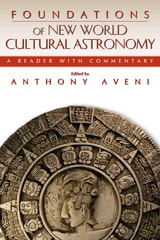
Foundations of New World Cultural Astronomy
A Reader with CommentaryAnthony Aveni
University Press of Colorado, 2008
Cultural astronomy, first called archaeoastronomy, has evolved at ferocious speed since its genesis in the 1960s, with seminal essays and powerful rebuttals published in far-flung, specialized journals. Until now, only the most closely involved scholars could follow the intellectual fireworks. In Foundations of New World Cultural Astronomy, Anthony Aveni, one of cultural astronomy's founders and top scholars, offers a selection of the essays that built the field, from foundational works to contemporary scholarship.
Including four decades of research throughout the Americas by linguists, archaeologists, historians, ethnologists, astronomers, and engineers, this reader highlights the evolution of the field through thematic organization and point-counterpoint articles. Aveni - an award-winning author and former National Professor of the Year - serves up incisive commentary, background for the uninitiated, and suggested reading, questions, and essay topics. Students, readers, and scholars will relish this collection and its tour of a new field in which discoveries about ancient ways of looking at the skies cast light on our contemporary views.

From White Dwarfs to Black Holes
The Legacy of S. ChandrasekharEdited by G. Srinivasan
University of Chicago Press, 1999
Over the course of more than six decades of active research Chandrasekhar investigated a dizzying array of subjects. G. Srinivasan notes in the preface to this book that "the range of Chandra's contributions is so vast that no one person in the physics or astronomy community can undertake the task of commenting on his achievements." Thus, in this collection, ten eminent scientists evaluate Chandrasekhar's contributions to their own fields of specialization. Donald E. Osterbrock closes the volume with a historical discussion of Chandrasekhar's interactions with graduate students during his more than quarter century at Yerkes Observatory.
Contributors are James Binney, John L. Friedman, Norman R. Lebovitz, Donald E. Osterbrock, E. N. Parker, Roger Penrose, A. R. P. Rau, George B. Rybicki, E. E. Salpeter, Bernard F. Schutz, and G. Srinivasan.

Fundamentals of Dark Matter
Ignacio Ferreras
University College London, 2025
Fundamentals of Dark Matter provides a comprehensive and accessible introduction to one of the greatest mysteries in astrophysics. Designed for advanced undergraduates and graduate students, this textbook presents the key discoveries that led to the dark matter hypothesis and also fosters critical thinking with thought-provoking “How about…?” questions in each chapter.
Ignacio Ferreras guides readers through the historical challenges in galactic astrophysics and the cosmic microwave background, outlining the evidence that has made dark matter a fundamental component of modern cosmology. The book also explores the latest developments in galaxy formation and the ongoing search for the true nature of dark matter.
Each chapter includes clear learning outcomes and discussion questions, making it an ideal resource for courses in extragalactic astrophysics or cosmology. With its engaging pedagogical approach, Fundamentals of Dark Matter equips students with both the knowledge and the curiosity to explore one of the most dynamic areas of modern astrophysics.
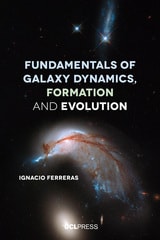
Fundamentals of Galaxy Dynamics, Formation and Evolution
Ignacio Ferreras
University College London, 2019