Results by title
428 books match the query 'Authorship' and 19 start with f
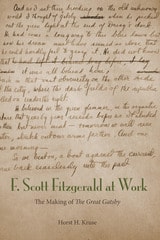
F. Scott Fitzgerald at Work
The Making of "The Great Gatsby"Horst H. Kruse
University of Alabama Press, 2014
The essays in F. Scott Fitzgerald at Work examine fresh facts that illuminate the experiences and source materials upon which Fitzgerald based this quintessentially American masterpiece. They confirm author Horst Kruse’s view that Fitzgerald’s flights of fancy, even at their most spectacular, are firmly grounded in biographical experience as well as in the social, literary, and philosophical circumstances of his era.
In the first essay, Kruse reconstructs the life story of the individual who allegedly inspired the character of Jay Gatsby: Max von Gerlach. Kruse recounts his journeys to various archives and libraries in the United States as well as in Germany to unearth new facts about the genesis of the Gatsby characters. In another journey, readers travel with Kruse to Long Island to explore its physical and moral geography in relation to Fitzgerald, specifically the role of certain elite Long Island families in the advancement of the “science of eugenics” movement. The final two essays take Kruse across the globe to various destinations to consider the broader place of The Great Gatsby in American and international intellectual history.
Replete with fascinating discoveries and insights, F. Scott Fitzgerald at Work both corrects previous assumptions about The Great Gatsby and deepens our appreciation and understanding of Fitzgerald‘s imagination.
Faithful Translators
Authorship, Gender, and Religion in Early Modern EnglandJaime Goodrich
Northwestern University Press, 2014
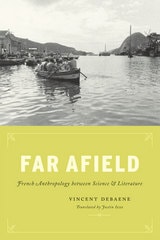
Far Afield
French Anthropology between Science and LiteratureVincent Debaene
University of Chicago Press, 2014
The relationship between anthropology and literature in France is one of careful curiosity. Literary writers are wary about anthropologists’ scientific austerity but intrigued by the objects they collect and the issues they raise, while anthropologists claim to be scientists but at the same time are deeply concerned with writing and representational practices. Debaene elucidates the richness that this curiosity fosters and the diverse range of writings it has produced, from Proustian memoirs to proto-surrealist diaries. In the end he offers a fascinating intellectual history, one that is itself located precisely where science and literature meet.

Feminism and American Literary History
EssaysBaym, Nina
Rutgers University Press, 1992
Fiat Flux
The Writings of Wilson R. Bachelor, Nineteenth-Century Country Doctor and PhilosopherWilliam D. Lindsey
University of Arkansas Press, 2013
Fields of Play
Constructing an Academic LifeRichardson, Laurel
Rutgers University Press, 1997
Deeply engaging, movingly written with grace, elegance, and clarity, the book stimulates readers to situate their own writing in personal, social, and political contexts.
Film and Authorship
Wexman, Virginia W
Rutgers University Press, 2003
During the 1960s, when cinema first entered the academy as a serious object of study, the primary focus was on auteurism, or on films authorship. Burgeoning cinema studies courses demonstrated how directors were the authors of work that undermined (or succeeded in spite of) all the constraints that Hollywood threw at them. New critical methods were introduced as the field matured, and studies of the author/director, for the most part, were considered obsolete.
Virginia Wright Wexman has pulled together some of the freshest writing available on the topic of film authorship. Spanning approaches including poststructuralism, feminism, queer theory, postcolonialism, and cultural studies, the contributors ask, what does auteurship look like today in light of all these developments? The contents of the volume are divided into three major sections: Theoretical Statements, Historical and Institutional Contexts, and Case Studies. Wexmans comprehensive introduction contextualizes the selections and summarizes the scholarly methods through which auteurism has been addressed in the past; it also provides a sketch of the history of media authorship. An extensive bibliography rounds off the volume.
Find Your Story, Write Your Memoir
Lynn C. Miller and Lisa Lenard-Cook
University of Wisconsin Press, 2013
Bronze winner, Foreword Book of the Year, Writing Guides
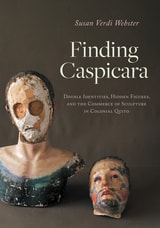
Finding Caspicara
Double Identities, Hidden Figures, and the Commerce of Sculpture in Colonial QuitoSusan Verdi Webster
University of Texas Press, 2024
2026 Eleanor Tufts Award, Society for Iberian Global Art, College Art Association
An examination of sculpture and authorship in eighteenth-century Quito that documents Caspicara as a participant in the innovative artistic production of the city’s workshops and its widespread commerce of polychrome sculptures.
Who is Caspicara? Nothing is known of Caspicara’s life, and not a single sculpture has been documented as his work. Yet traditional histories laud him as a prolific Indigenous sculptor in eighteenth-century Quito who created exquisite polychrome figures and became a national artistic icon. Drawing on extensive archival, historical, and object research, Susan Verdi Webster peels away layers of historiographical fabrication to reveal what we do and do not know about Caspicara and his work.
Rather than being a solitary master, Caspicara collaborated with other, largely Indigenous artists in Quito’s protoindustrial workshops, manufacturing sculptures now credited to him alone. The high quality of Quito sculptures produced by anonymous artists turned the city into a hub of wide-ranging commerce in religious icons. The art world and post-independence Ecuadorians have lionized the one named sculptor, Caspicara, according to the Western model of the artist-genius, amplifying the market for works bearing his name and creating a national hero on par with European masters. Lost in this process were the artists themselves. Webster returns to their world, detailing their methods and labor and, for the first time, documenting a sculpture made by Caspicara.

First Have Something to Say
Writing for the Library ProfessionAmerican Library Association, 2003
First Loves and Other Adventures
Grace Schulman
University of Michigan Press, 2009
Grace Schulman's acclaimed poetry is often about joy, the celebration of the miraculous, and the birth of beauty from adversity. In her new prose collection, she explores the passion for reading and other disciplines that led her to exult in her craft.
In First Loves and Other Adventures Schulman explores how she became a writer; her wide-ranging influences; and some of the many writers and works that have enchanted her over the years, ranging from Genesis and Song of Songs in the King James Bible to T. S. Eliot to Walt Whitman. These reflections on her art and career touch on a variety of other disciplines, including science, the novel, music, and art, and their relation to poetry as a field. Her belief that art transcends formal boundaries is a recurring theme throughout her discussion of these influences, as well as in her own work.
Grace Schulman is the author of six books of poems. Among her honors are the Aiken Taylor Award for poetry, the Delmore Schwartz Memorial Award, a Guggenheim Fellowship, and New York University's Distinguished Alumni Award. Her poems have won three Pushcart Prizes, and her collection Days of Wonder was selected by Library Journal as one of the best poetry books of 2002. Schulman is the former director of the Poetry Center and former poetry editor of the Nation and currently is Distinguished Professor of English at Baruch College, City University of New York.
A volume in the POETS ON POETRY series, which collects critical works by contemporary poets, gathering together the articles, interviews, and book reviews by which they have articulated the poetics of a new generation.
First Person Squared
A Study of Co-Authoring in the AcademyKami Day & Michele Eodice
Utah State University Press, 2001
In (First Person)2, Day and Eodice offer one of the few book-length studies of co-authoring in academic fields since Lunsford and Ede published theirs over a decade ago. The central research here involves in-depth interviews with ten successful academic collaborators from a range of disciplines and settings. The interviews explore the narratives of these informants' experience—what brought them to collaborate, what cognitive and logistical processes were involved as they worked together, what is the status of collaborated work in their field, and so on—and situate these informants within the broader discussion of collaboration theory and research as it has been articulated over the last ten years.
As the study develops, Day and Eodice become most interested in the affective domain of co-authorship, and they find the most promising explorations of that domain in the work of feminist theorists in composition.

Frank Capra
Authorship and the Studio SystemRobert Sklar
Temple University Press, 1998
This collection of nine essays by leading international film historians analyzes Capra's filmmaking during his most prolific period, from 1928 to 1939, taking a closer look at the more complex aspects of his work. They trace his struggles for autonomy against Columbia Pictures head Harry Cohn, his reputation as an amateur, and the ways in which working within studio modes of production my have enhanced the director's strengths.
The contributors also place their critiques within the context of the changing fortunes of the Hollywood studio system, the impact of the Depression, and Capra's working relationships with other studio staff and directors. The contributors' access to nineteen newly restored Capra films made at Columbia during this period fills this collection with some of the most comprehensive critiques available on the director's early body of work.
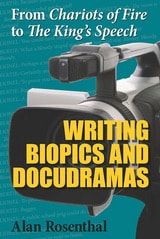
From Chariots of Fire to The King's Speech
Writing Biopics and DocudramasAlan Rosenthal
Southern Illinois University Press, 2014
Over the past decade, movie audiences have become hungry for films based on real people and historical events. Never was this more evident than during the best-picture showdown between The King’s Speech and The Social Network during the 2011 Academy Awards, a scene then repeated, with Argo, Lincoln and Zero Dark Thirty in the 2013 awards.. While Hollywood moguls have come to recognize the box-office revenue and critical acclaim that accompany such films and are now fast-tracking many docudramas into theaters, there remains a need for more reality-based film scripts.
In From “Chariots of Fire” to “The King’s Speech,” writer, director, and producer Alan Rosenthal presents a manual for screenwriters to develop their bio-pic or docudrama from concept to completion. This comprehensive guide begins with an overview of the genre before providing screenwriters with all the techniques and insights needed to navigate the often intimidating landscape of screenwriting for reality-based scripts. Included within the volume are tips for such challenges as inception and research, developing dialogue and narration, and capably addressing any legal and rights issues that may arise. Also included are appendixes containing useful marketing tips and broadcast guidelines.
A practical, down-to-earth manual for experienced and novice screenwriters alike, From “Chariots of Fire” to “The King’s Speech” is the only manual dedicated explicitly to writing the bio-pic and docudrama. Rosenthal shares his decades of experience in the film industry, along with hands-on tools and maps, to help screenwriters completely master this popular film genre.
From Dissertation to Book
William Germano
University of Chicago Press, 2005
Acknowledging first that not all theses can become books, Germano shows how some dissertations might have a better life as one or more journal articles or as chapters in a newly conceived book. But even dissertations strong enough to be published as books first need to become book manuscripts, and at the heart of From Dissertation to Book is the idea that revising the dissertation is a fundamental process of adapting from one genre of writing to another.
Germano offers clear guidance on how to do just this. Writers will find advice on such topics as rethinking the table of contents, taming runaway footnotes, shaping chapter length, and confronting the limitations of jargon, alongside helpful timetables for light or heavy revision. With crisp directives, engaging examples, and a sympathetic eye for the foibles of academic writing, From Dissertation to Book reveals to recent PhD's the process of careful and thoughtful revision—a truly invaluable skill as they grow into their new roles as professional writers.
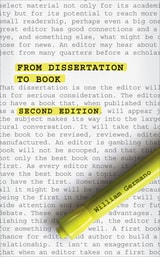
From Dissertation to Book, Second Edition
William Germano
University of Chicago Press, 2013
Since its publication in 2005, From Dissertation to Book has helped thousands of young academic authors get their books beyond the thesis committee and into the hands of interested publishers and general readers. Now revised and updated to reflect the evolution of scholarly publishing, this edition includes a new chapter arguing that the future of academic writing is in the hands of young scholars who must create work that meets the broader expectations of readers rather than the narrow requirements of academic committees.
At the heart of From Dissertation to Book is the idea that revising the dissertation is fundamentally a process of shifting its focus from the concerns of a narrow audience—a committee or advisors—to those of a broader scholarly audience that wants writing to be both informative and engaging. William Germano offers clear guidance on how to do this, with advice on such topics as rethinking the table of contents, taming runaway footnotes, shaping chapter length, and confronting the limitations of jargon, alongside helpful timetables for light or heavy revision.
Germano draws on his years of experience in both academia and publishing to show writers how to turn a dissertation into a book that an audience will actually enjoy, whether reading on a page or a screen. Germano also acknowledges that not all dissertations can or even should become books and explores other, often overlooked, options, such as turning them into journal articles or chapters in an edited work.
With clear directions, engaging examples, and an eye for the idiosyncrasies of academic writing, From Dissertation to Book reveals to recent PhDs the secrets of careful and thoughtful revision—a skill that will be truly invaluable as they add “author” to their curriculum vitae.
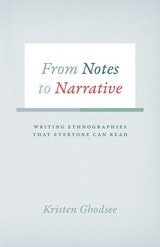
From Notes to Narrative
Writing Ethnographies That Everyone Can ReadKristen Ghodsee
University of Chicago Press, 2016
From Notes to Narrative picks up where methodological training leaves off. Kristen Ghodsee, an award-winning ethnographer, addresses common issues that arise in ethnographic writing. Ghodsee works through sentence-level details, such as word choice and structure. She also tackles bigger-picture elements, such as how to incorporate theory and ethnographic details, how to effectively deploy dialogue, and how to avoid distracting elements such as long block quotations and in-text citations. She includes excerpts and examples from model ethnographies. The book concludes with a bibliography of other useful writing guides and nearly one hundred examples of eminently readable ethnographic books.
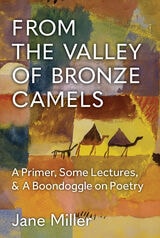
From the Valley of Bronze Camels
A Primer, Some Lectures, & A Boondoggle on PoetryJane Miller
University of Michigan Press, 2022
Jane Miller loves poetry. In these provocative and deeply insightful essays, she unpacks the work of giants like Adrienne Rich, Paul Celan, Marina Tsvetaeva, Osip Mandelstam, and Federico García Lorca alongside painters such as Caravaggio and Paul Klee, as well as ancient Chinese music and techniques of the contemporary poem. Miller explores the use of the question mark in the history of poetry and its function as a revelation of poetic voice. She considers the positive and negative aspects of surrealism on the contemporary poem, its anti-feminist origins in France, its contemporary usage, and the benefits of super-real images. Miller examines how identity politics might affect the imagination. She describes ancient Chinese musical instruments to show how their sounds resonate off/in American poems and on the aural integrity of the lyric poem. She interrogates the political implications of language and the degeneration and regeneration of words. Finally, in an essay about what she dares not say about poetry, she comes out against forms of surrealism, narrative, jargon, rhetoric, irony, and appropriation. This masterful work can be read as advice to a young writer, but it also invites us into the mind of a writer who has developed her craft through the course of a lifetime of writing, reading, and exploring the world, showing not only the ideas that influenced her—feminist, lesbian, and international works—but also how Miller has, in turn, influenced ideas.
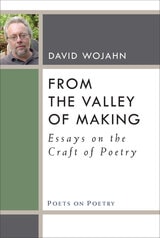
From the Valley of Making
Essays on the Craft of PoetryDavid Wojahn
University of Michigan Press, 2015