82 books match the query 'Birdwatching Guides' and 6 start with f
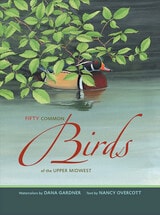
cover of Fifty Common Birds of the Upper Midwest

Fifty Common Birds of the Upper Midwest

Dana Gardner

University of Iowa Press, 2006
No bird is common, if we use “common” to mean ordinary. But birds that are seen more commonly than others can seem less noteworthy than species that are rarely glimpsed. In this gathering of essays and illustrations celebrating fifty of the most common birds of the Upper Midwest, illustrator Dana Gardner and writer Nancy Overcott encourage us to take a closer look at these familiar birds with renewed appreciation for their not-so-ordinary beauty and lifeways.Beginning with the garishly colored male and the more gently colored female wood duck, whose tree cavity nest serves as a launching pad for ducklings in the summer months, and ending on a bright yellow note with the American goldfinch, whose cheerful presence enlivens the midwestern landscape all year long, Overcott combines field observations drawn from her twenty-plus years of living and birding in Minnesota's Big Woods with anecdotes and data from other ornithologists to portray each species' life cycle, its vocalizations and appearance, and its habitat, food, and foraging methods as well as migration patterns and distribution. Infused with a dedication to conserving natural resources, her succinct yet personable prose forms an ideal complement to Gardner's watercolors as this renowned illustrator of avian life worldwide revisits the birds of his childhood. Together art and text ensure that the wild turkey, great blue heron, sharp-shinned hawk, barred owl, pileated woodpecker, house wren, ovenbird, field sparrow, rose-breasted grosbeak, red-winged blackbird, and forty other species of the Upper Midwest are never seen as common again.
[more]
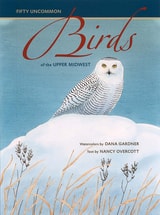
cover of Fifty Uncommon Birds of the Upper Midwest

Fifty Uncommon Birds of the Upper Midwest

Dana Gardner

University of Iowa Press, 2007
No bird is common, if we use “common” to mean ordinary. But birds that are seen more commonly than others can seem less noteworthy than species that are rarely glimpsed. In this gathering of essays and illustrations celebrating fifty of the most common birds of the Upper Midwest, illustrator Dana Gardner and writer Nancy Overcott encourage us to take a closer look at these familiar birds with renewed appreciation for their not-so-ordinary beauty and lifeways.Beginning with the garishly colored male and the more gently colored female wood duck, whose tree cavity nest serves as a launching pad for ducklings in the summer months, and ending on a bright yellow note with the American goldfinch, whose cheerful presence enlivens the midwestern landscape all year long, Overcott combines field observations drawn from her twenty-plus years of living and birding in Minnesota's Big Woods with anecdotes and data from other ornithologists to portray each species' life cycle, its vocalizations and appearance, and its habitat, food, and foraging methods as well as migration patterns and distribution. Infused with a dedication to conserving natural resources, her succinct yet personable prose forms an ideal complement to Gardner's watercolors as this renowned illustrator of avian life worldwide revisits the birds of his childhood. Together art and text ensure that the wild turkey, great blue heron, sharp-shinned hawk, barred owl, pileated woodpecker, house wren, ovenbird, field sparrow, rose-breasted grosbeak, red-winged blackbird, and forty other species of the Upper Midwest are never seen as common again.
[more]
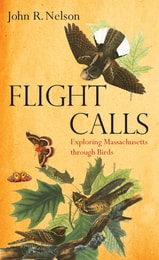
cover of Flight Calls: Exploring Massachusetts through Birds

Flight Calls

Exploring Massachusetts through Birds

John R. Nelson

University of Massachusetts Press, 2019

The paths of different birds look like double helixes, flowing strands of hair, and migrating serpents, and they beckon with calls that have definite meanings. These mysterious creatures inspire growing numbers of birders in their passionate pursuit of new species, and writer John R. Nelson is no exception. In Flight Calls, he takes readers on explorations to watch, hear, and know Massachusetts's hummingbirds, hawks, and herons along the coasts and in the woodlands, meadows, and marshes of Cape Ann, Cape Cod, the Great Marsh, Mount Auburn Cemetery, the Quabbin wilderness, Mount Wachusett, and elsewhere.

With style, humor, and a sense of wonder, Nelson blends his field adventures with a history of the birding community; natural and cultural history; bird stories from authors such as Henry David Thoreau, Emily Dickinson, and Mary Oliver; current scientific research; and observations about the fascinating habits of birds and their admirers. These essays are capped off with a plea for bird conservation, in Massachusetts and beyond.
[more]
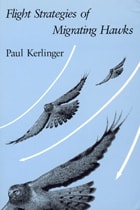
cover of Flight Strategies of Migrating Hawks

Flight Strategies of Migrating Hawks

Paul Kerlinger

University of Chicago Press, 1989

Hawks fly at very high altitudes, sometimes over water, and thus their flight behavior and migration patterns are extremely difficult to study. Now, based on nearly ten years of research, this book provides the most complete analysis to date of how hawks migrate. Paul Kerlinger has employed both direct observations and radar techniques to obtain a much more accurate understanding of the migratory behavior of hawks and the "decisions" they make in flight. And, he has integrated data on the flight behavior of raptors in general with information about their ecology, physiology, evolution, and nonmigratory behavior.

Kerlinger begins with an overview, discussing ecology and geography, research methods, natural history, and evolution, and atmospheric structure. He then addresses specific aspects of flight behavior: aerodynamics, morphology, mechanics, direction, altitude, flocking, water crossing, speed selection, daily distance traveled, and flight strategies. Kerlinger describes each aspect of behavior quantitatively, testing mechanistic hypotheses. In conclusion, he examines how migrants integrate these behavioral components. Throughout the text he draws comparisons between the migratory flight behavior of hawks and that of other taxa. By means of such comparisons, researchers can gain insight into the selective pressures that shape the behavior of migrant species.
[more]
cover of For The Birds: An Uncommon Guide

For The Birds

An Uncommon Guide

Laura Erickson

University of Minnesota Press, 2001

In 365 day-by-day sketches, Laura Erickson brings more than 250 birds right into your living room-from rare hawk owls to elusive sedge wrens to plastic lawn flamingos. Light-hearted, yet authoritative, For the Birds is brimming with fascinating birdlore.

Did you know that you can mail three chickadees with a single stamp? That Black-billed Cuckoos flourish on a diet of army worms? That winter finches are especially attracted to feeders offering grit and eggshells?

Enjoy Laura’s entertaining observations and record your own in For the Birds: An Uncommon Guide.
[more]
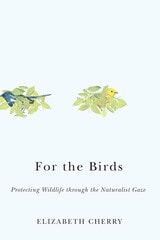
cover of For the Birds: Protecting Wildlife through the Naturalist Gaze

For the Birds

Protecting Wildlife through the Naturalist Gaze

Elizabeth Cherry

Rutgers University Press, 2019

2020 Award for Distinguished Book from the Animals & Society Section of the American Sociological Association

One in five people in the United States is a birdwatcher, yet the popular understanding of birders reduces them to comical stereotypes, obsessives who only have eyes for their favorite rare species. In real life, however, birders are paying equally close attention to the world around them, observing the devastating effects of climate change and mass extinction, while discovering small pockets of biodiversity in unexpected places.
 
For the Birds offers readers a glimpse behind the binoculars and reveals birders to be important allies in the larger environmental conservation movement. With a wealth of data from in-depth interviews and over three years of observing birders in the field, environmental sociologist Elizabeth Cherry argues that birders learn to watch wildlife in ways that make an invaluable contribution to contemporary conservation efforts. She investigates how birders develop a “naturalist gaze” that enables them to understand the shared ecosystem that intertwines humans and wild animals, an appreciation that motivates them to participate in citizen science projects and wildlife conservation.
 
[more]