384 books match the query 'Black Studies (Global)' and 23 start with f

cover of Familiar Stranger: A Life Between Two Islands

Familiar Stranger

A Life Between Two Islands

Stuart Hall

Duke University Press, 2017

"Sometimes I feel myself to have been the last colonial." This, in his own words, is the extraordinary story of the life and career of Stuart Hall—how his experiences shaped his intellectual, political, and theoretical work and how he became one of his age's brightest intellectual lights.

Growing up in a middle-class family in 1930s Kingston, Jamaica, still then a British colony, the young Stuart Hall found himself uncomfortable in his own home. He lived among Kingston's stiflingly respectable brown middle class, who, in their habits and ambitions, measured themselves against the white elite. As colonial rule was challenged, things began to change in Kingston and across the world. In 1951 a Rhodes scholarship took Hall across the Atlantic to Oxford University, where he met young Jamaicans from all walks of life, as well as writers and thinkers from across the Caribbean, including V. S. Naipaul and George Lamming. While at Oxford he met Raymond Williams, Charles Taylor, and other leading intellectuals, with whom he helped found the intellectual and political movement known as the New Left. With the emotional aftershock of colonialism still pulsing through him, Hall faced a new struggle: that of building a home, a life, and an identity in a postwar England so rife with racism that it could barely recognize his humanity.

With great insight, compassion, and wit, Hall tells the story of his early life, taking readers on a journey through the sights, smells, and streets of 1930s Kingston while reflecting on the thorny politics of 1950s and 1960s Britain. Full of passion and wisdom, Familiar Stranger is the intellectual memoir of one of our greatest minds.

[more]
cover of Far from Mecca: Globalizing the Muslim Caribbean

Far from Mecca

Globalizing the Muslim Caribbean

Aliyah Khan

Rutgers University Press, 2020

Honorable Mention, 2022 MLA Prize for a First Book

Far from Mecca: Globalizing the Muslim Caribbean is the first academic work on Muslims in the English-speaking Caribbean. Khan focuses on the fiction, poetry, and music of Islam in Guyana, Trinidad, and Jamaica. Combining archival research, ethnography, and literary analysis, Khan argues for a historical continuity of Afro- and Indo-Muslim presence and cultural production in the Caribbean. Case studies explored range from Arabic-language autobiographical and religious texts written by enslaved Sufi West Africans in nineteenth-century Jamaica, to early twentieth-century fictions of post-indenture South Asian Muslim indigeneity and El Dorado, to the attempted government coup in 1990 by the Jamaat al-Muslimeen in Trinidad, as well as the island’s calypso music, to contemporary judicial cases concerning Caribbean Muslims and global terrorism. Khan argues that the Caribbean Muslim subject, the “fullaman,” a performative identity that relies on gendering and racializing Islam, troubles discourses of creolization that are fundamental to postcolonial nationalisms in the Caribbean.
 
[more]
cover of Fashion Cities Africa

Fashion Cities Africa

Edited by Hannah Azieb Pool

Intellect Books, 2016

In a searing 2012 Guardian op-ed, Hannah Azieb Pool took Western fashion designers to task for their so-called African-inspired clothing. “Dear Fashion,” she wrote, “Africa is a continent, not a country. Can you imagine anyone describing a fashion trend as ‘European-inspired?' Of course not. It’s meaningless.” Now, with Fashion Cities Africa, Pool aims to correct the misconceptions about African fashion, providing key context for contemporary African fashion scenes and capturing the depth and breadth of truly African fashion.

Tied to the Fashion Cities Africa exhibition at the Brighton Museum, the book gives much needed attention to four key African fashion scenes: Nairobi, Lagos, Casablanca, and Johannesburg—one from each region of the continent. Filled with interviews of leading African fashion designers, stylists, and commentators, alongside hundreds of exclusive street-style images, Fashion Cities Africa is a landmark book that should be celebrated in fashion houses the world over.

[more]
cover of Fathers, Preachers, Rebels, Men: Black Masculinity in U.S. History and Literature, 1820–1945

Fathers, Preachers, Rebels, Men

Black Masculinity in U.S. History and Literature, 1820–1945

Timothy R. Buckner

The Ohio State University Press, 2011

 Fathers, Preachers, Rebels, Men: Black Masculinity in U.S. History and Literature, 1820–1945,edited by Timothy R. Buckner and Peter Caster, brings together scholars of history and literature focused on the lives and writing of black men during the nineteenth and twentieth centuries in the United States. The interdisciplinary study demonstrates the masculine character of cultural practices developed from slavery through segregation. Black masculinity embodies a set of contradictions, including an often mistaken threat of violence, the belief in its legitimacy, and the rhetorical union of truth and fiction surrounding slavery, segregation, resistance, and self-determination. The attention to history and literature is necessary because so many historical depictions of black men are rooted in fiction. The essays of this collection balance historical and literary accounts, and they join new descriptions of familiar figures such as Charles W. Chesnutt and W. E. B. Du Bois with the less familiar but critically important William Johnson and Nat Love.
 
The 2008 election of Barack Obama is a tremendously significant event in the vexed matter of race in the United States. However, the racial subtext of recent radical political movements and the 2009 arrest of scholar Henry Louis Gates, Jr., demonstrate that the perceived threat posed by black masculinity to the nation’s unity and vitality remains an alarming one in the cultural imagination.
[more]
cover of Fear of a Black Republic: Haiti and the Birth of Black Internationalism in the United States

Fear of a Black Republic

Haiti and the Birth of Black Internationalism in the United States

Leslie M. Alexander

University of Illinois Press, 2023

The emergence of Haiti as a sovereign Black nation lit a beacon of hope for Black people throughout the African diaspora. Leslie M. Alexander’s study reveals the untold story of how free and enslaved Black people in the United States defended the young Caribbean nation from forces intent on maintaining slavery and white supremacy. Concentrating on Haiti’s place in the history of Black internationalism, Alexander illuminates the ways Haitian independence influenced Black thought and action in the United States. As she shows, Haiti embodied what whites feared most: Black revolution and Black victory. Thus inspired, Black activists in the United States embraced a common identity with Haiti’s people, forging the idea of a united struggle that merged the destinies of Haiti with their own striving for freedom.

A bold exploration of Black internationalism’s origins, Fear of a Black Republic links the Haitian revolution to the global Black pursuit of liberation, justice, and social equality.
[more]
cover of Feelin: Creative Practice, Pleasure, and Black Feminist Thought

Feelin

Creative Practice, Pleasure, and Black Feminist Thought

Bettina Judd

Northwestern University Press, 2023

How creativity makes its way through feeling—and what we can know and feel through the artistic work of Black women
 
Feeling is not feelin. As the poet, artist, and scholar Bettina Judd argues, feelin, in African American Vernacular English, is how Black women artists approach and produce knowledge as sensation: internal and complex, entangled with pleasure, pain, anger, and joy, and manifesting artistic production itself as the meaning of the work. Through interviews, close readings, and archival research, Judd draws on the fields of affect studies and Black studies to analyze the creative processes and contributions of Black women—from poet Lucille Clifton and musician Avery*Sunshine to visual artists Betye Saar, Joyce J. Scott, and Deana Lawson.
 
Feelin: Creative Practice, Pleasure, and Black Feminist Thought makes a bold and vital intervention in critical theory’s trend toward disembodying feeling as knowledge. Instead, Judd revitalizes current debates in Black studies about the concept of the human and about Black life by considering how discourses on emotion as they are explored by Black women artists offer alternatives to the concept of the human. Judd expands the notions of Black women’s pleasure politics in Black feminist studies that include the erotic, the sexual, the painful, the joyful, the shameful, and the sensations and emotions that yet have no name. In its richly multidisciplinary approach, Feelin calls for the development of research methods that acknowledge creative and emotionally rigorous work as productive by incorporating visual art, narrative, and poetry.
[more]
cover of Feminism in Coalition: Thinking with US Women of Color Feminism

Feminism in Coalition

Thinking with US Women of Color Feminism

Liza Taylor

Duke University Press, 2022
In Feminism in Coalition Liza Taylor examines how US women of color feminists’ coalitional politics provides an indispensable resource to contemporary political theory, feminist studies, and intersectional social justice activism. Taylor charts the theorization of coalition in the work of Bernice Johnson Reagon, Audre Lorde, Barbara Smith, the Combahee River Collective, Gloria Anzaldúa, Cherríe Moraga, and others. For these activist-scholars, coalition is a dangerous struggle that emerges from a shared political commitment to undermining oppression and an emphasis on self-transformation. Taylor shows how their coalitional understandings of group politics, identity, consciousness, and scholarship have transformed how activists and theorists build alliances across race, class, gender, sexuality, faith, and ethnicity to tackle systems of domination. Their coalitional politics enrich current discussions surrounding the impetus and longevity of effective activism, present robust theoretical accounts of political subject formation and political consciousness, and demonstrate the promise of collective modes of scholarship. In this way, women of color feminists have been formulating solutions to long-standing problems in political theory. By illustrating coalition’s vitality to a variety of practical and philosophical interdisciplinary discussions, Taylor encourages us to rethink feminist and political theory.
[more]
cover of Finding Voice: A Visual Arts Approach to Engaging Social Change

Finding Voice

A Visual Arts Approach to Engaging Social Change

Kim S. Berman

University of Michigan Press, 2017

In Finding Voice, Kim Berman demonstrates how she was able to use visual arts training in disenfranchised communities as a tool for political and social transformation in South Africa. Using her own fieldwork as a case study, Berman shows how hands-on work in the arts with learners of all ages and backgrounds can contribute to economic stability by developing new skills, as well as enhancing public health and gender justice within communities. Berman’s work, and the community artwork her book documents, present the visual arts as a crucial channel for citizens to find their individual voices and to become agents for change in the arenas of human rights and democracy.

 
[more]
cover of Flip the Script: European Hip Hop and the Politics of Postcoloniality

Flip the Script

European Hip Hop and the Politics of Postcoloniality

J. Griffith Rollefson

University of Chicago Press, 2017

Hip hop has long been a vehicle for protest in the United States, used by its primarily African American creators to address issues of prejudice, repression, and exclusion. But the music is now a worldwide phenomenon, and outside the United States it has been taken up by those facing similar struggles. Flip the Script offers a close look at the role of hip hop in Europe, where it has become a politically powerful and commercially successful form of expression for the children and grandchildren of immigrants from former colonies.
 
Through analysis of recorded music and other media, as well as interviews and fieldwork with hip hop communities, J. Griffith Rollefson shows how this music created by black Americans is deployed by Senegalese Parisians, Turkish Berliners, and South Asian Londoners to both differentiate themselves from and relate themselves to the dominant culture. By listening closely to the ways these postcolonial citizens in Europe express their solidarity with African Americans through music, Rollefson shows, we can literally hear the hybrid realities of a global double consciousness.

 
[more]
cover of For a Pragmatics of the Useless

For a Pragmatics of the Useless

Erin Manning

Duke University Press, 2020
What has a use in the future, unforeseeably, is radically useless now. What has an effect now is not necessarily useful if it falls through the gaps. In For a Pragmatics of the Useless Erin Manning examines what falls outside the purview of already-known functions and established standards of value, not for want of potential but for carrying an excess of it. The figures are various: the infrathin, the artful, proprioceptive tactility, neurodiversity, black life. It is around the latter two that a central refrain echoes: "All black life is neurodiverse life." This is not an equation, but an "approximation of proximity." Manning shows how neurotypicality and whiteness combine to form a normative baseline for existence. Blackness and neurodiversity "schizz" around the baseline, uselessly, pragmatically, figuring a more-than of life living. Manning, in dialogue with Félix Guattari and drawing on the black radical tradition's accounts of black life and the aesthetics of black sociality, proposes a "schizoanalysis" of the more-than, charting a panoply of techniques for other ways of living and learning.
[more]
cover of Forms of Blackness: Race and Visibility in the French-Speaking World

Forms of Blackness

Race and Visibility in the French-Speaking World

Cécile Bishop

Duke University Press, 2025

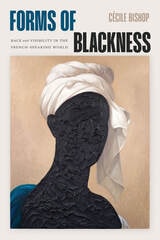
Forms of Blackness examines how race can be approached as a form shaped and perceived through visual and aesthetic practices. Cécile Bishop offers a new way of thinking about the politics of visibility and presses readers to question how to interpret what they see.

Considering race as form across literature, theory, painting, and photography, Cécile Bishop’s Forms of Blackness explores the formal devices that make blackness both visible and recognizable. In keeping with black Francophone theorists like Édouard Glissant and Frantz Fanon, Bishop uses the ambiguities these aesthetic forms carry to explore a range of identity concepts like opacity, formlessness, and doubleness. Bishop puts blackness-as-race and blackness-as-form in dialogue, showing how race disrupts the concept of artistic autonomy and how the aesthetic challenges race as a self-evident visual phenomenon. When thought together, form does not isolate blackness from race but rather calls attention to the material substrate that turns race into a phenomenon that can be experienced through sense perception. Moving between careful analysis and experimental modes of critique, Forms of Blackness offers a new way of thinking about the politics of visibility and offers a pressing invitation to question the ways we interpret what we see.
[more]
cover of Forms of Worship: How Orisa Worship Became Religion in Nigeria and Brazil

Forms of Worship

How Orisa Worship Became Religion in Nigeria and Brazil

Ayodeji Ogunnaike

Duke University Press, 2026

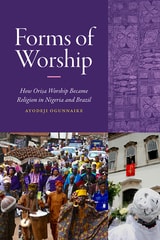
The worship of Yoruba deities known as oriṣa is commonly understood as an indigenous African religion, but Ayodeji Ogunnaike argues that these traditions initially differed from the modern Western concept of religion. In Forms of Worship, Ogunnaike analyzes how the configuration of oriṣa worship has changed across the Yoruba diaspora and homeland. As the meaning of the Yoruba word ẹsin, usually translated as “religion,” is closer to “form of worship,” he examines how reorienting understandings of oriṣa traditions as multiple forms of worship changes how religious identity, practice, and dynamics can be understood in contemporary and historical perspectives. By developing indigenous models for religious phenomena, Ogunnaike accounts for Yoruba cultural dynamics, including the high degree of religious harmony, syncretism, and interaction prevalent both in Nigeria and Brazil. Furthermore, he tracks the subtle and largely unperceived shift in oriṣa worship toward a more modern, closed, and rigid conception of religion and its resulting complications. Forms of Worship demonstrates how the advent of Western religious rigidity regarding practice and identity has led to rising religious tensions and fragmentation.
[more]
cover of Frantz Fanon: Philosopher of the Barricades

Frantz Fanon

Philosopher of the Barricades

Peter Hudis

Pluto Press, 2015

Few figures loom as large in the intellectual history of revolution and postcolonialism than Frantz Fanon. An intellectual who devoted his life to activism, he utilized his deep knowledge of psychology and philosophy in the service of the movement for democratic participation and political sovereignty in his native Martinique and around the world.
 
With FranzFanon, Peter Hudis presents a penetrating critical biography of the activist’s life and work. Countering the prevailing belief that Fanon’s contributions to modern thought can be wholly defined by an advocacy of violence, Hudis presents his work instead as an integrated whole, showing that its nuances—and thus its importance—can only be appreciated in light of Fanon’s efforts to fuse philosophical theory and actual practice. By taking seriously Fanon’s philosophical and psychological contributions, as well as his political activism, Hudis presents a powerful and perceptive new view of the man and his achievement.
 
This brief, richly perceptive introduction to Fanon will give new force to his ideas, his life, and his example for people engaged in radical political theory and taking action against oppression around the world today.
 
[more]
cover of Free Up Yuhself: Transgressive Bodies and Contestations in the Carnivalesque

Free Up Yuhself

Transgressive Bodies and Contestations in the Carnivalesque

Nikoli A. Attai

Rutgers University Press, 2025

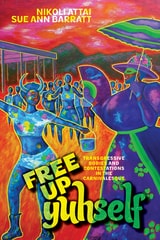
Free Up Yuhself explores and theorizes what it means to embody and be empowered by the chaos of transgression, evaluating the implications for people who destabilize the Caribbean region’s dominant gender and sexuality politics within the Caribbean and the Caribbean diaspora. This book examines how people actively utilize the carnivalesque—spaces of festivity and places of excitement, the extraordinary, the ritualistic—to confront, negotiate, disrupt, and transgress normative trends, boundaries, and perspectives in the Caribbean and Caribbean diaspora communities. This book is particularly concerned with the ways that Caribbean people contest sexual and gendered expectations through their bodily performances across regional and diasporic festival spaces. Through illustrative, analytical, evaluative, and reflective chapters, the collection contemplates the themes of freedom, belonging, acceptance, and recognition as these affect the experience of people’s sense of being. The authors reflect on “freeing up” as a contentious politics, understanding that people have the capacity to enact their freedom through transgressive movements and performances that persistently grapple with notions of respectability, agency, empowerment, disruption, and the meanings and consequences of their varied social and political locations.

[more]
cover of Freedom Seekers: Escaping from Slavery in Restoration London

Freedom Seekers

Escaping from Slavery in Restoration London

Simon P. Newman

University of London Press, 2021

Freedom Seekers reveals the hidden stories of Britain’s enslaved people and their liberation.

This book brings the history of slavery in England to light, revealing the powerful untold stories of resistance by enslaved workers from Africa, South Asia, and First-Nations America forced to work in London as sailors and dockworkers, wet-nurses and washerwomen. Featuring a series of original case studies on those enslaved people who escaped captivity, this volume provides a rich source of information about slavery in eighteenth-century mainland Britain and the “freedom seekers” therein. Using maps, photographs, newspaper advertisements, and more, the book details escape routes, the networks of slaveholders, and the community of people of color across the London region.

Freedom Seekers demonstrates that not only were enslaved people present in Restoration London but that white Londoners were intimately involved in the construction of the system of racial slavery, a process traditionally regarded as happening in the colonies rather than the British Isles. Freedom Seekers is an utterly unmissable and important book that seeks to delve into Britain’s colonial past.

[more]
cover of From Dessalines to Duvalier: Race, Colour and National Independence in Haiti

From Dessalines to Duvalier

Race, Colour and National Independence in Haiti

Nicholls, David

Rutgers University Press, 1996

In this lively, provocative, and well-documented history, David Nicholls discusses the impact of "color" on the political relationship between the black majority and the mulatto elite during almost two hundred years of Haitian history. The divisive factor impeding harmony in Haitian culture, argues Nicholls, has not been race, but color. Identifying themselves as non-white, blacks and mulattos acknowledge racial unity. But color divisions, reinforced by religious, regional, and class differences, have nonetheless prevented the two groups from achieving poltitical and ideological unity. Nicholls grounds this sophisticated analysis in great historical detail and engaging, witty prose. Students and general readers alike will delight in this insightful and informative history of Haiti.
[more]
cover of From Dessalines to Duvalier: Race, Colour and National Independence in Haiti

From Dessalines to Duvalier

Race, Colour and National Independence in Haiti

Nicholls, David

Rutgers University Press, 1996
In this lively, provocative, and well-documented history, David Nicholls discusses the impact of "color" on the political relationship between the black majority and the mulatto elite during almost two hundred years of Haitian history. The divisive factor impeding harmony in Haitian culture, argues Nicholls, has not been race, but color. Identifying themselves as non-white, blacks and mulattos acknowledge racial unity. But color divisions, reinforced by religious, regional, and class differences, have nonetheless prevented the two groups from achieving poltitical and ideological unity. Nicholls grounds this sophisticated analysis in great historical detail and engaging, witty prose. Students and general readers alike will delight in this insightful and informative history of Haiti.
[more]
cover of From Jim Crow to Jay-Z: Race, Rap, and the Performance of Masculinity

From Jim Crow to Jay-Z

Race, Rap, and the Performance of Masculinity

Miles White

University of Illinois Press, 2011

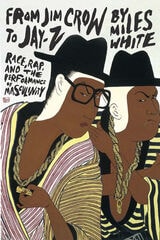
This multilayered study of the representation of black masculinity in musical and cultural performance takes aim at the reduction of African American male culture to stereotypes of deviance, misogyny, and excess. Broadening the significance of hip-hop culture by linking it to other expressive forms within popular culture, Miles White examines how these representations have both encouraged the demonization of young black males in the United States and abroad and contributed to the construction of their identities.

From Jim Crow to Jay-Z traces black male representations to chattel slavery and American minstrelsy as early examples of fetishization and commodification of black male subjectivity. Continuing with diverse discussions including black action films, heavyweight prizefighting, Elvis Presley's performance of blackness, and white rappers such as Vanilla Ice and Eminem, White establishes a sophisticated framework for interpreting and critiquing black masculinity in hip-hop music and culture. Arguing that black music has undeniably shaped American popular culture and that hip-hop tropes have exerted a defining influence on young male aspirations and behavior, White draws a critical link between the body, musical sound, and the construction of identity.
[more]
cover of From Plantation to Paradise?: Cultural Politics and Musical Theatre in French Slave Colonies, 1764–1789

From Plantation to Paradise?

Cultural Politics and Musical Theatre in French Slave Colonies, 1764–1789

David M. Powers

Michigan State University Press, 2014

In 1764 the first printing press was established in the French Caribbean colonies, launching the official documentation of operas and plays performed there, and marking the inauguration of the first theatre in the colonies. A rigorous study of pre–French Revolution performance practices in Guadeloupe, Martinique, and Saint-Domingue (now Haiti), Powers’s book examines the elaborate system of social casting in these colonies; the environments in which nonwhite artists emerged; and both negative and positive contributions of the Catholic Church and the military to operas and concerts produced in the colonies. The author also explores the level of participation of nonwhites in these productions, as well as theatre architecture, décor, repertoire, seating arrangements, and types of audiences. The status of nonwhite artists in colonial society; the range of operas in which they performed; their accomplishments, praise, criticism; and the use of créole texts and white actors/singers à visage noirs (with blackened faces) present a clear picture of French operatic culture in these colonies. Approaching the French Revolution, the study concludes with an examination of the ways in which colonial opera was affected by slave uprisings, the French Revolution, the emergence of “patriotic theatres,” and their role in fostering support for the king, as well as the impact on subsequent operas produced in the colonies and in the United States.
[more]
cover of From Rights to Lives: The Evolution of the Black Freedom Struggle

From Rights to Lives

The Evolution of the Black Freedom Struggle

Edited by Françoise N. Hamlin and Charles W. McKinney Jr.

Vanderbilt University Press, 2024

Broadly speaking, the traditionally conceptualized mid-twentieth-century Civil Rights Movement and the newer #BlackLivesMatter Movement possess some similar qualities. They both represent dynamic, complex moments of possibility and progress. They also share mass-based movement activities, policy/legislative advocacy, grassroots organizing, and targeted media campaigns. Innovation, growth, and dissension—core aspects of movement work—mark them both. Crucially, these moments also engender aggressive, repressive, multilevel responses to these assertions of Black humanity.

From Rights to Lives critically engages the dynamic relationship between these two moments of liberatory possibility on the Black Freedom Struggle timeline. The book’s contributors explore what we can learn when we place these moments of struggle in dialogue with each other. They grapple with how our understanding of the postwar moment shapes our analysis of #BLM and wherein lie the discontinuities, in order to glean lessons for future moments of insurgency.
[more]
cover of Fueling Development: How Black Radical Trade Unionism Transformed Trinidad and Tobago

Fueling Development

How Black Radical Trade Unionism Transformed Trinidad and Tobago

Zophia Edwards

Duke University Press, 2025

Despite Trinidad and Tobago’s economic dependence on oil and gas production and its history of colonial exploitation of labor and resources, it enjoys relatively high democratic and redistributive development compared to other nations in the global South. In Fueling Development, Zophia Edwards draws on archival data, historical analysis, and Black radical political economic thought to trace Trinidad and Tobago’s success to a specific form of working-class mobilization she calls “liberation unionism.” A Black radical labor tradition, liberation unionism was multiracial, multisectoral, and gender inclusive; and Pan-African, anti-imperial, anticolonial, and diasporic; it advocated not only for workplace issues, but for economic, political, and social transformation. Emerging during the colonial period, liberation unionism forced the colonial state to increase its institutional capacity to promote equitable development. The movement persisted into the post-independence period and further compelled the independent state to channel oil windfalls toward increasing its ability to better serve the needs of the people. By uncovering liberation unionism’s power to create robust social and economic change, Edwards expands understandings of the relationship between development, race, labor, and political economy.
[more]
cover of Fugitive Modernities: Kisama and the Politics of Freedom

Fugitive Modernities

Kisama and the Politics of Freedom

Jessica A. Krug

Duke University Press, 2018
During the early seventeenth century, Kisama emerged in West Central Africa (present-day Angola) as communities and an identity for those fleeing expanding states and the violence of the trans-Atlantic slave trade. The fugitives mounted effective resistance to European colonialism despite—or because of—the absence of centralized authority or a common language. In Fugitive Modernities Jessica A. Krug offers a continent- and century-spanning narrative exploring Kisama's intellectual, political, and social histories. Those who became Kisama forged a transnational reputation for resistance, and by refusing to organize their society around warrior identities, they created viable social and political lives beyond the bounds of states and the ruthless market economy of slavery. Krug follows the idea of Kisama to the Americas, where fugitives in the New Kingdom of Grenada (present-day Colombia) and Brazil used it as a means of articulating politics in fugitive slave communities. By tracing the movement of African ideas, rather than African bodies, Krug models new methods for grappling with politics and the past, while showing how the history of Kisama and its legacy as a global symbol of resistance that has evaded state capture offers essential lessons for those working to build new and just societies.
[more]
cover of Fugitive Time: Global Aesthetics and the Black Beyond

Fugitive Time

Global Aesthetics and the Black Beyond

Matthew Omelsky

Duke University Press, 2023

In Fugitive Time, Matthew Omelsky theorizes the embodied experience of time in twentieth- and twenty-first-century black artforms from across the world. Through the lens of time, he charts the sensations and coursing thoughts that accompany desires for freedom as they appear in the work of artists as varied as Toni Morrison, Yvonne Vera, Aimé Césaire, and Issa Samb. “Fugitive time” names a distinct utopian desire directed at the anticipated moment when the body and mind have been unburdened of the violence that has consumed black life globally for centuries, bringing with it a new form of being. Omelsky shows how fugitive time is not about attaining this transcendent release but is instead about sustaining the idea of it as an ecstatic social gathering. From the desire for ethereal queer worlds in the Black Audio Film Collective’s Twilight City to Sun Ra’s transformation of nineteenth-century scientific racism into an insurgent fugitive aesthetic, Omelsky shows how fugitive time evolves and how it remains a dominant form of imagining freedom in global black cultural expression.
[more]