Results by title
211 books match the query 'Blacks' and 4 start with f

Fernando Ortiz on Music
Selected Writing on Afro-Cuban CultureRobin D. Moore
Temple University Press, 2018
Fernando Ortiz (1881–1969) is recognized as one of the most influential Latin American authors of the twentieth century. Although he helped establish the field of Afro-diasporic studies, his writings are still relatively unknown to the English-speaking world. In Fernando Ortiz on Music, accomplished ethnomusicologist Robin Moore has collected and translated an essential selection of Ortiz’s publications. These essays on Afro-Cuban expressive culture, music and dance are now available for the first time in English.
Ortiz’s writings are accompanied by an extended introduction that contextualizes the author’s life, intellectual influences, and collaborators as well as his fieldwork and interviews. Fernando Ortiz on Music also charts the writer’s changing views of black heritage through the years. This comprehensive anthology, which includes examples of his early scholarship as well as publications from the 1940s and ’50s, extends the life and legacy of this important and under-known scholar of Latin American and Caribbean music.
Contributors include: David Garcia, Sarah Lahasky, Cary Peñate, Susan Thomas, and the editor

Freedom In Our Lifetime
The Collected Writings Of Anton Muziwakhe LembedeAnton Muziwakhe Lembede
Ohio University Press, 1996
When a group of young political activists met in 1944 to launch the African National Congress Youth League, it included the nucleus of a remarkable generation of leaders who forged the struggle for freedom and equality in South Africa for the next half century: Nelson Mandela, Oliver Tambo, Walter Sisulu, Jordan Ngubane, Ellen Kuzwayo, Albertina Smith, A. P. Mda, Dan Tloome, and David Bopape. It was Anton Lembede, however whom they chose as their first president.
Lembede, who had just begun practicing law in Johannesburg, was known for his sharp intellect, fiery personality, and unwavering commitment to the struggle at hand. The son of farm laborers from the district of Georgedale, Natal, Lembede had worked tirelessly to put himself through school and college, and then to qualify for the bachelor of laws degree. When he began law practice in 1943, he had also earned the respect of his fellows, not only for his intellectual achievements (which were many), but also for his dedication to the cause of freedom in South Africa. “I am,” he explained, “Africa’s own child.”
His untimely death in 1947 at the age of 33 sent a wave of grief through the Congress Youth, who had looked to him for moral as well as political leadership. With the publication of Freedom In Our Lifetime, the editors acknowledge Lembede’s early contribution to the freedom movement, in particular his passionate and eloquent articulation of the African-centered philosophy he called “Africanism.”
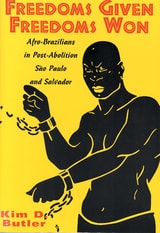
Freedoms Given, Freedoms Won
Afro-Brazilians in Post-Abolition São Paolo and SalvadorButler, Kim D
Rutgers University Press, 1998
Freedoms Given, Freedoms Won explores the ways Afro-Brazilians in two major cities adapted to the new conditions of life after the abolition of slavery and how they confronted limitations placed on their new freedom. The book sets forth new ways of understanding why the abolition of slavery did not yield equitable fruits of citizenship, not only in Brazil, but throughout the Americas and the Caribbean.
Afro-Brazilians in Sao Paulo and Salvador lived out their new freedom in ways that raise issues common to the entire Afro-Atlantic diaspora. In Sao Paulo, they initiated a vocal struggle for inclusion in the creation of the nation's first black civil rights organization and political party, and they appropriated a discriminatory identity that isolated blacks. In contrast, African identity prevaled over black identity in Salvador, where social protest was oriented toward protecting the right of cultural pluralism.
Of all the eras and issues studied in Afro-Brazilian history, post-abolition social and political action has been the most neglected. Butler provides many details of this period for the first time in English and supplements published sources with original oral histories, Afro-Brazilian newspapers, and new state archival documents currently being catalogued in Bahia. Freedoms Given, Freedoms Won sets the Afro-Brazilian experience in a national context as well as situating it within the Afro-Atlantic diaspora through a series of explicit parallels, particularly with Cuba and Jamaica.
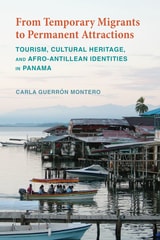
From Temporary Migrants to Permanent Attractions
Tourism, Cultural Heritage, and Afro-Antillean Identities in PanamaCarla Guerrón Montero
University of Alabama Press, 2020
A new reading of Panama’s nation-building process, interpreted through a lens of transnational tourism
Based on long-term ethnographic and archival research, From Temporary Migrants to Permanent Attractions: Tourism, Cultural Heritage, and Afro-Antillean Identities in Panama considers the intersection of tourism, multiculturalism, and nation building. Carla Guerrón Montero analyzes the ways in which tourism becomes a vehicle for the development of specific kinds of institutional multiculturalism and nation-building projects in a country that prides itself on being multiethnic and racially democratic.
The narrative centers on Panamanian Afro-Antilleans who arrived in Panama in the nineteenth century from the Greater and Leeward Antilles as a labor force for infrastructural projects and settled in Panama City, Colón, and the Bocas del Toro Archipelago. The volume discusses how Afro-Antilleans, particularly in Bocas del Toro, have struggled since their arrival to become part of Panama’s narrative of nationhood and traces their evolution from plantation workers for the United Fruit Company to tourism workers. Guerrón Montero notes that in the current climate of official tolerance, they have seized the moment to improve their status within Panamanian society, while also continuing to identify with their Caribbean heritage in ways that conflict with their national identity.