Results by title
61 books match the query 'Business Development' and 3 start with f

Financial Markets Volatility and Performance in Emerging Markets
Edited by Sebastian Edwards and Márcio G. P. Garcia
University of Chicago Press, 2008
Capital mobility is a double-edged sword for emerging economies, as governments must weigh the benefits of investment against the potential economic costs and political consequences of currency crises, devaluations, and instability. Financial Markets Volatility and Performance in Emerging Markets addresses the delicate balance between capital mobility and capital controls as developing countries navigate the convoluted global network of private investors, hedge funds, large corporations, and international institutions such as the International Monetary Fund.
A group of experts here examine rapidly globalizing financial markets with regard to capital flows and crises, domestic credit, international financial integration, and economic policy. Featuring detailed analyses and cross-national comparisons of countries such as Brazil, Argentina, Uruguay, and Korea, this book will shape economists’ and policymakers’ understanding of the effectiveness of restrictions on capital mobility in the world’s most fragile economies.
A group of experts here examine rapidly globalizing financial markets with regard to capital flows and crises, domestic credit, international financial integration, and economic policy. Featuring detailed analyses and cross-national comparisons of countries such as Brazil, Argentina, Uruguay, and Korea, this book will shape economists’ and policymakers’ understanding of the effectiveness of restrictions on capital mobility in the world’s most fragile economies.
[more]

Fragments of Development
Nation, Gender, and the Space of ModernitySuzanne Bergeron
University of Michigan Press, 2005
"A bold and challenging consideration of questions of development, economic globalization, communities and subjectivity from a unique feminist perspective. A must-read book for those who wish to understand restructuring and resistance in this era of intensified globalization."
---Isabella C. Bakker, York University
"Bergeron's pathbreaking analysis challenges orthodox development theories, questions current feminist economic thinking and highlights crucial new gendered challenges to globalization."
---Jane Parpart, Dalhousie University
"Cutting-edge scholarship. Bergeron deftly engages the complexity of current debates while retaining clarity, improving analyses, and illuminating alternatives."
---V. S. Peterson, University of Arizona
By tracing out the intersection between the imagined space of the national economy and the gendered construction of "expert" knowledge in development thought, Suzanne Bergeron provides a provocative analysis of development discourse and practice. By elaborating a framework of including/excluding economic subjects and activities in development economics, she provides a rich account of the role that economists have played in framing the contested political and cultural space of development.
Bergeron's account of the construction of the national economy as an object of development policy follows its shifting meanings through modernization and growth models, dependency theory, structural adjustment, and contemporary debates about globalization and highlights how intersections of nation and economy are based on gendered and colonial scripts. The author's analysis of development debates effectively demonstrates that critics of development who ignore economists' nation stories may actually bolster the formation they are attempting to subvert. Fragments of Development is essential reading for those interested in development studies, feminist economics, international political economy, and globalization studies.
[more]
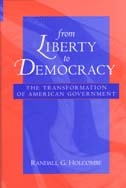
From Liberty to Democracy
The Transformation of American GovernmentRandall G. Holcombe
University of Michigan Press, 2002
At the nation's founding, the fundamental principle underlying American government was liberty, and the nation's new government was designed to protect the rights of individuals. The American founders intended to design a government that would protect the rights of its citizens, and at that time the most serious threat to people's rights was government. Thus, the United States government was designed with a constitutionally limited scope to preserve the rights of individuals and limit the powers of government.
The government's activities during two world wars and the Great Depression greatly increased its involvement in people's economic affairs, and by the time of Lyndon Johnson's Great Society, the transformation was complete. By the end of the twentieth century, the fundamental principle underlying American government had been transformed to democracy, and public policy was designed to further the will of the majority. The result has been a government that is larger and broader in scope.
From Liberty to Democracy examines American political history using the framework of public choice theory to show how American government grew more democratic, and how this resulted in an increase in the size and scope of government. It should appeal to historians, political scientists, and economists who are interested in the evolution of American government but does not assume any specialized training and can be read by anyone interested in American political history.
Randall G. Holcombe is DeVoe Moore Professor of Economics, Florida State University
[more]