53 books match the query 'Capital punishment' and 5 start with f
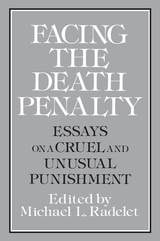
cover of Facing the Death Penalty: Essays on a Cruel and Unusual Punishment

Facing the Death Penalty

Essays on a Cruel and Unusual Punishment

edited by Michael L. Radelet, foreword by Henry Schwarzschild

Temple University Press, 1990
"These essays...show us the human and inhuman realities of capital punishment through the eyes of the condemned and those who work with them. By focusing on those awaiting death, they present the awful truth behind the statistics in concrete, personal terms." --William J. Bowers, author of Legal Homicide Between 1930 and 1967, there were 3,859 executions carried out under state and civil authority in the United States. Since the ten-year moratorium on capital punishment ended in 1977, more than one hundred prisoners have been executed. There are more than two thousand men and women now living on death row awaiting their executions. Facing the Death Penalty offers an in-depth examination of what life under a sentence of death is like for condemned inmates and their families, how and why various professionals assist them in their struggle for life, and what these personal experiences with capital punishment tell us about the wisdom of this penal policy. The contributors include historians, attorneys, sociologists, anthropologists, criminologists, a minister, a philosopher, and three prisoners. One of the prisoner-contributors is Willie Jasper Darden, Jr., whose case and recent execution after fourteen years on death row drew international attention. The inter-disciplinary perspectives offered in this book will not solve the death penalty debate, but they offer important and unique insights on the full effects of American capital punishment provisions. While the book does not set out to generate sympathy for those convicted of horrible crimes, taken together, the essays build a case for abolition of the death penalty. "This work stands with the best of what's been written. It represents the best of those who have seen the worst." --Colman McCarthy, The Washington Post Book World
[more]
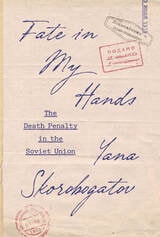
cover of Fate in My Hands: The Death Penalty in the Soviet Union

Fate in My Hands

The Death Penalty in the Soviet Union

Yana Skorobogatov

University of Chicago Press, 2026

A striking examination of the death penalty in the Soviet Union that documents in heart-rending detail how its citizens, hopeful for a new life post-Stalin, lost faith that their transgressions could be forgiven.

From 1954 to 1991 in the Soviet Union, nearly forty thousand citizens were executed after the death penalty was reinstated as a punishment for homicide. Fate in My Hands introduces readers to the many citizens in this period—women and men of all ages and backgrounds—who found themselves on death row and tried to escape it in the only way available to them: asking for forgiveness.

Examining the letters and objects the dead left behind, Skorobogatov recovers their voices and allows them to speak anew. She offers a striking portrait of life in the Soviet Union and the citizens who dreamed of new possibilities even as they faced their tragic end. Using a corpus of never-before-accessed criminal court records, Fate in My Hands brings readers not just into the police interrogation rooms, courthouses, and cells where the condemned awaited their fates, but into the homes, workplaces, and psychiatric hospitals where families and friends alike came together to pursue an elusive, bitter justice in the wake of violent tragedy.
[more]
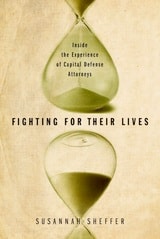
cover of Fighting for Their Lives: Inside the Experience of Capital Defense Attorneys

Fighting for Their Lives

Inside the Experience of Capital Defense Attorneys

Susannah Sheffer

Vanderbilt University Press, 2013

How do attorneys who represent clients facing the death penalty cope with the stress and trauma of their work? Through conversations with twenty of the most experienced and dedicated post-conviction capital defenders in the United States, Fighting for Their Lives explores this emotional territory for the first time. What it is like for these capital defenders in their last visits or phone calls with clients who are about to be taken to the execution chamber? Or the next mornings, in their lives with their families, in their dreams and flashbacks and moments alone in the car? What is it like to do this work year after year? (These attorneys had, on average, spent nineteen years doing capital defense.)


Through vivid interviews amplified by the author's responses and commentary, these attorneys reveal aspects of their internal experience that they have never talked about until now. How do capital defenders manage the weight of the responsibility they carry? To what extent do they experience symptoms of trauma in the aftermath of losing a client to execution or as a result of the cumulative effects of engaging in capital defense work? What motivates them, and what do they draw upon, in order to keep engaging in such emotionally demanding work? Have they considered practicing other types of law? What can we learn from capital defenders not only about the deep and long-term effects of the death penalty but also about broader human questions of hope, effectiveness, success, failure, strength, fragility, and perseverance?
[more]
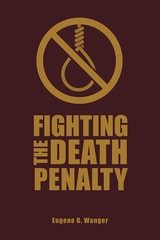
cover of Fighting the Death Penalty: A Fifty-Year Journey of Argument and Persuasion

Fighting the Death Penalty

A Fifty-Year Journey of Argument and Persuasion

Eugene G. Wanger

Michigan State University Press, 2019
Michigan is the only state in the country that has a death penalty prohibition in its constitution—Eugene G. Wanger’s compelling arguments against capital punishment is a large reason it is there. The forty pieces in this volume are writings created or used by the author, who penned the prohibition clause, during his fifty years as a death penalty abolitionist. His extraordinary background in forensics, law, and political activity as constitutional convention delegate and co-chairman of the Michigan Committee Against Capital Punishment has produced a remarkable collection. It is not only a fifty-year history of the anti–death penalty argument in America, it also is a detailed and challenging example of how the argument against capital punishment may be successfully made.
 
 
[more]
cover of From Noose to Needle: Capital Punishment and the Late Liberal State

From Noose to Needle

Capital Punishment and the Late Liberal State

Timothy V. Kaufman-Osborn

University of Michigan Press, 2002

From Noose to Needle contributes a new perspective on the controversial topic of capital punishment by asking how the conduct of state killing reveals broader contradictions in the contemporary liberal state, especially, but not exclusively, in the United States. Moving beyond more familiar legal and sociological approaches to this matter, Timothy V. Kaufman-Osborn asks several questions. Why do executions no longer take the form of public spectacles? Why are certain methods of execution considered barbaric? Why must the liberal state strictly segregate the imposition of a death sentence, whether by judge or jury, from its actual infliction, whether by a state official or an ordinary citizen? Why are women so infrequently sentenced to death and executed? How does the state seek to hide the suffering inflicted by capital punishment through its endorsement of a bio-medical conception of pain? How does the nearly-universal shift to lethal injection pose problems for the late liberal state by confusing its punitive and welfare responsibilities?
Drawing on a wide range of theoretical sources, including John Locke, Max Weber, Nicos Poulantzas, Friedrich Nietzsche, J. L. Austin, Michel Foucault, Judith Butler, Pierre Bourdieu, Elaine Scarry, and others, Kaufman-Osborn grounds his appropriation of these authors in analyses of specific recent executions, including that of Wesley Allan Dodd and Charles Campbell in Washington, Karla Faye Tucker in Texas, and Allen Lee Davis in Florida.
From Noose to Needle will be of interest to students of law, political theory, and sociology as well as more general readers interested in the troublesome issue of capital punishment.
Timothy V. Kaufman-Osborn is Baker Ferguson Professor of Politics and Leadership, Whitman College.
[more]