Results by title
99 books match the query 'Censorship' and 4 start with f
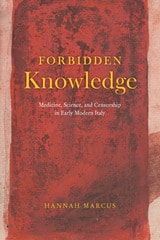
Forbidden Knowledge
Medicine, Science, and Censorship in Early Modern ItalyHannah Marcus
University of Chicago Press, 2020
Forbidden Knowledge explores the censorship of medical books from their proliferation in print through the prohibitions placed on them during the Counter-Reformation. How and why did books banned in Italy in the sixteenth century end up back on library shelves in the seventeenth? Historian Hannah Marcus uncovers how early modern physicians evaluated the utility of banned books and facilitated their continued circulation in conversation with Catholic authorities.
Through extensive archival research, Marcus highlights how talk of scientific utility, once thought to have begun during the Scientific Revolution, in fact, began earlier, emerging from ecclesiastical censorship and the desire to continue to use banned medical books. What’s more, this censorship in medicine, which preceded the Copernican debate in astronomy by sixty years, has had a lasting impact on how we talk about new and controversial developments in scientific knowledge. Beautiful illustrations accompany this masterful, timely book about the interplay between efforts at intellectual control and the utility of knowledge.
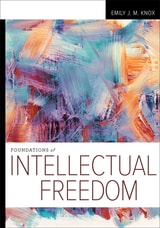
Foundations of Intellectual Freedom
Emily J. M. Knox
American Library Association, 2022
- the historical and legal roots of intellectual freedom, with an in-depth examination of John Stuart Mill’s “On Liberty” and Article 19 of the U.N Declaration of Human Rights, and its central concepts and principles;
- the intersection of intellectual freedom, freedom of expression, and social justice;
- professional values, codes of ethics, ALA’s Library Bill of Rights, and Freedom to Read/View Statements;
- pro- and anti- censorship arguments and their use in impeding and facilitating access to information;
- book banning and internet filtering;
- privacy and its relationship to information services;
- U.S. case law and precedents;
- the basics of U.S. copyright law, including fair use, and how it differs from international copyright law; and
- emerging global issues and their impact on future intellectual freedom.
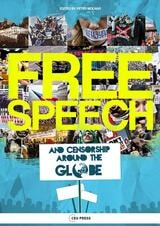
Free Speech and Censorship Around the Globe
Peter Molnar
Central European University Press, 2015
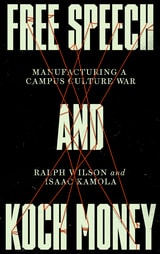
Free Speech and Koch Money
Manufacturing a Campus Culture WarRalph Wilson
Pluto Press, 2021
In recent years hundreds of high-profile ‘free speech’ incidents have rocked US college campuses. Milo Yiannopoulos, Ben Shapiro, Ann Coulter and other right-wing speakers have faced considerable protest, with many being disinvited from speaking. These incidents are widely circulated as examples of the academy’s intolerance towards conservative views.
But this response is not the spontaneous outrage of the liberal colleges. There is a darker element manufacturing the crisis, funded by political operatives, and designed to achieve specific political outcomes. If you follow the money, at the heart of the issue lies the infamous and ultra-libertarian Koch donor network.
Grooming extremist celebrities, funding media platforms that promote these controversies, developing legal organzations to sue universities and corrupting legislators, the influence of the Koch network runs deep. We need to abandon the ‘campus free speech’ narrative and instead follow the money if we ever want to root out this dangerous network from our universities.