Results by title
51 books match the query 'Children's & Young Adult Literature' and 3 start with f
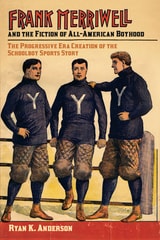
Frank Merriwell and the Fiction of All-American Boyhood
The Progressive Era Creation of the Schoolboy Sports StoryRyan K. Anderson
University of Arkansas Press, 2015
Merriwell came to symbolize the Progressive Era debate about how sport and school made boys into men. The saga featured the attractive Merriwell distinguishing between “good” and “bad” girls and focused on his squeaky-clean adventures in physical development and mentorship. By the serial’s conclusion, Merriwell had opened a school for “weak and wayward boys” that made him into a figure who taught readers how to approximate his example.
In Frank Merriwell and the Fiction of All-American Boyhood, Anderson treats Tip Top Weekly as a historical artifact, supplementing his reading of its text, illustrations, reader letters, and advertisements with his use of editorial correspondence, memoirs, trade journals, and legal documents. Anderson blends social and cultural history, with the history of business, gender, and sport, along with a general examination of childhood and youth in this fascinating study of how a fictional character was used to promote a homogeneous “normal” American boyhood rooted in an assumed pecking order of class, race, and gender.

Freud in Oz
At the Intersections of Psychoanalysis and Children’s LiteratureKenneth B. Kidd
University of Minnesota Press, 2011
Children’s literature has spent decades on the psychiatrist’s couch, submitting to psychoanalysis by scores of scholars and popular writers alike. Freud in Oz turns the tables, suggesting that psychoanalysts owe a significant and largely unacknowledged debt to books ostensibly written for children. In fact, Kenneth B. Kidd argues, children’s literature and psychoanalysis have influenced and interacted with each other since Freud published his first case studies.
In Freud in Oz, Kidd shows how psychoanalysis developed in part through its engagement with children’s literature, which it used to articulate and dramatize its themes and methods, turning first to folklore and fairy tales, then to materials from psychoanalysis of children, and thence to children’s literary texts, especially such classic fantasies as Peter Pan and Alice’s Adventures in Wonderland. He traces how children’s literature, and critical response to it, aided the popularization of psychoanalytic theory. With increasing acceptance of psychoanalysis came two new genres of children’s literature—known today as picture books and young adult novels—that were frequently fashioned as psychological in their forms and functions.
Freud in Oz offers a history of reigning theories in the study of children’s literature and psychoanalysis, providing fresh insights on a diversity of topics, including the view that Maurice Sendak and Bruno Bettelheim can be thought of as rivals, that Sendak’s makeover of monstrosity helped lead to the likes of the Muppets, and that “Poohology” is its own kind of literary criticism—serving up Winnie the Pooh as the poster bear for theorists of widely varying stripes.
From Little Houses to Little Women
Revisiting a Literary ChildhoodNancy McCabe
University of Missouri Press, 2018
McCabe, who grew up in Kansas just a few hours from the Ingalls family’s home in Little House on the Prairie, always felt a deep connection with Laura Ingalls Wilder, author of the Little House series. McCabe read Little House on the Prairie during her childhood and visited Wilder sites around the Midwest with her aunt when she was thirteen. But then she didn’t read the series again until she decided to revisit in adulthood the books that had so influenced her childhood. It was this decision that ultimately sparked her desire to visit the places that inspired many of her childhood favorites, taking her on a journey that included stops in the Missouri of Laura Ingalls Wilder, the Minnesota of Maud Hart Lovelace, the Massachusetts of Louisa May Alcott, and even the Canada of Lucy Maud Montgomery.
From Little Houses to Little Women reveals McCabe’s powerful connection to the characters and authors who inspired many generations of readers. Traveling with McCabe as she rediscovers the books that shaped her and ultimately helped her to forge her own path, readers will enjoy revisiting their own childhood favorites as well.