662 books match the query 'China' and 14 start with f
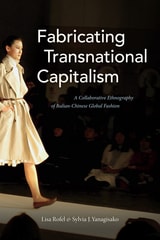
cover of Fabricating Transnational Capitalism: A Collaborative Ethnography of Italian-Chinese Global Fashion

Fabricating Transnational Capitalism

A Collaborative Ethnography of Italian-Chinese Global Fashion

Lisa Rofel and Sylvia J. Yanagisako

Duke University Press, 2018
In this innovative collaborative ethnography of Italian-Chinese ventures in the fashion industry, Lisa Rofel and Sylvia J. Yanagisako offer a new methodology for studying transnational capitalism. Drawing on their respective linguistic and regional areas of expertise, Rofel and Yanagisako show how different historical legacies of capital, labor, nation, and kinship are crucial in the formation of global capitalism. Focusing on how Italian fashion is manufactured, distributed, and marketed by Italian-Chinese ventures and how their relationships have been complicated by China's emergence as a market for luxury goods, the authors illuminate the often-overlooked processes that produce transnational capitalism—including privatization, negotiation of labor value, rearrangement of accumulation, reconfiguration of kinship, and outsourcing of inequality. In so doing, Fabricating Transnational Capitalism reveals the crucial role of the state and the shifting power relations between nations in shaping the ideas and practices of the Italian and Chinese partners.
[more]
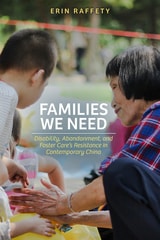
cover of Families We Need: Disability, Abandonment, and  Foster Care’s Resistance in Contemporary China

Families We Need

Disability, Abandonment, and Foster Care’s Resistance in Contemporary China

Erin Raffety

Rutgers University Press, 2023
Set in the remote, mountainous Guangxi Autonomous Region and based on ethnographic fieldwork, Families We Need traces the movement of three Chinese foster children, Dengrong, Pei Pei, and Meili, from the state orphanage into the humble, foster homes of Auntie Li, Auntie Ma, and Auntie Huang. Traversing the geography of Guangxi, from the modern capital Nanning where Pei Pei and Meili reside, to the small farming village several hours away where Dengrong is placed, this ethnography details the hardships of social abandonment for disabled children and disenfranchised, older women in China, while also analyzing the state’s efforts to cope with such marginal populations and incorporate them into China’s modern future. The book argues that Chinese foster families perform necessary, invisible service to the Chinese state and intercountry adoption, yet the bonds they form also resist such forces, exposing the inequalities, privilege, and ableism at the heart of global family making.
[more]
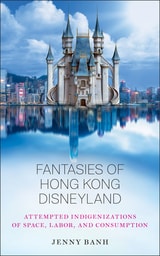
cover of Fantasies of Hong Kong Disneyland: Attempted Indigenizations of Space, Labor, and Consumption

Fantasies of Hong Kong Disneyland

Attempted Indigenizations of Space, Labor, and Consumption

Jenny Banh

Rutgers University Press, 2025
Fantasies of Hong Kong Disneyland: Attempted Indigenizations of Space, Labor, and Consumption examines the attempt to transplant Disney's "happiest place on Earth" ethos to Hong Kong—with unhappy results. Focusing on the attempted localization/indigenization of this idea in a globalized transnational park, the book delves into the three-way dynamics of an American culture-corporation's intentions, Hong Kong, China's government investment and Hong Konger audience, and the Hong Kong Chinese locale. The triple actors introduce an especially complex case as two of the world's most powerful entities, the nominally Communist state of China and corporate behemoth Disney, come together for a project in the third space of Hong Kong. The situation poses special challenges for Disney's efforts to manage space, labor, and consumption to achieve local adaptation and business success. 
[more]
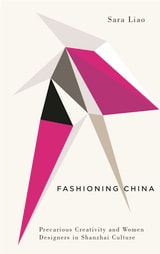
cover of Fashioning China: Precarious Creativity and Women Designers in Shanzhai Culture

Fashioning China

Precarious Creativity and Women Designers in Shanzhai Culture

Sara Liao

Pluto Press, 2020

'Shanzhai'  from Cantonese slang, refers to the production of fake goods in China, which enjoy an anti-authoritarian-like dissemination across the global market. Starting with mobile phones, now fashion brands are subverted in this way, with many women at the helm of design and production. Fashioning China looks at the women designers simultaneously subverting and reinforcing the nationalist-developmentalist, masculinist and technocratic dream of brands that are 'Made in China'.

Broadening the digital labor debate beyond typical masculine and techno-utopic readings, Sara Liao studies the precarious practices of women trying to create sustainable and creative lives, vividly illustrating a fashion culture that exists online as a significant part of the digital economy.

Drawing on material from interviews, participant observation, archives, policy documents, films and advertisements, Liao takes a multi-disciplinary approach to the topic, charting out the politics of intellectual property rights, globalization, technocracy, patriarchy and nationalism in a non-Western context.
[more]
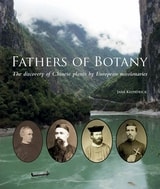
cover of Fathers of Botany: The Discovery of Chinese Plants by European Missionaries

Fathers of Botany

The Discovery of Chinese Plants by European Missionaries

Jane Kilpatrick

Royal Botanic Gardens, Kew, 2014

Many of the world’s most renowned and exciting ornamental plants—including magnolias, roses, rhododendrons, tree peonies, lilies, and blue poppies—have their origins in China. In the mid-nineteenth century, professional plant hunters were dispatched by nurseries and botanic gardens to collect living botanical specimens from China for cultivation in Europe, and it is these adventurers and nurserymen who are often credited with the explosive bloom of Chinese flowers in the West.

But as Jane Kilpatrick shows in Fathers of Botany, the first Westerners to come upon and document this bounty were in fact cut from a different cloth: the clergy. Following the Opium Wars, European missionaries were the first explorers to dig further into the Chinese interior and send home evidence of one of the richest and most varied floras ever seen, and it was their discoveries that caused a sensation among Western plantsmen. Both men of faith and talented botanists alike, these missionaries lent their names to many of the plants they discovered, but their own stories disappeared into the leaf litter of history. Drawing on their letters and contemporary accounts, Kilpatrick focuses on the lives of four great French missionary botanists—Pères Armand David (of Davidia involucrata—the dove tree—and discoverer of the giant panda), Jean Marie Delavay, Paul Guillaume Farges, and Jean André Soulié—as well as a group of other French priests, Franciscan missionaries, and a single German Protestant pastor who all amassed significant plant collections, as she unearths a lost chapter of botanical history. In so doing, she reminds today’s gardeners and botanists—and any of us who stop to smell the roses—of the enormous debt owed to these obscure fathers of botany.
[more]
cover of Fiery Cinema: The Emergence of an Affective Medium in China, 1915–1945

Fiery Cinema

The Emergence of an Affective Medium in China, 1915–1945

Weihong Bao

University of Minnesota Press, 2015

What was cinema in modern China? It was, this book tells us, a dynamic entity, not strictly tied to one media technology, one mode of operation, or one system of aesthetic code. It was, in Weihong Bao’s term, an affective medium, a distinct notion of the medium as mediating environment with the power to stir passions, frame perception, and mold experience. In Fiery Cinema, Bao traces the permutations of this affective medium from the early through the mid-twentieth century, exploring its role in aesthetics, politics, and social institutions.

Mapping the changing identity of cinema in China in relation to Republican-era print media, theatrical performance, radio broadcasting, television, and architecture, Bao has created an archaeology of Chinese media culture. Within this context, she grounds the question of spectatorial affect and media technology in China’s experience of mechanized warfare, colonial modernity, and the shaping of the public into consumers, national citizens, and a revolutionary collective subject. Carrying on a close conversation with transnational media theory and history, she teases out the tension and affinity between vernacular, political modernist, and propagandistic articulations of mass culture in China’s varied participation in modernity.

Fiery Cinema advances a radical rethinking of affect and medium as a key insight into the relationship of cinema to the public sphere and the making of the masses. By centering media politics in her inquiry of the forgotten future of cinema, Bao makes a major intervention into the theory and history of media.

[more]
cover of Film Studies in China, Volume 2: Selected Writings from Contemporary Cinema

Film Studies in China, Volume 2

Selected Writings from Contemporary Cinema

Edited by Contemporary Cinema (China Film Archive)

Intellect Books, 2020

Film Studies in China, Volume 2 is a collection of articles selected from issues of the journal Contemporary Cinema, published throughout the year and translated for an English-speaking audience. As one of the most prestigious academic film studies journals in China, Contemporary Cinema has been active not only in publishing Chinese scholarship for Chinese readers but also in reaching out to academics from across the globe. This anthology hopes to encourage a cross-cultural academic conversation on the fields of Chinese cinema and media studies. Following the successful release of the first volume, this is the second collection to be released in Intellect’s Film Studies in China series.
[more]
cover of Film Studies in China: Selected Writings from Contemporary Cinema

Film Studies in China

Selected Writings from Contemporary Cinema

Edited by Contemporary Cinema

Intellect Books, 2017
Film Studies in China is a collection of selected articles chosen from issues of the journal Contemporary Cinema published throughout the year and translated for an English-speaking audience. As one of the most prestigious academic film studies journals in China, Contemporary Cinema has been active not only in publishing Chinese scholarship for Chinese readers but also in reaching out to academics from across the globe. This anthology hopes to encourage a cross-cultural academic conversation on the fields of Chinese cinema and media studies.
 
[more]
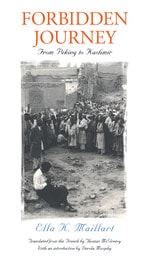
cover of Forbidden Journey

Forbidden Journey

Ella Maillart

Northwestern University Press, 2003

A classic account of a trip through China during the golden age of travel

In 1935 Ella Maillart contemplated one of the most arduous journeys in the world: the "impossible journey" from Peking, then a part of Japanese-occupied China, through the distant province of Sinkiang (present day Tukestan), to Kashmir. Enlisting with newswriter Peter Fleming (with the caveat that his company remain tolerable), Maillart undertook a journey considered almost beyond imagination for any European and doubly so for a woman.
The trip promised hardships such as typhus and bandits, as well as the countless hazards surrounding the civil war between Chinese communists and Chiang Kai-shek's nationalists. Setting out with pockets full of Mexican money (the currency used in China at the time), Maillart encountered a way of life now lost, but one that then had gone unchanged for centuries.

Maillart describes it all with the sharp eye and unvarnished prose of a veteran reporter-the missionaries and rogues, parents binding daughters' feet with rags, the impatient Fleming lighting fires under stubborn camels. It's a hard road, not that Maillart cares. At all times she is a witty, always-enchanted guide-except when it comes to bureaucrats.

Forbidden Journey ranks among other travel narratives like Fleming's News from Tartary, (based on the same journey) and Robert Byron's The Road to Oxiana. But it is also a portrait of a fascinating woman, one of many women from the pre-WWII era who ignored convention and traveled in hidden lands. It remains a vivid account of its time and a classic of travel literature.
[more]
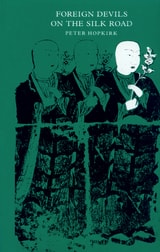
cover of Foreign Devils on the Silk Road: The Search for the Lost Cities and Treasures of Chinese Central Asia

Foreign Devils on the Silk Road

The Search for the Lost Cities and Treasures of Chinese Central Asia

Peter Hopkirk

University of Massachusetts Press, 1980
The Silk Road, which linked imperial Rome and distant China, was once the greatest thoroughfare on earth. Along it traveled precious cargoes of silk, gold and ivory, as well as revolutionary new ideas. Its oasis towns blossomed into thriving centers of Buddhist art and learning. In time it began to decline. The traffic slowed, the merchants left and finally its towns vanished beneath the desert sands to be forgotten for a thousand years; however, legends grew up of lost cities filled with treasures and guarded by demons. In the early years of the last century foreign explorers began to investigate these legends, and very soon an international race began for the art treasures of the Silk Road. Huge wall paintings, sculptures and priceless manuscripts were carried away, literally by the ton, and are today scattered through the museums of a dozen countries. Peter Hopkirk tells the story of the intrepid men who, at great personal risk, led these long-range archaeological raids, incurring the undying wrath of the Chinese.
[more]
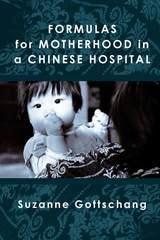
cover of Formulas for Motherhood in a Chinese Hospital

Formulas for Motherhood in a Chinese Hospital

Suzanne Gottschang

University of Michigan Press, 2018

What happens to pregnant women when the largest country in the world implements a global health policy aimed at reorganizing hospitals and re- training health care workers to promote breastfeeding? Since 1992, the Chinese government has led the world in reorganizing more than 7,000 hospitals into “Baby- Friendly” hospitals. The initiative’s goal, overseen by UNICEF and the World Health Organization, is to promote the practice of breastfeeding by reorganizing hospital routines, spaces, and knowledge in maternity wards and obstetrics clinics. At the same time, China’s hospitals in the mid- 1990s operated as sites where the effects of economic reform and capitalism increasingly blurred the boundaries between state imperatives to produce healthy future citizens and the flexibility accorded individuals through their participation in an emerging consumer culture.

Formulas for Motherhood follows a group of women over eighteen months as they visited a Beijing Baby- Friendly Hospital over the course of their pregnancies and throughout their postpartum recoveries. The book shows how the space of the hospital operates as a microcosm of the larger social, political, and economic forces that urban Chinese women navigate in the process of becoming a mother. Relations between biomedical practices, heightened expectations of femininity and sexuality demanded by a consumer culture, alongside international and national agendas to promote maternal and child health, reveal new agents of maternal governance emerging at the very moment China’s economy heats up. This ethnography provides insight into how women’s creative pragmatism in a rapidly changing society leads to their views and decisions about motherhood.
[more]
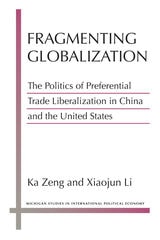
cover of Fragmenting Globalization: The Politics of Preferential Trade Liberalization in China and the United States

Fragmenting Globalization

The Politics of Preferential Trade Liberalization in China and the United States

Ka Zeng and Xiaojun Li

University of Michigan Press, 2021

Global supply chain integration is not only a rapidly growing feature of international trade, it is responsible for fundamentally changing trade policy at international and domestic levels. Given that final goods are produced with both domestic and foreign suppliers, Ka Zeng and Xiaojun Li argue that global supply chain integration pits firms and industries that are more heavily dependent on foreign supply chains against those that are less dependent on intermediate goods for domestic production. Hence, businesses whose supply chain would be disrupted as a result of increased trade barriers should lobby for preferential trade liberalization to maintain access to those foreign markets. Moreover, businesses whose products are used in the production of goods in foreign countries should also support preferential trade liberalization to compete with suppliers from other parts of the world.

Fragmenting Globalization uses multiple methods, including time series, cross-sectional analysis of the pattern of Preferential Trade Alliance formation by existing World Trade Organization members, a firm-level survey, and case studies of the pattern of corporate support for regional trade liberalization in both China and the United States. Zeng and Li show that the growing fragmentation of global production, trade, and investment is altering trade policy away from the traditional divide between export-oriented and import-competing industries.
 
[more]
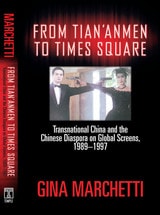
cover of From Tian'anmen to Times Square: Transnational China and the Chinese Diaspora on Global Screens, 1989-1997

From Tian'anmen to Times Square

Transnational China and the Chinese Diaspora on Global Screens, 1989-1997

Gina Marchetti

Temple University Press, 2006

Global perceptions of China have changed dramatically since the massive student protests that took place in Tian'anmen Square in April 1989. The media spotlight trained on Beijing, and the international uproar over the events of that spring still shape the world's perceptions of the People's Republic and the ways that Chinese people, within and beyond China, see and portray themselves.

In From Tian'anmen to Times Square, leading film scholar Gina Marchetti considers the complex changes in the ways that China and the Chinese have been portrayed in cinema and media arts since the Tian'anmen revolt. Drawing on her interviews with leading contemporary Chinese filmmakers, Marchetti looks at a wide range of work by Chinese and non-Chinese media artists working in China, Hong Kong, Taiwan, and Singapore and on transnational co-productions involving those places. Focusing on the intersections of race, ethnicity, gender, and sexuality on global screens, Marchetti traces the momentous political, cultural, social, and economic forces confronting contemporary media artists and filmmakers working within "Greater China."

[more]
cover of Fruitful Sites: Garden Culture in Ming Dynasty China

Fruitful Sites

Garden Culture in Ming Dynasty China

Craig Clunas

Duke University Press, 1996

Gardens are sites that can be at one and the same time admired works of art and valuable pieces of real estate. As the first account in English to be wholly based on contemporary Chinese sources, this innovative, beautifully illustrated book grounds the practices of garden-making in Ming dynasty China (1368–1644) firmly in the social and cultural history of the day.
Who owned Ming gardens? Who visited them? How were they represented in words, in paintings, and in visual culture generally, and what meanings did these representations hold at different levels of Chinese society? How did the discourse of gardens intersect with other discourses such as those of aesthetics, agronomy, geomancy, and botany? By examining the gardens of the city of Suzhou from a number of different angles, Craig Clunas provides a rich picture of a complex cultural phenomenon—one that was of crucial importance to the self-fashioning of the Ming elite.
Drawing on a wide range of recent work in cultural theory, the author provides for the first time a historical and materialist account of Chinese garden culture, and replaces broad generalizations and orientalist fantasy with a convincing picture of the garden’s role in social life. Fruitful Sites will appeal to all students of China’s cultural history, to students of garden history from any part of the world, to art historians, and to readers engaged in Asian and cultural studies.
[more]