Results by title
128 books match the query 'Church of Jesus Christ of Latter-day Saints' and 3 start with f
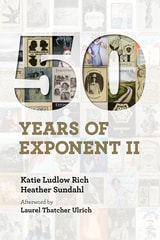
Fifty Years of Exponent II
Katie Ludlow Rich
Signature Books, 2024
On a sweltering day in June 1974, a group of housewives, graduate students, and young professionals gathered in the Boston suburbs. Their mission: to produce the first issue of Exponent II, a “humble yet sincere” newspaper “poised on the dual platforms of Mormonism and Feminism.” They viewed their work as an act of devotion, not rebellion, and were naïve of the cold reception they would soon receive from LDS Church leaders. Nevertheless, the paper became a national platform connecting Mormon feminists. It provided a vital space for them to question and integrate different aspects of their dual—and sometimes dueling—identities. From the Equal Rights Amendment to queer identity, Exponent II has hosted some of the most urgent conversations of its time while also embracing life’s dailiness.
This comprehensive history and anthology celebrate five decades of Exponent II. Through meticulous research and compelling storytelling, the authors chronicle the organization’s evolution from a kitchen-table-style newspaper to a quarterly magazine, blog, and annual retreat. Its transformative impact on the lives of its participants stands as a testament to the power of connection, resilience, and community over ideological purity.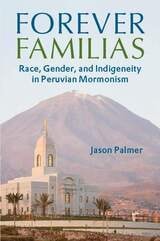
Forever Familias
Race, Gender, and Indigeneity in Peruvian MormonismJason Palmer
University of Illinois Press, 2024
Peruvian members of the Church of Jesus Christ of Latter-day Saints face the dilemma of embracing their faith while finding space to nourish their Peruvianness. Jason Palmer draws on eight years of fieldwork to provide an on-the-ground look at the relationship between Peruvian Saints and the racial and gender complexities of the contemporary Church.
Peruvian Saints discovered that the foundational ideas of kinship and religion ceased being distinct categories in their faith. At the same time, they came to see that LDS rituals and reenactments placed coloniality in opposition to the Peruvians’ indigenous roots and family against the more expansive Peruvian idea of familia. In part one, Palmer explores how Peruvian Saints resolved the first clash by creating the idea of a new pioneer indigeneity that rejected victimhood in favor of subtle engagements with power. Part two illuminates the work performed by Peruvian Saints as they stretched the Anglo Church’s model of the nuclear family to encompass familia.
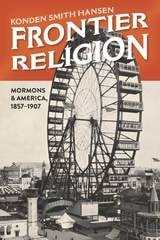
Frontier Religion
Mormons and America, 1857–1907Konden Smith Hansen
University of Utah Press, 2019
In Frontier Religion Konden Smith Hansen examines the dramatic influence these perceptions of the frontier had on Mormonism and other religions in America. Endeavoring to better understand the sway of the frontier on religion in the United States, this book follows several Mormon-American conflicts, from the Utah War and the antipolygamy crusades to the Reed Smoot hearings. The story of Mormonism’s move toward American acceptability represents a larger story of the nation’s transition to modernity and the meaning of religious pluralism. This book challenges old assumptions and provokes further study of the ever changing dialectic between society and faith.