153 books match the query 'Cities and towns' and 3 start with f
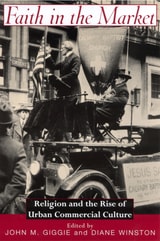
cover of Faith in the Market: Religion and the Rise of Urban Commercial Culture

Faith in the Market

Religion and the Rise of Urban Commercial Culture

Edited by John M. Giggie and Diane Winston

Rutgers University Press, 2002
Scholars have long assumed that industrialization and the growth of modern cities signaled a decline of religious practice among urban dwellers - that urban commercial culture weakened traditional religious ties by luring the faithful away from their devotional practice. Spanning many disciplines, the essays in this volume challenge this notion of the "secular city" and examine how members of metropolitan houses of worship invented fresh expressions of religiosity by incorporating consumer goods, popular entertainment, advertising techniques, and marketing into their spiritual lives. Faith in the Market explores phenomena from Salvation Army "slum angels" to the "race movies" of the mid-twentieth century, from Catholic teens' modest dress crusades to Black Muslim artists. The contributors-integrating gender, performance, and material culture studies into their analyses-reveal the many ways in which religious groups actually embraced commercial culture to establish an urban presence. Although the city streets may have proved inhospitable to some forms of religion, many others, including evangelicalism, Catholicism, and Judaism, assumed rich and complex forms as they developed in vital urban centers.
[more]
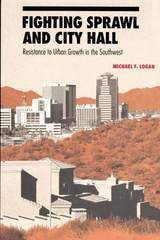
cover of Fighting Sprawl and City Hall: Resistance to Urban Growth in the Southwest

Fighting Sprawl and City Hall

Resistance to Urban Growth in the Southwest

Michael F. Logan

University of Arizona Press, 1995

The line is drawn in cities of the American West: on one side, chambers of commerce, developers, and civic boosters advocating economic growth; on the other, environmentalists and concerned citizens who want to limit what they see as urban sprawl. While this conflict is usually considered to have its origins in the rise of environmental activism during the late 1960s, opposition to urban growth in the Southwest began as early as the economic boom that followed World War II. Evidence of this resistance abounds, but it has been largely ignored by both western and urban historians.

Fighting Sprawl and City Hall now sets the record straight, tracing the roots of antigrowth activism in two southwestern cities, Tucson and Albuquerque, where urbanization proceeded in the face of constant protest. Logan tells how each of these cities witnessed multifaceted opposition to post-war urbanization and a rise in political activism during the 1950s. For each city, he describes the efforts by civic boosters and local government to promote development, showing how these booster-government alliances differed in effectiveness; tells how middle-class Anglos first voiced opposition to annexations and zoning reforms through standard forms of political protest such as referendums and petitions; then documents the shift to ethnic resistance as Hispanics opposed urban renewal plans that targeted barrios. Environmentalism, he reveals, was a relative latecomer to the political arena and became a focal point for otherwise disparate forms of resistance.

Logan's study enables readers to understand not only these similarities in urban activism but also important differences; for example, Tucson provides the stronger example of resistance based on valuation of the physical environment, while Albuquerque better demonstrates anti-annexation politics. For each locale, it offers a testament to grass-roots activism that will be of interest to historians as well as to citizens of its subject cities.
[more]
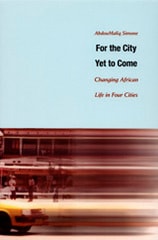
cover of For the City Yet to Come: Changing African Life in Four Cities

For the City Yet to Come

Changing African Life in Four Cities

AbdouMaliq Simone

Duke University Press, 2004

Among government officials, urban planners, and development workers, Africa’s burgeoning metropolises are frequently understood as failed cities, unable to provide even basic services. Whatever resourcefulness does exist is regarded as only temporary compensation for fundamental failure. In For the City Yet to Come, AbdouMaliq Simone argues that by overlooking all that does work in Africa’s cities, this perspective forecloses opportunities to capitalize on existing informal economies and structures in development efforts within Africa and to apply lessons drawn from them to rapidly growing urban areas around the world. Simone contends that Africa’s cities do work on some level and to the extent that they do, they function largely through fluid, makeshift collective actions running parallel to proliferating decentralized local authorities, small-scale enterprises, and community associations.

Drawing on his nearly fifteen years of work in African cities—as an activist, teacher, development worker, researcher, and advisor to ngos and local governments—Simone provides a series of case studies illuminating the provisional networks through which most of Africa’s urban dwellers procure basic goods and services. He examines informal economies and social networks in Pikine, a large suburb of Dakar, Senegal; in Winterveld, a neighborhood on the edge of Pretoria, South Africa; in Douala, Cameroon; and among Africans seeking work in Jeddah, Saudi Arabia. He contextualizes these particular cases through an analysis of the broad social, economic, and historical conditions that created present-day urban Africa. For the City Yet to Come is a powerful argument that any serious attempt to reinvent African urban centers must acknowledge the particular history of these cities and incorporate the local knowledge reflected in already existing informal urban economic and social systems.

[more]