401 books match the query 'Civil War, 1861-1865' and 16 start with f

cover of FOR THE UNION: OHIO LEADERS IN THE CIVIL WAR

FOR THE UNION

OHIO LEADERS IN THE CIVIL WAR

KENNETH W. WHEELER

The Ohio State University Press, 1998
[more]
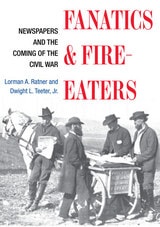
cover of Fanatics and Fire-eaters: Newspapers and the Coming of the Civil War

Fanatics and Fire-eaters

Newspapers and the Coming of the Civil War

Lorman A. Ratner and Dwight L. Teeter Jr.

University of Illinois Press, 2003

In the troubled years leading up to the Civil War, newspapers in the North and South presented the arguments for and against slavery, debated the right to secede, and in general denounced opposing viewpoints with imagination and vigor. At the same time, new technologies like railroads and the telegraph lent the debates an immediacy that both enflamed emotions and brought the slavery issue into every home. 

Lorman A. Ratner and Dwight L. Teeter Jr. look at the power of America's fast-growing media to influence perception and the course of events prior to the Civil War. Drawing on newspaper accounts from across the United States, the authors look at how the media covered—and the public reacted to—major events like the Dred Scott decision, John Brown's raid on Harper's Ferry, and the election of 1860. They find not only North-South disputes about the institution of slavery but differing visions of the republic itself—and which region was the true heir to the legacy of the American Revolution.
[more]
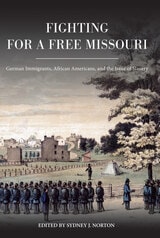
cover of Fighting for a Free Missouri: German Immigrants, African Americans, and the Issue of Slavery

Fighting for a Free Missouri

German Immigrants, African Americans, and the Issue of Slavery

Sydney J. Norton

University of Missouri Press, 2023
Missouri is well-known for its German American heritage, but the story of nineteenth-century German immigrant abolitionists is often neglected in discussions of the state’s history. This collection of ten original essays (with a foreword by renowned Missouri historian Gary Kremer), relates what unfolded when idealistic Germans, many of whom were highly educated and devoted to the ideals of freedom and democracy, left their homeland and settled in a pre–Civil War slave state. Fleeing political persecution during the 1830s and 1840s, immigrants such as Friedrich Münch, Eduard Mühl, Heinrich Boernstein, and Arnold Krekel arrived in the area now known as the Missouri German Heritage Corridor in hopes of finding a land more congenial to their democratic ideals. When they witnessed the state of enslaved Blacks, many of them became abolitionist activists and fervent supporters of Abraham Lincoln and the Union in the emerging Civil War. Editor Sydney Norton and the other contributing authors to Fighting for a Free Missouri explore the Germans’ abolitionist mission, their relationships with African Americans, and their activity in the radical wing of the Republican Party.

 
[more]
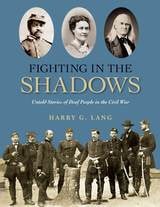
cover of Fighting in the Shadows: Untold Stories of Deaf People in the Civil War

Fighting in the Shadows

Untold Stories of Deaf People in the Civil War

Harry G. Lang

Gallaudet University Press, 2017

This visually rich volume presents Harry G. Lang’s groundbreaking study of deaf people’s experiences in the Civil War. Based on meticulous archival research, Fighting in the Shadows reveals the stories of deaf soldiers and civilians who lived through this transformative period in American history. Lang describes the participation of deaf soldiers in the war, whose personal tests of fortitude and perseverance have not been previously explored. There were also many deaf people in noncombat roles whose stories have not yet been told—clerks and cooks, nurses and spies, tradespeople supporting the armies, farmers supplying food to soldiers, and landowners who assisted (or resisted) troops during battles. Deaf writers, diarists, and artists documented the war. Lang chronicles the lives of people from all walks of life, from common soldiers who faced the daily horrors of war to the extraordinary tale of the deaf poet who was friends with Abraham Lincoln and who also taught sign language to John Wilkes Booth. Even deaf children contributed actively to the war efforts. 
       Lang pieces together hundreds of stories, accompanied by numerous historical images, to reveal a powerful new perspective on the Civil War. These soldiers and civilians were not “disabled” by their deafness. On the contrary, despite the marginalization and paternalism they experienced in society, they were able to apply their skills and knowledge to support the causes in which they ardently believed.
       Fighting in the Shadows is a story of how deaf civilians and soldiers put aside personal concerns about deafness, in spite of the discrimination they faced daily, in order to pursue a cause larger than themselves. Yet their stories have remained in the shadows, leaving most Americans, hearing and deaf, largely unaware of the deaf people who made significant contributions to the events that changed the course of our nation’s history. This book provides new insights into Deaf history as well as into mainstream interpretations of the Civil War.
[more]
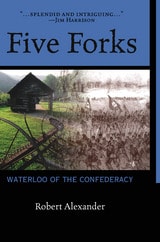
cover of Five Forks: Waterloo of the Confederacy

Five Forks

Waterloo of the Confederacy

Robert Alexander

Michigan State University Press, 2003

The Battle of Five Forks was one of the the last battles of the American Civil War. A week later, Lee surrendered. Two weeks later, Lincoln was dead. In this meditation on that battle, Alexander juxtaposes the story of the battle, which he tells through narrative, letters, and journal entries, with his own impressions, viewing the South through Northern eyes. In addition, he views contemporary American society through the story of the Civil War and specifically through the story of Five Forks. If it is true that we meet our past coming to us out of the future, then, Alexander posits, America is still grappling with issues unresolved by the Civil War. Those issues are not just the obvious ones of race and class, or of North vs. South, but also the more ephemeral issues surrounding the mythos Americans live by.
     Alexander is not a historian, and this is much more a literary work than a battle story. However, the immediacy with which Alexander tells his tale leads the reader to experience Five Forks—the land, the smells, the cries—as if present there in 1865. Thus, he does not just describe a battle; he captures the spirit of all battles, all wars.
[more]
cover of Food in the Civil War Era: The North

Food in the Civil War Era

The North

Helen Zoe Veit

Michigan State University Press, 2014
Cookbooks offer a unique and valuable way to examine American life. Their lessons, however, are not always obvious. Direct references to the American Civil War were rare in cookbooks, even in those published right in the middle of it. In part, this is a reminder that lives went on and that dinner still appeared on most tables most nights, no matter how much the world was changing outside. But people accustomed to thinking of cookbooks as a source for recipes, and not much else, can be surprised by how much information they can reveal about the daily lives and ways of thinking of the people who wrote and used them. In this fascinating historical compilation, excerpts from five Civil War–era cookbooks present a compelling portrait of cooking and eating in the urban north of the 1860s United States.
[more]
cover of Food in the Civil War Era: The South

Food in the Civil War Era

The South

Helen Zoe Veit

Michigan State University Press, 2015
Almost immediately, the Civil War transformed the way Southerners ate, devastating fields and food transportation networks. The war also spurred Southerners to canonize prewar cooking styles, resulting in cuisine that retained nineteenth-century techniques in a way other American cuisines did not. This fascinating book presents a variety of Civil War-era recipes from the South, accompanied by eye-opening essays describing this tumultuous period in the way people lived and ate. The cookbooks excerpted here teem with the kinds of recipes we expect to find when we go looking for Southern food: grits and gumbo, succotash and Hopping John, catfish, coleslaw, watermelon pickles, and sweet potato pie. The cookbooks also offer plenty of surprises. This volume, the second in the American Food in History series, sheds new light on cooking and eating in the Civil War South, pointing out how seemingly neutral recipes can reveal unexpected things about life beyond the dinner plate, from responses to the anti-slavery movement to shifting economic imperatives to changing ideas about women’s roles. Together, these recipes and essays provide a unique portrait of Southern life via the flavors, textures, and techniques that grew out of a time of crisis.
[more]
cover of For Duty and Destiny: The Life and Civil War Diary of William Taylor Stott, Hoosier Soldier and Educator

For Duty and Destiny

The Life and Civil War Diary of William Taylor Stott, Hoosier Soldier and Educator

Lloyd A. Hunter

Indiana Historical Society Press, 2011
William Taylor Stott was a native Hoosier and an 1861 graduate of Franklin College, who later became the president who took the college from virtual bankruptcy in 1872 to its place as a leading liberal arts institution in Indiana. The story of Franklin College is the story of W. T. Stott, yet his influence was not confined to the school’s parameters. Stott was an inspirational and intellectual force in the Indiana Baptist community, and a foremost champion of small denominational colleges and of higher education in general. He also fought in the Eighteenth Indiana Volunteer Infantry during the Civil War, rising from private to captain by 1863. Stott’s diary reveals a soldier who was also a scholar.
[more]
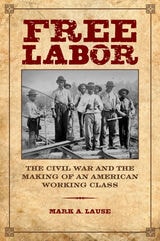
cover of Free Labor: The Civil War and the Making of an American Working Class

Free Labor

The Civil War and the Making of an American Working Class

Mark A. Lause

University of Illinois Press, 2015

Monumental and revelatory, Free Labor explores labor activism throughout the country during a period of incredible diversity and fluidity: the American Civil War.

Mark A. Lause describes how the working class radicalized during the war as a response to economic crisis, the political opportunity created by the election of Abraham Lincoln, and the ideology of free labor and abolition. His account moves from battlefield and picket line to the negotiating table, as he discusses how leaders and the rank-and-file alike adapted tactics and modes of operation to specific circumstances. His close attention to women and African Americans, meanwhile, dismantles notions of the working class as synonymous with whiteness and maleness.

In addition, Lause offers a nuanced consideration of race's role in the politics of national labor organizations, in segregated industries in the border North and South, and in black resistance in the secessionist South, creatively reading self-emancipation as the largest general strike in U.S. history.
[more]
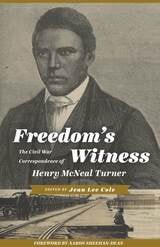
cover of Freedom's Witness: The Civil War Correspondence of Henry McNeal Turner

Freedom's Witness

The Civil War Correspondence of Henry McNeal Turner

Jean Lee Cole

West Virginia University Press, 2013
In a series of columns published in the African American newspaper The Christian Recorder, the young, charismatic preacher Henry McNeal Turner described his experience of the Civil War, first from the perspective of a civilian observer in Washington, D.C., and later, as one of the Union army’s first black chaplains.
 
In the halls of Congress, Turner witnessed the debates surrounding emancipation and black enlistment. As army chaplain, Turner dodged “grape” and cannon, comforted the sick and wounded, and settled disputes between white southerners and their former slaves. He was dismayed by the destruction left by Sherman’s army in the Carolinas, but buoyed by the bravery displayed by black soldiers in battle. After the war ended, he helped establish churches and schools for the freedmen, who previously had been prohibited from attending either.
 
Throughout his columns, Turner evinces his firm belief in the absolute equality of blacks with whites, and insists on civil rights for all black citizens. In vivid, detailed prose, laced with a combination of trenchant commentary and self-deprecating humor, Turner established himself as more than an observer: he became a distinctive and authoritative voice for the black community, and a leader in the African Methodist Episcopal church. After Reconstruction failed, Turner became disillusioned with the American dream and became a vocal advocate of black emigration to Africa, prefiguring black nationalists such as Marcus Garvey and Malcolm X. Here, however, we see Turner’s youthful exuberance and optimism, and his open-eyed wonder at the momentous changes taking place in American society.
 
Well-known in his day, Turner has been relegated to the fringes of African American history, in large part because neither his views nor the forms in which he expressed them were recognized by either the black or white elite. With an introduction by Jean Lee Cole and a foreword by Aaron Sheehan-Dean, Freedom’s Witness: The Civil War Correspondence of Henry McNeal Turner restores this important figure to the historical and literary record.

[more]
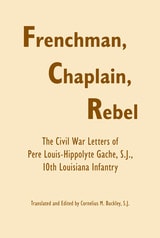
cover of Frenchman, Chaplain, Rebel: The Civil War Letters of Pere Louis-Hippoltye Gache, 10th Louisiana Infantry

Frenchman, Chaplain, Rebel

The Civil War Letters of Pere Louis-Hippoltye Gache, 10th Louisiana Infantry

Pere Louis-Hippolyte Gache, S.J.

University of Alabama Press, 2007

The American Civil War through the eyes of a French Jesuit chaplain.

"This book has a tantalizing quality, and it certainly is fresh literature for those who have watched the story of the Civil War unfold. . . . One cannot help but marvel at the research undertaken by Fr. Buckley. These letters of Fr. Gache cover such subjects as the duties of a chaplain, the lack of stimulating conversation in camp, whiskey as medication for diarrhea, the chaplain’s uniform, the oversupply of Catholic chaplains, descriptions of battles—Chancellorsville, Fredericksburg—chaplains as prisoners of war, the possibility of General Lee being chosen as the second president of the Confederacy, making candles for the alter and bleaching wax, procuring sacramental wine, conflicts with Protestant preachers, and the surrender of Richmond. Such subjects allow the personality and character of Hippolyte to stand out. . . . [The book] is interesting reading for all who love and admire the Jesuits. Its wealth of information makes it a must for others whose concern is the Confederate soldier and his God."

—Journal of Southern History
[more]
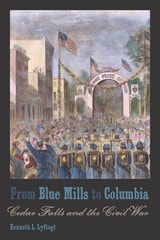
cover of From Blue Mills to Columbia: Cedar Falls and the Civil War

From Blue Mills to Columbia

Cedar Falls and the Civil War

Kenneth L. Lyftogt

University of Iowa Press, 1993
Historian Kenneth Lyftogt introduces us to the volunteer soldiers of the Pioneer Grays and Cedar Falls Reserves infantry companies and in turn examines Iowa’s role in the Civil War. Many of these soldiers served the Union for the duration of the war, from the early fighting in Missouri to Shiloh, Vicksburg, and Sherman’s destructive marches through Georgia and the Carolinas. Their letters home are Lyftogt’s primary sources, as are editorials and articles published in the Cedar Falls Gazette.
[more]
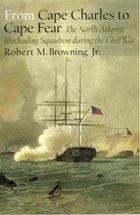
cover of From Cape Charles to Cape Fear: The North Atlantic Blockading Squadron during the Civil War

From Cape Charles to Cape Fear

The North Atlantic Blockading Squadron during the Civil War

Robert M. Browning

University of Alabama Press, 2003

A definitive study of Union naval power and the blockade that reshaped the Civil War.

In From Cape Charles to Cape Fear, acclaimed historian Robert M. Browning, Jr. offers a vivid and authoritative account of the Union Navy’s North Atlantic Blockading Squadron, a critical force in the American Civil War. Charged with enforcing the blockade along the Atlantic coastline from Virginia to North Carolina, the squadron played a decisive role in crippling the Confederacy’s economy and restricting its access to vital supplies.

Browning reveals the blockade as far more than a passive defensive strategy. Through detailed analysis of naval operations, coastal engagements, and strategic planning, he demonstrates how Union forces exerted control over key waterways and ports, including Norfolk and Wilmington. These contested hubs became focal points in a high-stakes struggle involving daring blockade runners, shifting naval tactics, and constant pressure on Southern trade networks.

Blending operational history with compelling narrative, Browning also captures the human dimension of naval warfare. Sailors and officers faced unpredictable weather, dangerous missions, and the relentless demands of maintaining control over an expansive coastline. Their experiences illuminate the challenges and complexities of maritime warfare during one of America’s defining conflicts.

Accessible yet richly researched, this book highlights the central importance of naval power in shaping Civil War outcomes. From Cape Charles to Cape Fear stands as an essential work for readers interested in Civil War history, naval strategy, and the enduring impact of maritime operations on the American past.
 

[more]
cover of From Conciliation to Conquest: The Sack of Athens and the Court-Martial of Colonel John B. Turchin

From Conciliation to Conquest

The Sack of Athens and the Court-Martial of Colonel John B. Turchin

George C. Bradley and Richard L. Dahlen

University of Alabama Press, 2006

In the summer of 1862, the U.S. Army court martialed Colonel John B. Turchin, a Russian-born Union officer, for "outrages" committed by his troops in Athens, Alabama

In the summer of 1862, the U.S. Army court martialed Colonel John B. Turchin, a Russian-born Union officer, for offenses committed by his troops in Athens, Alabama, including looting, safe cracking, the vandalization of homes, and the rape of young black women. The pillage of Athens violated a government policy of conciliation; it was hoped that if Southern civilians were treated gently as citizens of the United States, they would soon return their allegiance to the federal government.
 
By examining the volunteers who made up Turchin’s force, the colonel's trial, his subsequent promotion, the policy debate surrounding the incident and the public reaction to the outcome, the authors further illuminate one of the most provocative questions in Civil War studies: how did the policy set forth by President Lincoln evolve from one of conciliation to one far more modern in nature, placing the burden of war on the civilian population of the South?
[more]
cover of From Home Guards to Heroes: The 87th Pennsylvania and Its Civil War Community

From Home Guards to Heroes

The 87th Pennsylvania and Its Civil War Community

Dennis W. Brandt

University of Missouri Press, 2007
The soldiers of the 87th Pennsylvania Infantry fought in the Overland campaign under Grant and in the Shenandoah valley under Sheridan, notably at the Battle of Monocacy. But as Dennis Brandt reveals in From Home Guards to Heroes, their real story takes place beyond the battlefield. The 87th drew its men from the Scotch-Irish and German populations of York and Adams counties in south-central Pennsylvania—a region with closer ties to Baltimore than to Philadelphia—where some citizens shared Marylanders’ southern views on race while others aided the Underground Railroad.
Brandt’s unique regimental history investigates why these “boys from York” enlisted and why some deserted, the ways in which soldiers reflected their home communities, and the area’s attitudes toward the war both before and after hostilities broke out. Brandt takes a humanistic approach to the Civil War, revealing the more personal aspects of the struggle in a book that focuses on the soldiers themselves.
Using their own words to describe action both on and off the battlefield, he sheds light on the lives of ordinary men: the comparative values of farm and city boys, their motives and concerns, the effect of battle on soldiers and their families, and the suffering that veterans took to the grave. Brandt also looks at soldiers’ racial views, illuminating their deepest worries about the war, and at community politics and problems of discipline surrounding this ideologically divided unit.
Grounded in more than a decade of research into nearly two thousand military records, this is one of the few regimental histories based on more than one thousand pension records for the entire regiment, plus nearly eight hundred additional record sets for other area soldiers. Brandt tapped regional newspapers and a cache of unpublished letters and diaries—some from private collections not previously known—to provide an invaluable account of Civil War sensibilities in a northern area bordering a slave state.
From Home Guards to Heroes is a book about war in which humanity rather than troop movement takes center stage. Engagingly written for a wide audience and meticulously researched, it offers a distinctive image of a community and the intimate lives of the men it sent off to fight—and a story that will intrigue any Civil War aficionado.
[more]
cover of From That Terrible Field: Civil War Letters of James M. Williams, 21st Alabama Infantry Volunteers

From That Terrible Field

Civil War Letters of James M. Williams, 21st Alabama Infantry Volunteers

James M. Williams

University of Alabama Press, 1981

“The well-written and candid letters of a reasonably articulate Southern officer, who paints a lucid picture of everyday life in the Confederate army in a little-known theater… Williams’s letters, personally written and shot through with his sharp sense of humor and folksy artwork, provide an excellent account of a long neglected theater of the American Civil War.” – Western Pennsylvania History

[more]