Results by title
143 books match the query 'Class' and 4 start with f
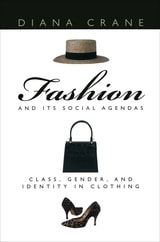
Fashion and Its Social Agendas
Class, Gender, and Identity in ClothingDiana Crane
University of Chicago Press, 2000
Crane compares nineteenth-century societies—France and the United States—where social class was the most salient aspect of social identity signified in clothing with late twentieth-century America, where lifestyle, gender, sexual orientation, age, and ethnicity are more meaningful to individuals in constructing their wardrobes. Today, clothes worn at work signify social class, but leisure clothes convey meanings ranging from trite to political. In today's multicode societies, clothes inhibit as well as facilitate communication between highly fragmented social groups.
Crane extends her comparison by showing how nineteenth-century French designers created fashions that suited lifestyles of Paris elites but that were also widely adopted outside France. By contrast, today's designers operate in a global marketplace, shaped by television, film, and popular music. No longer confined to elites, trendsetters are drawn from many social groups, and most trends have short trajectories. To assess the impact of fashion on women, Crane uses voices of college-aged and middle-aged women who took part in focus groups. These discussions yield fascinating information about women's perceptions of female identity and sexuality in the fashion industry.
An absorbing work, Fashion and Its Social Agendas stands out as a critical study of gender, fashion, and consumer culture.
"Why do people dress the way they do? How does clothing contribute to a person's identity as a man or woman, as a white-collar professional or blue-collar worker, as a preppie, yuppie, or nerd? How is it that dress no longer denotes social class so much as lifestyle? . . . Intelligent and informative, [this] book proposes thoughtful answers to some of these questions."-Library Journal
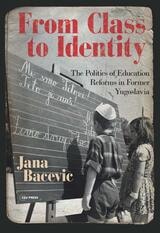
From Class to Identity
The politics of education reforms in former YugoslaviaJana Bacevic
Central European University Press, 2014
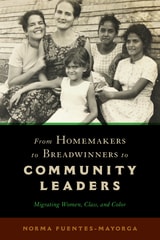
From Homemakers to Breadwinners to Community Leaders
Migrating Women, Class, and ColorNorma Fuentes-Mayorga
Rutgers University Press, 2022
From Peones to Politicos
Class and Ethnicity in a South Texas Town, 1900–1987By Douglas E Foley, with Clarice Mota, Donald E. Post, and Ignacio Lozano
University of Texas Press, 1988
How does a relatively powerless ethnic group deal with the problems of economic inequality and racial discrimination? How do they gain power in the community? From Peones to Politicos examines these questions in detail, focusing on the changes in Mexicano-Anglo relations in one small South Texas community called North Town. These changes are typical of evolving Mexicano-Anglo relations in much of Texas and the Southwest.
The authors divide their study into three historical periods: the rancho era (1900–1930), the colonia era (1930–1970), and the contemporary period (1970–1977). They trace how Mexicano-Anglo relations have evolved away from the extremely exploitative, paternalistic sharecropper system of the rancho era, when open racism, strict social segregation, and effective Anglo political machines prevailed. They reveal, by contrast, how Mexicanos have become a power to be reckoned with by developing their own economic and political leaders and ethnic political organizations and challenging the Anglo control of the city, school, and county governments. The study also shows how Mexican American family practices have been changed by this transformation of the local political economy.
This revised edition of From Peones to Politicos presents updated fieldwork and additional discussion of class theory and the study of racial orders. Of special interest are reactions to the study by North Town residents themselves, which appear in the new Part IV.