Results by title
212 books match the query 'Colonial Period (1600-1775)' and 10 start with f
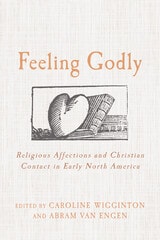
Feeling Godly
Religious Affections and Christian Contact in Early North AmericaCaroline Wigginton
University of Massachusetts Press, 2021
Feeling Godly brings together well-known and highly regarded scholars of early American history and literature, Native American studies, African American history, and religious studies to investigate the shape, feel, look, theology, and influence of religious affections in early American sites of contact with and between Christians. While remaining focused on the question of religious affections, these essays span a wide range of early North American cultures, affiliations, practices, and devotions, and enable a comparative approach that draws together a history of emotions with a history of religion.
In addition to the volume editors, this collection includes essays from Joanna Brooks, Kathleen Donegan, Melissa Frost, Stephanie Kirk, Jon Sensbach, Scott Manning Stevens, and Mark Valeri, with an afterword by Barbara H. Rosenwein.
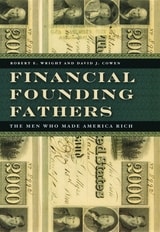
Financial Founding Fathers
The Men Who Made America RichRobert E. Wright and David J. Cowen
University of Chicago Press, 2006
Robert E. Wright and David J. Cowen here chronicle how a different group of founding fathers forged the wealth and institutions necessary to transform the American colonies from a diffuse alliance of contending business interests into one cohesive economic superpower. From Alexander Hamilton to Andrew Jackson, the authors focus on the lives of nine Americans in particular—some famous, some unknown, others misunderstood, but all among our nation’s financial founding fathers. Such men were instrumental in creating and nurturing a financial system that drove economic growth in the nascent United States because they were quick to realize that wealth was as crucial as the Constitution in securing the blessings of liberty and promoting the general welfare. The astonishing economic development made possible by our financial founding fathers was indispensable to the preservation of national unity and of support for a government that was then still a profoundly radical and delicate political experiment.
Grand in scope and vision, Financial Founding Fathers is an entertaining and inspiring history of the men who made America rich and steered her toward greatness.
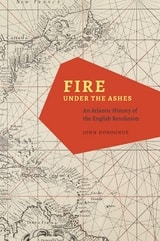
Fire under the Ashes
An Atlantic History of the English RevolutionJohn Donoghue
University of Chicago Press, 2013
Prominent merchant revolutionaries from Coleman Street led England’s imperial expansion by investing deeply in the slave trade and projects of colonial conquest. Opposing them were other Coleman Street puritans, who having crossed and re-crossed the ocean as colonists and revolutionaries, circulated new ideas about the liberty of body and soul that they defined against England’s emergent, political economy of empire. These transatlantic radicals promoted social justice as the cornerstone of a republican liberty opposed to both political tyranny and economic slavery—and their efforts, Donoghue argues, provided the ideological foundations for the abolitionist movement that swept the Atlantic more than a century later.
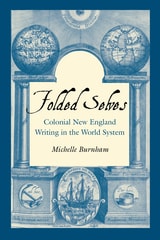
Folded Selves
Colonial New England Writing in the World SystemMichelle Burnham
Dartmouth College Press, 2014
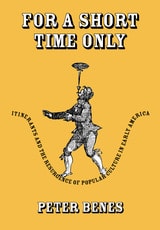
For a Short Time Only
Itinerants and the Resurgence of Popular Culture in Early AmericaPeter Benes
University of Massachusetts Press, 2016
By the 1740s, colonists living in North America began to encounter scores of itinerant performers from England and Europe. These show people—acrobats, wire dancers, tumblers, trick riders, painters, dancing-masters, waxworks proprietors, healers, and singing and language teachers—brought novelty and culture to remote areas. Advertising in newspapers, they attracted audiences with the hook of appearing "for a short time only."
In this richly illustrated and deeply researched book, Peter Benes examines the rise of early American popular culture through the lives and work of itinerants who circulated in British North America and the United States from the late seventeenth through the early nineteenth century. Although they were frequently reviled as quacks and absconders by many provincials, these transients enjoyed a unique camaraderie and found audiences among high- and lowbrow alike. Drawing on contemporary diaries, letters, reminiscences, and hitherto inaccessible newspaper ads, broadsides, and images, Benes suggests why some elements of Europe's carnival and folklore traditions failed to gain acceptance in American society while others flourished brilliantly.
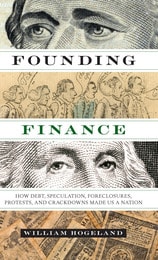
Founding Finance
How Debt, Speculation, Foreclosures, Protests, and Crackdowns Made Us a NationBy William Hogeland
University of Texas Press, 2014
Recent movements such as the Tea Party and anti-tax “constitutional conservatism” lay claim to the finance and taxation ideas of America’s founders, but how much do we really know about the dramatic clashes over finance and economics that marked the founding of America? Dissenting from both right-wing claims and certain liberal preconceptions, Founding Finance brings to life the violent conflicts over economics, class, and finance that played directly, and in many ways ironically, into the hardball politics of forming the nation and ratifying the Constitution—conflicts that still continue to affect our politics, legislation, and debate today.
Mixing lively narrative with fresh views of America’s founders, William Hogeland offers a new perspective on America’s economic infancy: foreclosure crises that make our current one look mild; investment bubbles in land and securities that drove rich men to high-risk borrowing and mad displays of ostentation before dropping them into debtors’ prisons; depressions longer and deeper than the great one of the twentieth century; crony mercantilism, war profiteering, and government corruption that undermine any nostalgia for a virtuous early republic; and predatory lending of scarce cash at exorbitant, unregulated rates, which forced people into bankruptcy, landlessness, and working in the factories and on the commercial farms of their creditors. This story exposes and corrects a perpetual historical denial—by movements across the political spectrum—of America’s all-important founding economic clashes, a denial that weakens and cheapens public discourse on American finance just when we need it most.
Francois Vallé and His World
Upper Louisiana before Lewis and ClarkCarl J. Ekberg
University of Missouri Press, 2002
Winner of the Kemper & Leila Williams Prize in Louisiana History for excellence in historical scholarship for the year 2002, awarded by The Historic New Orleans Collection, The Louisiana Historical Association.
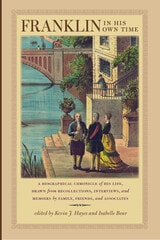
Franklin in His Own Time
A Biographical Chronicle of His Life, Drawn from Recollections, Interviews, and Memoirs by Family, Friends, and AssociatesKevin J. Hayes
University of Iowa Press, 2011
@font-face { font-family: "Courier New";}@font-face { font-family: "Times";}@font-face { font-family: "Cambria";}@font-face { font-family: "Palatino";}p.MsoNormal, li.MsoNormal, div.MsoNormal { margin: 0in 0in 0.0001pt; font-size: 12pt; font-family: "Times New Roman"; }div.Section1 { page: Section1; }
In his time Benjamin Franklin (1706–1790) was the most famous American in the world. Even those personally unacquainted with the man knew him as the author of Poor Richard’s Almanack, as a pioneer in the study of electricity and a major figure in the American Enlightenment, as the creator of such life-changing innovations as the lightning rod and America’s first circulating library, and as a leader of the American Revolution. His friends also knew him as a brilliant conversationalist, a great wit, an intellectual filled with curiosity, and most of all a master anecdotist whose vast store of knowledge complemented his conversational skills. In Franklin in His Own Time, by reprinting the original documents in which those anecdotes occur, Kevin Hayes and Isabelle Bour restore those oft-told stories to their cultural contexts to create a comprehensive narrative of his life and work.
The thirty-five recollections gathered in Franklin in His Own Time form an animated, collaborative biography designed to provide a multitude of perspectives on the “First American.” Opening with an account by botanist Peter Kalm showing that Franklin was doing all he could to encourage the development of science in North America, it includes on-the-spot impressions from Daniel Fisher’s diary, the earliest surviving interview with Franklin, recollections from James Madison and Abigail Adams, Manasseh Cutler’s detailed description of the library at Franklin Court, and extracts from Alexander Hamilton’s unvarnished Minutes of the Tuesday Club. Franklin’s political missions to Great Britain and France, where he took full advantage of rich social and intellectual opportunities, are a source of many reminiscences, some published here in new translations. Genuine memories from such old friends as Thomas Jefferson and John Adams, as opposed to memories influenced by the Autobiography, clarify Franklin’s reputation. Robert Carr may have been the last remaining person who knew Franklin personally, and thus his recollections are particularly signific

French Roots in the Illinois Country
The Mississippi Frontier in Colonial TimesCarl J. Ekberg
University of Illinois Press, 1998
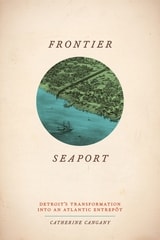
Frontier Seaport
Detroit's Transformation into an Atlantic EntrepôtCatherine Cangany
University of Chicago Press, 2014
In Frontier Seaport, Catherine Cangany details this seldom-discussed chapter of Detroit’s history. She argues that by the time of the American Revolution, Detroit functioned much like a coastal town as a result of the prosperous fur trade, serving as a critical link in a commercial chain that stretched all the way to Russia and China—thus opening Detroit’s shores for eastern merchants and other transplants. This influx of newcomers brought its own transatlantic networks and fed residents’ desires for popular culture and manufactured merchandise. Detroit began to be both a frontier town and seaport city—a mixed identity, Cangany argues, that hindered it from becoming a thoroughly “American” metropolis.