Results by title
90 books match the query 'Colonial period, ca. 1600-1775' and 3 start with f
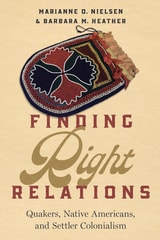
Finding Right Relations
Quakers, Native Americans, and Settler ColonialismMarianne O. Nielsen and Barbara M. Heather
University of Arizona Press, 2022
Quakers were one of the early settler colonist groups to invade northeastern North America. William Penn set out to develop a “Holy Experiment,” or utopian colony, in what is now Pennsylvania. Here, he thought, his settler colonists would live in harmony with the Indigenous Lenape and other settler colonists.
Centering on the relationship between Quaker colonists and the Lenape people, Finding Right Relations explores the contradictory position of the Quakers as both egalitarian, pacifist people, and as settler colonists. This book explores major challenges to Quaker beliefs and resulting relations with American Indians from the mid-seventeenth century to the late nineteenth century. It shows how the Quakers not only failed to prevent settler colonial violence against American Indians but also perpetuated it. It provides historical examples such as the French and Indian War, the massacre of the Conestoga Indians, and the American Indian boarding schools to explore the power of colonialism to corrupt even those colonists with a belief system rooted in social justice.
While this truth rubs against Quaker identity as pacifists and socially conscious, justice-minded people, the authors address how facing these truths provide ways forward for achieving restitution for the harms of the past. This book offers a path to truth telling that is essential to the healing process.
[more]
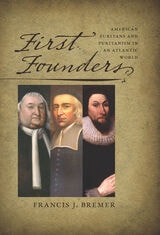
First Founders
American Puritans and Puritanism in an Atlantic WorldFrancis J. Bremer
University of New Hampshire Press, 2012
Francis J. Bremer has spent his entire career broadening our understanding of America’s colonial founders. Now, in this eminently readable collection of biographies, Bremer brings us a surprisingly varied and dynamic group of characters who continue to guide and influence America today. With its cast of magistrates, women, clergy, merchants, and Native Americans, First Founders underscores the breadth of early American experience and the profound transatlantic roots of our country’s forebears. Bremer succeeds in bringing little-known figures out of the shadows, while allowing us to appreciate better known figures in an entirely new light.
This is a truly fascinating look at the Puritans with keenly drawn portraits and the insight that only a lifetime of scholarship can achieve. It should become the standard introduction to the field. Written in the mold of Joseph Ellis’s Founding Brothers and Gordon Wood’s Revolutionary Characters, the book will appeal to general readers, students, and scholars alike.
This is a truly fascinating look at the Puritans with keenly drawn portraits and the insight that only a lifetime of scholarship can achieve. It should become the standard introduction to the field. Written in the mold of Joseph Ellis’s Founding Brothers and Gordon Wood’s Revolutionary Characters, the book will appeal to general readers, students, and scholars alike.
[more]
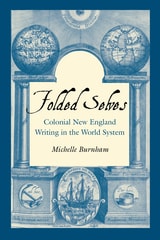
Folded Selves
Colonial New England Writing in the World SystemMichelle Burnham
Dartmouth College Press, 2014
Folded Selves radically refigures traditional portraits of seventeenth-century New England literature and culture by situating colonial writing within the spatial, transnational, and economic contexts that characterized the early-modern “world system” theorized by Immanuel Wallerstein and others. Michelle Burnham rethinks American literary history and the politics of colonial dissent, and her book breaks new ground in making the economic relations of investment, credit, and trade central to this new framework for early American literary and cultural study. Transcontinental colonialism and mercantile capitalism underwrote not just the emerging world system but New World writing—suggesting that early modern literary aesthetics and the early modern economy helped to sponsor each other. Burnham locates in New England’s literature of dissent—from Ma-re Mount to the Salem witchcraft trials – a persistent use of economic language, as well as competing economies of style. The brilliance of Burnham’s study is that it exposes the transoceanic material and commercial concerns of colonial America’s literature and culture of dissent.
[more]