Results by title
231 books match the query 'Colonies' and 8 start with f
Fire under the Ashes
An Atlantic History of the English RevolutionJohn Donoghue
University of Chicago Press, 2013
Prominent merchant revolutionaries from Coleman Street led England’s imperial expansion by investing deeply in the slave trade and projects of colonial conquest. Opposing them were other Coleman Street puritans, who having crossed and re-crossed the ocean as colonists and revolutionaries, circulated new ideas about the liberty of body and soul that they defined against England’s emergent, political economy of empire. These transatlantic radicals promoted social justice as the cornerstone of a republican liberty opposed to both political tyranny and economic slavery—and their efforts, Donoghue argues, provided the ideological foundations for the abolitionist movement that swept the Atlantic more than a century later.
Formations of United States Colonialism
Alyosha Goldstein
Duke University Press, 2014
Contributors. Julian Aguon, Joanne Barker, Berenika Byszewski, Jennifer Nez Denetdale, Augusto Espiritu, Alyosha Goldstein, J. K?haulani Kauanui, Barbara Krauthamer, Lorena Oropeza, Vicente L. Rafael, Dean Itsuji Saranillio, Lanny Thompson, Lisa Uperesa, Manu Vimalassery
Freedom Time
Negritude, Decolonization, and the Future of the WorldGary Wilder
Duke University Press, 2015

French Colonial Documentary
Mythologies of HumanitarianismPeter J. Bloom
University of Minnesota Press, 2008
Despite altruistic goals, humanitarianism often propagates foreign, and sometimes unjust, power structures where it is employed. Tracing the visual rhetoric of French colonial humanitarianism, Peter J. Bloom’s unexpected analysis reveals how the project of remaking the colonies in the image of France was integral to its national identity.
French Colonial Documentary investigates how the promise of universal citizenship rights in France was projected onto the colonies as a form of evolutionary interventionism. Bloom focuses on the promotion of French education efforts, hygienic reform, and new agricultural techniques in the colonies as a means of renegotiating the social contract between citizens and the state on an international scale. Bloom’s insightful readings disclose the pervasiveness of colonial iconography, including the relationship between “natural man” and colonial subjectivity; representations of the Senegalese Sharpshooters as obedient, brave, and sexualized colonial subjects; and the appeal of exotic adventure narratives in the trans-Saharan film genre.
Examining the interconnection between French documentary realism and the colonial enterprise, Bloom demonstrates how the colonial archive is crucial to contemporary debates about multiculturalism in France.
Peter J. Bloom is associate professor of film and media studies at the University of California-Santa Barbara.y debates about multiculturalism in France.
French Primitivism and the Ends of Empire, 1945-1975
Daniel J. Sherman
University of Chicago Press, 2011
For over a century, the idea of primitivism has motivated artistic modernism. Focusing on the three decades after World War II, known in France as “les trentes glorieuses” despite the loss of most of the country’s colonial empire, this probing and expansive book argues that primitivism played a key role in a French society marked by both economic growth and political turmoil.
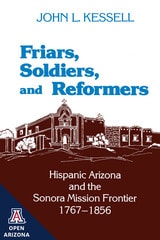
Friars, Soldiers, and Reformers
Hispanic Arizona and the Sonora Mission Frontier, 1767–1856John L. Kessell
University of Arizona Press, 1976
Kessell provides exciting accounts of the explorations of Francisco Garcés, de Anza's expeditions, and the Yuma massacre. Drawing from widely scattered archival materials, he vividly describes the epic struggle between Bishop Reyes and Father President Barbastro, the missionary scandals of 1815–18, and the bloody victory of Mexican civilian volunteers over Apaches in Arivaipa Canyon in 1832. Numerous missionaries, presidials, and bureaucrats—nameless in histories until now—emerge as living, swearing, praying, individuals.
This authoritative chronicle offers an engrossing picture of the continually threatened mission frontier. Reformers championing civil rights for mission Indians time and again challenged the friars' "tight-fisted paternalistic control" over their wards. Expansionists repeatedly saw their plans dashed by Indian raids, uncooperative military officials, or lack of financial support.
Frairs, Soldiers, and Reformers brings into sharp focus the long, blurry period between Jesuit Sonora and Territorial Arizona.
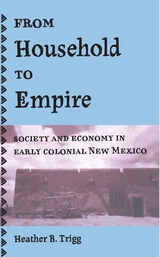
From Household to Empire
Society and Economy in Early Colonial New MexicoHeather B. Trigg
University of Arizona Press, 2005
William P. Clements Center for Southwest Studies, Southern Methodist University
Settlers at Santa Fe and outlying homesteads during the seventeenth century established a thriving economy that saw the exchange of commodities produced by indigenous peoples, settlers, and Franciscan friars for goods manufactured as far away as China, France, and Turkey. This early Spanish colonial period in New Mexico provides an opportunity to explore both economic activity within a colony and the relations between colony and homeland. By examining the material remains of this era from 1598 to 1680, Heather Trigg reveals a more complete picture of colonial life. Drawing on both archaeological and historical sources, Trigg analyzes the various levels of economic activity that developed: production of items in colonial households, exchanges between households, and trade between the colony and Mexico. Rather than focusing only on the flow of products and services, she also explores the social mechanisms that likely had a significant impact on the economic life of the colony. Because economic activity was important to so many aspects of daily life, she is able to show how and why colonial society worked the way it did. While focusing on the colonists, she also explores their relations with Pueblo peoples. Through her analysis of these two pools of data, Trigg generates insights not usually gleaned from the limited texts of the period, providing information about average colonists in addition to the governors and clergy usually covered in historical accounts. By using specific examples from historical documents and archaeological materials, she shows that colonists from all levels of society modified both formal and informal rules of economic behavior to better fit the reality of the colonial frontier. With its valuable comparative data on colonization, From Household to Empire provides a novel way of examining colonial economies by focusing on the maintenance and modification of social values. For all readers fascinated by the history of the Southwest, this book provides a fuller picture of life in early New Mexico than has previously been seen.
From the Margins
Historical Anthropology and Its FuturesBrian Keith Axel, ed.
Duke University Press, 2002
In original articles encompassing a wide range of geographic and temporal locations, eminent scholars contest some of the primary preconceptions of their fields. The contributors tackle such topics as the paradoxical nature of American Civil War monuments, the figure of the “New Christian” in early seventeenth-century Peru, the implications of statistics for ethnography, and contemporary South Africa's “occult economies.” That anthropology and history have their provenance in—and have been complicit with—colonial formations is perhaps commonplace knowledge. But what is rarely examined is the specific manner in which colonial processes imbue and threaten the celebratory ideals of postcolonial reason or the enlightenment of today’s liberal practices in the social sciences and humanities.
By elaborating this critique, From the Margins offers diverse and powerful models that explore the intersections of historically specific local practices with processes of a world historical order. As such, the collection will not only prove valuable reading for anthropologists and historians, but also for scholars in colonial, postcolonial, and globalization studies.
Contributors. Talal Asad, Brian Keith Axel, Bernard S. Cohn, Jean Comaroff, John L. Comaroff, Nicholas B. Dirks, Irene Silverblatt, Paul A. Silverstein, Teri Silvio, Ann Laura Stoler, Michel-Rolph Trouillot