Results by title
148 books match the query 'Colonization' and 8 start with f
Family and Frontier in Colonial Brazil
Santana de Parnaíba, 1580–1822By Alida C. Metcalf
University of Texas Press, 2005
Family and Frontier in Colonial Brazil was originally published by the University of California Press in 1992. Alida Metcalf has written a new preface for this first paperback edition.
Fictions of Land and Flesh
Blackness, Indigeneity, SpeculationMark Rifkin
Duke University Press, 2019
Figurations of Modernity
Global and Local Representations in Comparative PerspectiveEdited by Vincent Houben and Mona Schrempf
Campus Verlag, 2008
Finding Italy
Travel, Nation, and Colonization in Vergil's AeneidK. F. B. Fletcher
University of Michigan Press, 2014
Finding Italy explores the journey of the Romans’ ancestor Aeneas and his fellow Trojans from their old home, Troy, to their new country, Italy, narrated in Vergil’s epic poem Aeneid. K. F. B. Fletcher argues that a main narrative theme is patriotism, specifically the problem of how one comes to love one’s new country. The various directions Aeneas receives throughout the first half of the poem are meant to create this love, explaining both to Aeneas and to Vergil’s readers how they should respond to the new, unified Italy synonymous with Rome. These directions come from the gods, or from people close to Aeneas who have divine connections, and they all serve to instill an emotional connection to the land, creating a mental image of Italy that tells him far more about his destination than merely its location, and ultimately making him fall in love with Italy enough to fight for it soon after his arrival. The poem thus dramatizes the birth of nationalism, as Italy is only a concept to Aeneas throughout his trip; these directions do not describe Italy as it is at the time of Aeneas’ journey, but as an ideal to be realized by Aeneas and his descendants, reaching its final, perfect form under Augustus Caesar.
Finding Italy provides a very detailed reading of the directions Aeneas receives by situating them within their relevant contexts: ancient geography, Greek colonization narratives, prophecy, and ancient views of wandering. Vergil draws on all of these concepts to craft instructions that create in Aeneas an attachment to Italy before he ever arrives, a process that dramatizes a key emotional problem in the late first century BCE in the wake of the Social and Civil Wars: how to balance the love of one's modest birthplace with the love of Rome, the larger city that now encompasses it.
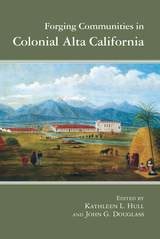
Forging Communities in Colonial Alta California
Edited by Kathleen L. Hull and John G. Douglass
University of Arizona Press, 2018
Forging Communities in Colonial Alta California reorients understandings of this dynamic period, which challenged both Native and non-Native people to reimagine communities not only in different places and spaces but also in novel forms and practices. The contributors draw on archaeological and historical archival sources to analyze the generative processes and nature of communities of belonging in the face of rapid demographic change and perceived or enforced difference.
Contributors provide important historical background on the effects that colonialism, missions, and lives lived beyond mission walls had on Indigenous settlement, marriage patterns, trade, and interactions. They also show the agency with which Indigenous peoples make their own decisions as they construct and reconstruct their communities. With nine different case studies and an insightful epilogue, this book offers analyses that can be applied broadly across the Americas, deepening our understanding of colonialism and community.
Contributors:
Julienne Bernard
James F. Brooks
John Dietler
Stella D’Oro
John G. Douglass
John Ellison
Glenn Farris
Heather Gibson
Kathleen L. Hull
Linda Hylkema
John R. Johnson
Kent G. Lightfoot
Lee M. Panich
Sarah Peelo
Seetha N. Reddy
David W. Robinson
Tsim D. Schneider
Christina Spellman
Benjamin Vargas
Formations of United States Colonialism
Alyosha Goldstein
Duke University Press, 2014
Contributors. Julian Aguon, Joanne Barker, Berenika Byszewski, Jennifer Nez Denetdale, Augusto Espiritu, Alyosha Goldstein, J. K?haulani Kauanui, Barbara Krauthamer, Lorena Oropeza, Vicente L. Rafael, Dean Itsuji Saranillio, Lanny Thompson, Lisa Uperesa, Manu Vimalassery
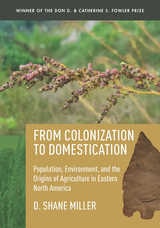
From Colonization to Domestication
Population, Environment, and the Origins of Agriculture in Eastern North AmericaD. Shane Miller
University of Utah Press, 2018
Eastern North America is one of only a handful of places in the world where people first discovered how to domesticate plants. In this book, anthropologist Shane Miller uses two common, although unconventional, sources of archaeological data—stone tools and the distribution of archaeological sites—to trace subsistence decisions from the initial colonization of the American Southeast at the end of the last Ice Age to the appearance of indigenous domesticated plants roughly 5,000 years ago.
Miller argues that the origins of plant domestication lie within the context of a boom/bust cycle that culminated in the mid-Holocene, when hunter-gatherers were able to intensively exploit shellfish, deer, oak, and hickory. After this resource “boom” ended, some groups shifted to other plants in place of oak and hickory, which included the suite of plants that were later domesticated. Accompanying these subsistence trends is evidence for increasing population pressure and declining returns from hunting. Miller contends, however, that the appearance of domesticated plants in eastern North America, rather than simply being an example of necessity as the mother of invention, is the result of individuals adjusting to periods of both abundance and shortfall driven by climate change.
From Moon Goddesses to Virgins
The Colonization of Yucatecan Maya Sexual DesireBy Pete Sigal
University of Texas Press, 2000
For the preconquest Maya, sexuality was a part of ritual discourse and performance, and all sex acts were understood in terms of their power to create, maintain, and destroy society. As postconquest Maya adapted to life under colonial rule, they neither fully abandoned these views nor completely adopted the formulation of sexuality prescribed by Spanish Catholicism. Instead, they evolved hybridized notions of sexual desire, represented in the figure of the Virgin Mary as a sexual goddess, whose sex acts embodied both creative and destructive components.
This highly innovative book decodes the process through which this colonization of Yucatan Maya sexual desire occurred. Pete Sigal frames the discussion around a series of texts, including the Books of Chilam Balam and the Ritual of the Bacabs, that were written by seventeenth and eighteenth century Maya nobles to elucidate the history, religion, and philosophy of the Yucatecan Maya communities. Drawing on the insights of philology, discourse analysis, and deconstruction, he analyzes the sexual fantasies, fears, and desires that are presented, often unintentionally, in the "margins" of these texts and shows how they illuminate issues of colonialism, power, ritual, and gender.