73 books match the query 'Color' and 6 start with f

cover of Faculty of Color in the Health Professions: Stories of Survival and Success

Faculty of Color in the Health Professions

Stories of Survival and Success

Dena Hassouneh

Dartmouth College Press, 2017

This book provides the first in-depth examination of the experiences of a large sampling of faculty members of color in nursing, medicine, pharmacy, and dentistry schools across the United States. Anchoring her study in grounded theory, Dena Hassouneh draws on extraordinary interviews with one hundred diverse faculty members—together with rich contextual data—to illuminate the deeply entrenched cultural and institutional challenges to equity that they confront. She also presents practical strategies to overcome those challenges. The book documents the ways in which faculty members of color are excluded from full participation in their laboratory or department; yet Hassouneh’s research shows that faculty of color can survive and even thrive. The interviews and data clearly reveal both the social, educational, and departmental contexts that determine satisfaction and success in recruitment and advancement and the impact that faculty of color have had on their students, peers, patients, schools, and communities.
[more]
cover of Fandom, Now in Color: A Collection of Voices

Fandom, Now in Color

A Collection of Voices

Rukmini Pande

University of Iowa Press, 2020

Fandom, Now in Color gathers together seemingly contradictory narratives that intersect at the (in)visibility of race/ism in fandom and fan studies. This collection engages the problem by undertaking the different tactics of decolonization—diversifying methodologies, destabilizing canons of “must-read” scholarship by engaging with multiple disciplines, making whiteness visible but not the default against which all other kinds of racialization must compete, and decentering white fans even in those fandoms where they are the assumed majority. These new narratives concern themselves with a broad swath of media, from cosplay and comics to tabletop roleplay and video games, and fandoms from Jane the Virgin to Japan’s K-pop scene. Fandom, Now in Color asserts that no one answer or approach can sufficiently come to grips with the shifting categories of race, racism, and racial identity.

Contributors: McKenna Boeckner, Angie Fazekas, Monica Flegel, Elizabeth Hornsby, Katherine Anderson Howell, Carina Lapointe, Miranda Ruth Larsen, Judith Leggatt, Jenni Lehtinen, joan miller, Swati Moitra, Samira Nadkarni, Indira Neill Hoch, Sam Pack, Rukmini Pande, Deepa Sivarajan, Al Valentín

[more]
cover of Feminism in Coalition: Thinking with US Women of Color Feminism

Feminism in Coalition

Thinking with US Women of Color Feminism

Liza Taylor

Duke University Press, 2022

In Feminism in Coalition Liza Taylor examines how US women of color feminists’ coalitional politics provides an indispensable resource to contemporary political theory, feminist studies, and intersectional social justice activism. Taylor charts the theorization of coalition in the work of Bernice Johnson Reagon, Audre Lorde, Barbara Smith, the Combahee River Collective, Gloria Anzaldúa, Cherríe Moraga, and others. For these activist-scholars, coalition is a dangerous struggle that emerges from a shared political commitment to undermining oppression and an emphasis on self-transformation. Taylor shows how their coalitional understandings of group politics, identity, consciousness, and scholarship have transformed how activists and theorists build alliances across race, class, gender, sexuality, faith, and ethnicity to tackle systems of domination. Their coalitional politics enrich current discussions surrounding the impetus and longevity of effective activism, present robust theoretical accounts of political subject formation and political consciousness, and demonstrate the promise of collective modes of scholarship. In this way, women of color feminists have been formulating solutions to long-standing problems in political theory. By illustrating coalition’s vitality to a variety of practical and philosophical interdisciplinary discussions, Taylor encourages us to rethink feminist and political theory.
[more]
cover of Fire and Desire: Mixed-Race Movies in the Silent Era

Fire and Desire

Mixed-Race Movies in the Silent Era

Jane M. Gaines

University of Chicago Press, 2001

In the silent era, American cinema was defined by two separate and parallel industries, with white and black companies producing films for their respective, segregated audiences. Jane Gaines's highly anticipated new book reconsiders the race films of this era with an ambitious historical and theoretical agenda.

Fire and Desire offers a penetrating look at the black independent film movement during the silent period. Gaines traces the profound influence that D. W. Griffith's racist epic The Birth of a Nation exerted on black filmmakers such as Oscar Micheaux, the director of the newly recovered Within Our Gates. Beginning with What Happened in the Tunnel, a movie that played with race and sex taboos by featuring the first interracial kiss in film, Gaines also explores the cinematic constitution of self and other through surprise encounters: James Baldwin sees himself in the face of Bette Davis, family resemblance is read in Richard S. Robert's portrait of an interracial family, and black film pioneer George P. Johnson looks back on Micheaux.

Given the impossibility of purity and the co-implication of white and black, Fire and Desire ultimately questions the category of "race movies" itself.
[more]
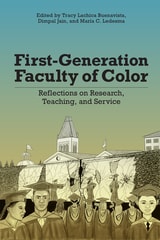
cover of First-Generation Faculty of Color: Reflections on Research, Teaching, and Service

First-Generation Faculty of Color

Reflections on Research, Teaching, and Service

Tracy Lachica Buenavista

Rutgers University Press, 2023
First-Generation Faculty of Color: Reflections on Research, Teaching, and Service is the first book to examine the experiences of racially minoritized faculty who were also the first in their families to graduate college in the United States. From contingent to tenured faculty who teach at community colleges, comprehensive, and research institutions, the book is a collection of critical narratives that collectively show the diversity of faculty of color, attentive to and beyond race. The book is organized into three major parts comprised of chapters in which faculty of color depict how first-generation college student identities continue to inform how minoritized people navigate academe well into their professional careers, and encourage them to reconceptualize research, teaching, and service responsibilities to better consider the families and communities that shaped their lives well before college.
[more]
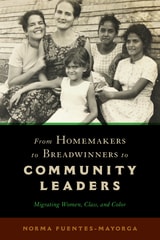
cover of From Homemakers to Breadwinners to Community Leaders: Migrating Women, Class, and Color

From Homemakers to Breadwinners to Community Leaders

Migrating Women, Class, and Color

Norma Fuentes-Mayorga

Rutgers University Press, 2022

In From Homemakers to Breadwinners to Community Leaders, Norma Fuentes-Mayorga compares the immigration and integration experiences of Dominican and Mexican women in New York City, a traditional destination for Dominicans but a relatively new one for Mexicans. Her book documents the significance of women-led migration within an increasingly racialized context and underscores the contributions women make to their communities of origin and of settlement. Fuentes-Mayorga’s research is timely, especially against the backdrop of policy debates about the future of family reunification laws and the unprecedented immigration of women and minors from Latin America, many of whom seek human rights protection or to reunite with families in the US. From Homemakers to Breadwinners to Community Leaders provides a compelling look at the suffering of migrant mothers and the mourning of family separation, but also at the agency and contributions that women make with their imported human capital and remittances to the receiving and sending community. Ultimately the book contributes further understanding to the heterogeneity of Latin American immigration and highlights the social mobility of Afro-Caribbean and indigenous migrant women in New York. 
[more]