Results by title
56 books match the query 'Crafts & Hobbies' and 4 start with f

Fashion Knowledge
Theories, Methods, Practices and PoliticsEdited by Elke Gaugele and Monica Titton
Intellect Books, 2024
At a point when fashion studies are expanding and the fashion industry is at a crucial point of change, Fashion Knowledge makes a valuable contribution to the field. The book explores current issues in fashion research, with a focus on the relationship between theory and practice. This edited collection assembles academic essays and intellectual activism next to visual essays and artistic interventions, proposing a different concept for fashion research that eschews the traditional logic of academic fashion studies. It features acclaimed designers, artists, curators, and theorists whose work investigates the multi-faceted debates on the rise of practice-based research in fashion. Contributors look at new forms of fashion knowledge that are forming along with shifting practices, shedding light on the entanglement of fashion and politics in both contemporary and historical moments.
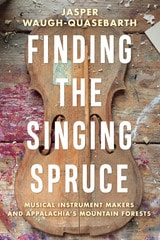
Finding the Singing Spruce
Musical Instrument Makers and Appalachia's Mountain ForestsJasper Waugh-Quasebarth
West Virginia University Press, 2023
Environment, craft, and meaning in the work of Appalachian instrument makers.
How can the craft of musical instrument making help reconnect people to place and reenchant work in Appalachia? How does the sonic search for musical tone change relationships with trees and forests? Following three craftspeople in the mountain forests of Appalachia through their processes of making instruments, Finding the Singing Spruce considers the meanings of work, place, and creative expression in drawing music from wood.
Jasper Waugh-Quasebarth explores the complexities and contradictions of instrument-making labor, which is deeply rooted in mountain forests and expressive traditions but also engaged with global processes of production and consumption. Using historical narratives and sensory ethnography, among other approaches, he finds that the craft of lutherie speaks to the past, present, and future of the region’s work and nature.
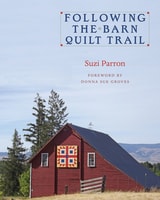
Following the Barn Quilt Trail
Suzi Parron
Ohio University Press, 2016
Suzi Parron, in cooperation with Donna Sue Groves, documented the massive public art project known as the barn quilt trail in her 2012 book Barn Quilts and the American Quilt Trail Movement. The first of these projects began in 2001, when Groves and community members created a series of twenty painted quilt squares in Adams County, Ohio. Since then, barn quilts have spread throughout forty-eight states and several Canadian provinces.
In Following the Barn Quilt Trail, Parron brings readers along as she, her new love, Glen, their dog Gracie, and their converted bus Ruby, leave the stationary life behind. Suzi and Glen follow the barn quilt trail through thirty states across thirteen thousand miles as Suzi collects the stories behind the brightly painted squares. With plentiful color photographs, this endearing hybrid of memoir and travelogue is for quilt lovers, Americana and folk art enthusiasts, or anyone up for a good story.
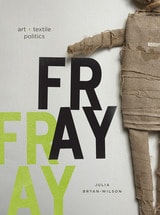
Fray
Art and Textile PoliticsJulia Bryan-Wilson
University of Chicago Press, 2017
Closely examining how amateurs and fine artists in the United States and Chile turned to sewing, braiding, knotting, and quilting amid the rise of global manufacturing, Julia Bryan-Wilson argues that textiles unravel the high/low divide and urges us to think flexibly about what the politics of textiles might be. Her case studies from the 1970s through the 1990s—including the improvised costumes of the theater troupe the Cockettes, the braided rag rugs of US artist Harmony Hammond, the thread-based sculptures of Chilean artist Cecilia Vicuña, the small hand-sewn tapestries depicting Pinochet’s torture, and the NAMES Project AIDS Memorial Quilt—are often taken as evidence of the inherently progressive nature of handcrafted textiles. Fray, however, shows that such methods are recruited to often ambivalent ends, leaving textiles very much “in the fray” of debates about feminized labor, protest cultures, and queer identities; the malleability of cloth and fiber means that textiles can be activated, or stretched, in many ideological directions.
The first contemporary art history book to discuss both fine art and amateur registers of handmaking at such an expansive scale, Fray unveils crucial insights into how textiles inhabit the broad space between artistic and political poles—high and low, untrained and highly skilled, conformist and disobedient, craft and art.