Results by title
190 books match the query 'Critical theory' and 7 start with f
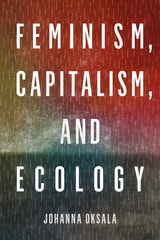
Feminism, Capitalism, and Ecology
Johanna Oksala
Northwestern University Press, 2023
In the face of ecological catastrophe, neither feminists nor environmentalists have the option of merely supporting an environmental politics that would preserve an imagined nature somewhere outside capitalism. As Johanna Oksala contends, the political goal must be more radical: to challenge the capitalist economic system itself and the mechanisms by which it expropriates life on the planet.
Feminism, Capitalism, and Ecology lays the critical groundwork for this political project. It develops a new way of bringing feminist and ecological responses to capitalism together into a cohesive framework. By exposing the systemic logic by which environmental destruction and gender oppression are jointly rooted in capitalism, Oksala establishes the theoretical foundations for an effective political alliance. The traditions of materialist ecofeminism and Marxist feminism are critical starting points. But the rapid rise of biotechnology and the steady increase of precarity necessitate a model of resistance that responds to the distinctive challenges of contemporary biocapitalism. Timely and urgent, this book articulates a theoretically sophisticated response and maps out our real-world options in this existential struggle.
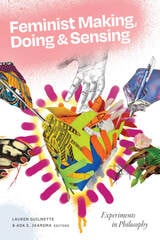
Feminist Making, Doing, and Sensing
Experiments in PhilosophyLauren Guilmette and Ada S. Jaarsma, editors
Duke University Press, 2026
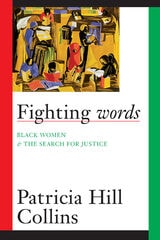
Fighting Words
Black Women and the Search for JusticePatricia Hill Collins
University of Minnesota Press, 1998

Film and Everyday Resistance
Marguerite La Caze
Northwestern University Press, 2024
A philosophical exploration of how modern global cinema represents everyday means of resisting authoritarianism and totalitarianism
Václav Havel’s concept of “living within the truth” in an authoritarian regime frames Marguerite La Caze’s readings of international cinema, highlighting forms of resistance in which seemingly pre- or nonpolitical aspects of life—such as professional labor, exile, and truth telling—can be recognized as political when seen against a backdrop of general acquiescence. La Caze’s case studies cross genres, historical eras, and national contexts: the apartheid regime in South Africa, in A Dry White Season; post-Suharto Indonesia, in The Look of Silence; 1980s East Germany, in Barbara; the Chilean military dictatorship, in No; contemporary Iran, in A Separation; and current-day Saudi Arabia, in Wadjda. This book explores the films’ use of image, sound, narrative, and character in dialogue with the work of Simone de Beauvoir, Aimé Cesaire, Hannah Arendt, Sara Ahmed, and W. E. B. Du Bois to reveal how cinema depicts ordinary people enacting their own philosophies of defiance.
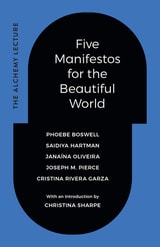
Five Manifestos for the Beautiful World
The Alchemy LecturePhoebe Boswell, Saidiya Hartman, Janaina Oliveira, Joseph M. Pierce, and Cristina Rivera Garza
Duke University Press, 2025
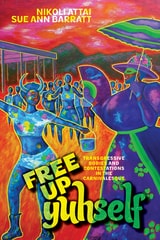
Free Up Yuhself
Transgressive Bodies and Contestations in the CarnivalesqueNikoli A. Attai
Rutgers University Press, 2025
Free Up Yuhself explores and theorizes what it means to embody and be empowered by the chaos of transgression, evaluating the implications for people who destabilize the Caribbean region’s dominant gender and sexuality politics within the Caribbean and the Caribbean diaspora. This book examines how people actively utilize the carnivalesque—spaces of festivity and places of excitement, the extraordinary, the ritualistic—to confront, negotiate, disrupt, and transgress normative trends, boundaries, and perspectives in the Caribbean and Caribbean diaspora communities. This book is particularly concerned with the ways that Caribbean people contest sexual and gendered expectations through their bodily performances across regional and diasporic festival spaces. Through illustrative, analytical, evaluative, and reflective chapters, the collection contemplates the themes of freedom, belonging, acceptance, and recognition as these affect the experience of people’s sense of being. The authors reflect on “freeing up” as a contentious politics, understanding that people have the capacity to enact their freedom through transgressive movements and performances that persistently grapple with notions of respectability, agency, empowerment, disruption, and the meanings and consequences of their varied social and political locations.
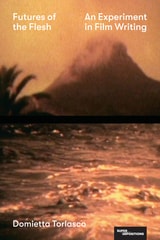
Futures of the Flesh
An Experiment in Film WritingDomietta Torlasco
Northwestern University Press, 2026
Exploring alternative possibilities of viewpoint through cinematic experimentation
In this boldly multidimensional work, Domietta Torlasco alternates between theoretical writings, film essays, and fragmented excerpts from an original screenplay to construct a temporal as well as spatial architecture for her critical intervention. Futures of the Flesh posits that cinematic experimentation holds the strongest potential to reimagine life—its forms, rhythms, and affects—beyond the division between subject and object, human and animal, animate and inanimate. Such potential cannot be clearly located in either space or time but, on the contrary, requires that we think according to momentum, diffraction, and difference.
As a novel notion and the formative medium of both subject and object, the flesh affirms the openness and indefinite generativity of being, allowing for the appearance of new perceptual relations and forms of kinship. Torlasco stages a dialogue between thinkers including Hortense Spillers and Maurice Merleau-Ponty and turns to canonical films, including Blade Runner and Solaris, classic sci-fi literature, such as Octavia Butler’s Kindred, and contemporary video art to elucidate how these media imaginatively rework the distinction between categories of being. This book endeavors to redefine the relation between theory and practice, analysis and creation, to name the primary relations that, under specific techno-aesthetic conditions, enable the emergence of porous, un-bordered forms of life.