Results by title
281 books match the query 'Criticism, interpretation, etc' and 6 start with f
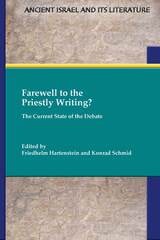
Farewell to the Priestly Writing? The Current State of the Debate
Friedhelm Hartenstein
SBL Press, 2020
Now available in English
In discussions of the origin of the Pentateuch, the Priestly source traditionally constitutes an undisputed reference point for different source-critical models, and it is the only literary layer with concise terminology and a theological conception that can be extracted from a non-Priestly context. This English translation of Abschied von der Priesterschrift? Zum Stand der Pentateuchdebatte revisits the scholarly debate surrounding the Documentary Hypothesis and the so-called Priestly material’s position either as an independent written source or as a redaction within the books of Genesis through Deuteronomy. Contributors include Christoph Berner, Erhard Blum, Jan Christian Gertz, Christoph Levin, Eckart Otto, Christophe Nihan, and Thomas Römer.
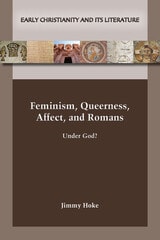
Feminism, Queerness, Affect, and Romans
Under God?Jimmy Hoke
SBL Press, 2021
"This is a book about submission and subversion, injustice and justice, heroes and villains."
In Feminism, Queerness, Affect, and Romans: Under God? Jimmy Hoke reads Romans with an innovative, intersectional approach that produces distinctive meanings for passages that probe how queer wo/men who first encountered Paul's letter could have engaged with it. Though Paul's letter to the Romans arguably contains the Bible’s strongest condemnation of queer wo/men (1:26–27), that is not the letter's full story. Hoke turns a feminist and queer gaze toward Paul’s conception of faith and ethics, making explicit how Paul's theology throughout Romans has been affectively motivated by imperial notions of gender, race, and sexuality. Moving beyond Paul's singular voice, Hoke engages with a feminist and queer praxis of assemblage to generate plausible ways wo/men of Rome interacted with this epistle. By engaging affect theory, Hoke brings to life not only ideas and words but the feelings and sensations that moved in-between some of the earliest Christ-followers, revealing how queer wo/men were there among them and what that means for queer wo/men today. Hoke includes a reader's guide with key terms used throughout the book, making this an excellent option for both students and scholars beginning to engage not only Paul's letters but also the complex worlds of feminist, queer, and affect theories.
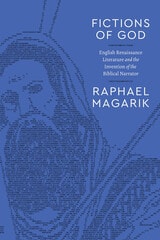
Fictions of God
English Renaissance Literature and the Invention of the Biblical NarratorRaphael Magarik
University of Chicago Press, 2025
We often identify secularization's characteristic literary form as the modern novel: out with divine scripture, in with human fictions. In Fictions of God, Raphael Magarik argues that this story overlooks the cultural upheavals of the Protestant Reformation. Early reformers imagined a Bible that was neither infallible nor inerrant but fictional, composed by a divine counterfactual: God crafted the text, they said, as if it had been written by the prophets. Early modern Protestants now found in their Bibles not a source of foundational truths but a model for unreliable narration, even fiction.
Fictions of God traces how this approach to literature passed from biblical commentators to poets like Abraham Cowley, John Milton, and Lucy Hutchinson amid the violent emergence of a new religious and political order—long before the eighteenth-century rise of the English novel. The result is a transformative account of the Reformation’s effect on imaginative literature and the secularization of the Bible itself.
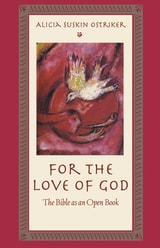
For the Love of God
The Bible as an Open BookOstriker, Alicia Suskin
Rutgers University Press, 2009
For the Love of God is a provocative and inspiring re-interpretation of six essential Biblical texts: The Song of Songs, the Book of Ruth, Psalms, Ecclesiastes, Jonah, and Job. In prose that is personal and probing, analytically acute and compellingly readable, Ostriker sees these writings as “counter-texts,” deviating from convention yet deepening and enriching the Bible, our images of God, and our own potential spiritual lives. Attempting to understand “some of the wildest, strangest, most splendid writing in Western tradition,” she shows how the Bible embraces sexuality and skepticism, boundary crossing and challenges to authority, how it illuminates the human psyche and mirrors our own violent times, and how it asks us to make difficult choices in the quest for justice.
For better or worse, our society is wedded to the Bible. But according to Talmud, “There is always another interpretation.” Ostriker demonstrates that the Bible, unlike its reputation, offers a plenitude of surprises.
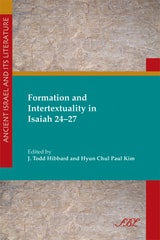
Formation and Intertextuality in Isaiah 24-27
J. Todd Hibbard
SBL Press, 2013
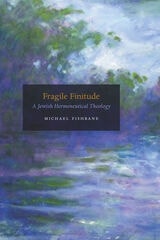
Fragile Finitude
A Jewish Hermeneutical TheologyMichael Fishbane
University of Chicago Press, 2021
In Fragile Finitude, Fishbane clears new ground for a theological life through a novel reinterpretation of the Book of Job. On this basis, he offers a contemporary engagement with the four classical types of Jewish Scriptural exegesis. The first focuses on worldly experience, the second on communal forms of practice and thought in the rabbinical tradition, the third on personal development, and the fourth on transcendent, cosmic orientations. Through these four modes, Fishbane manages to transform Jewish theology from within, at once reinvigorating a long tradition and moving beyond it. What he offers is nothing short of a way to reorient our lives in relation to the divine and our fellow humans. Written from within the Jewish tradition, Fragile Finitude is intended for readers across the religious spectrum.