Results by title
92 books match the query 'Cultural & Social Aspects' and 2 start with f
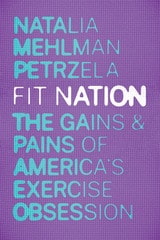
Fit Nation
The Gains and Pains of America's Exercise ObsessionNatalia Mehlman Petrzela
University of Chicago Press, 2022
How is it that Americans are more obsessed with exercise than ever, and yet also unhealthier? Fit Nation explains how we got here and imagines how we might create a more inclusive, stronger future.
If a shared American creed still exists, it’s a belief that exercise is integral to a life well lived. A century ago, working out was the activity of a strange subculture, but today, it’s almost impossible to avoid exhortations to exercise: Walk 5K to cure cancer! Awaken your inner sex kitten at pole-dancing class! Sweat like (or even with) a celebrity in spin class! Exercise is everywhere.
Yet the United States is hardly a “fit nation.” Only 20 percent of Americans work out consistently, over half of gym members don’t even use the facilities they pay for, and fewer than 30 percent of high school students get an hour of exercise a day. So how did fitness become both inescapable and inaccessible?
Spanning more than a century of American history, Fit Nation answers these questions and more through original interviews, archival research, and a rich cultural narrative. As a leading political and intellectual historian and a certified fitness instructor, Natalia Mehlman Petrzela is uniquely qualified to confront the complex and far-reaching implications of how our contemporary exercise culture took shape. She explores the work of working out not just as consumers have experienced it, but as it was created by performers, physical educators, trainers, instructors, and many others.
For Petrzela, fitness is a social justice issue. She argues that the fight for a more equitable exercise culture will be won only by revolutionizing fitness culture at its core, making it truly inclusive for all bodies in a way it has never been. Examining venues from the stage of the World’s Fair and Muscle Beach to fat farms, feminist health clinics, radical and evangelical college campuses, yoga retreats, gleaming health clubs, school gymnasiums, and many more, Fit Nation is a revealing history that shows fitness to be not just a matter of physical health but of what it means to be an American.
[more]
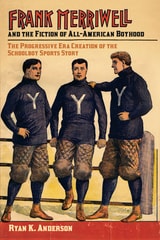
Frank Merriwell and the Fiction of All-American Boyhood
The Progressive Era Creation of the Schoolboy Sports StoryRyan K. Anderson
University of Arkansas Press, 2015
Gilbert Patten, writing as Burt L. Standish, made a career of generating serialized twenty-thousand-word stories featuring his fictional creation Frank Merriwell, a student athlete at Yale University who inspired others to emulate his example of manly boyhood. Patten and his publisher, Street and Smith, initially had only a general idea about what would constitute Merriwell’s adventures and who would want to read about them when they introduced the hero in the dime novel Tip Top Weekly in 1896, but over the years what took shape was a story line that capitalized on middle-class fears about the insidious influence of modern life on the nation’s boys.
Merriwell came to symbolize the Progressive Era debate about how sport and school made boys into men. The saga featured the attractive Merriwell distinguishing between “good” and “bad” girls and focused on his squeaky-clean adventures in physical development and mentorship. By the serial’s conclusion, Merriwell had opened a school for “weak and wayward boys” that made him into a figure who taught readers how to approximate his example.
In Frank Merriwell and the Fiction of All-American Boyhood, Anderson treats Tip Top Weekly as a historical artifact, supplementing his reading of its text, illustrations, reader letters, and advertisements with his use of editorial correspondence, memoirs, trade journals, and legal documents. Anderson blends social and cultural history, with the history of business, gender, and sport, along with a general examination of childhood and youth in this fascinating study of how a fictional character was used to promote a homogeneous “normal” American boyhood rooted in an assumed pecking order of class, race, and gender.
[more]