Results by title
50 books match the query 'Culture in motion pictures' and 2 start with f
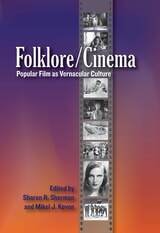
Folklore/Cinema
Popular Film as Vernacular CultureSharon R. Sherman and Mikel J. Koven
Utah State University Press, 2007
Interest in the conjunctions of film and folklore is stronger and more diverse than ever. Documentaries on folk life and expression remain a vital genre, but scholars such as Sharon Sherman and Mikel Koven also are exploring how folklore elements appear in, and merge with, popular cinema. They look at how movies, a popular culture medium, can as well be both a medium and type of folklore, playing cultural roles and conveying meanings customarily found in other folkloric forms. They thus use the methodology of folklore studies to analyze films made for commercial distribution.
The contributors to this book look at film and folklore convergences, showing how cinema conveys vernacular culture in traditional and popular venues. Folklore/Cinema will be of interest to scholars from many fields---folklore, film studies, popular culture, American studies, history, anthropology, and literature among them---and will help introduce students in various courses to intersections of film and culture.
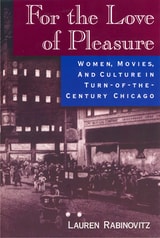
For the Love of Pleasure
Women, Movies, and Culture in Turn-of-the-Century ChicagoRabinovitz, Lauren
Rutgers University Press, 1998
--Gaylyn Studlar, atuhor of This Mad Masquerade: Stardom and Masculinity in the Jazz Age
The period from the 1880s until the 1920s saw the making of a consumer society, the inception of the technological, economic, and social landscape in which we currently live. Cinema played a key role in the changing urban landscape. For working-class women, it became a refuge from the factory. For middle-class women, it presented a new language of sexual danger and pleasure. Women found greater freedom in big cities, entering the workforce in record numbers and moving about unchaperoned in public spaces. Turn-of-the-century Chicago surpassed even New York as a proving ground for pleasure and education, attracting women workers at three times the national rate. Using Chicago as a model, Lauren Rabinovitz analyzes the rich interplay among demographic, visual, historical, and theoretical materials of the period. She skillfully links cinema theory and women's studies for a fuller understanding of cultural history. She also demonstrates how cinema dramatically affected social conventions, ultimately shaping modern codes of masculinity and feminity.