Results by title
89 books match the query 'Curricula' and 3 start with f
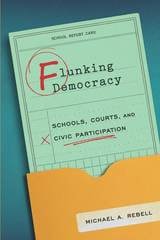
Flunking Democracy
Schools, Courts, and Civic ParticipationMichael A. Rebell
University of Chicago Press, 2018
The 2016 presidential election campaign and its aftermath have underscored worrisome trends in the present state of our democracy: the extreme polarization of the electorate, the dismissal of people with opposing views, and the widespread acceptance and circulation of one-sided and factually erroneous information. Only a small proportion of those who are eligible actually vote, and a declining number of citizens actively participate in local community activities.
In Flunking Democracy, Michael A. Rebell makes the case that this is not a recent problem, but rather that for generations now, America’s schools have systematically failed to prepare students to be capable citizens. Rebell analyzes the causes of this failure, provides a detailed analysis of what we know about how to prepare students for productive citizenship, and considers examples of best practices. Rebell further argues that this civic decline is also a legal failure—a gross violation of both federal and state constitutions that can only be addressed by the courts. Flunking Democracy concludes with specific recommendations for how the courts can and should address this deficiency, and is essential reading for anyone interested in education, the law, and democratic society.
In Flunking Democracy, Michael A. Rebell makes the case that this is not a recent problem, but rather that for generations now, America’s schools have systematically failed to prepare students to be capable citizens. Rebell analyzes the causes of this failure, provides a detailed analysis of what we know about how to prepare students for productive citizenship, and considers examples of best practices. Rebell further argues that this civic decline is also a legal failure—a gross violation of both federal and state constitutions that can only be addressed by the courts. Flunking Democracy concludes with specific recommendations for how the courts can and should address this deficiency, and is essential reading for anyone interested in education, the law, and democratic society.
[more]
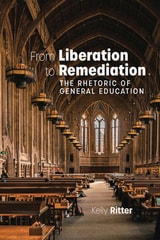
From Liberation to Remediation
The Rhetoric of General EducationKelly Ritter
Utah State University Press, 2026
Ever since its origins as a post–World War II movement designed to democratize education and promote civic engagement, General Education has been the source and subject of political battles. From Liberation to Remediation explores how Gen Ed’s initial goal of providing a common intellectual foundation for all students has been gradually undermined, resulting in a growing perception that General Education is unnecessary for high-achieving students and is instead a remedial path for those deemed underprepared.
Kelly Ritter addresses how lawmakers, for-profit testing companies, and even universities fuel public misconceptions of what Gen Ed can provide for our democracy and the role that a broad-based college education plays in social uplift. Tracing the history of the public rhetoric that persuades parents and students to see these courses as a set of interchangeable precollege credits to gain (or game) by any means necessary, she examines how positive and negative public responses to the curricula affected the position of core subjects in US universities, focusing on first-year writing. She also explores the role local, state, and organizational politics played in Gen Ed’s positioning, including decisions related to race, social class, and educational attainment; the impact credit-by-exemption and seamless transfer had on the quality and import of Gen Ed programming in both high schools and colleges; and the perceived use-value of the courses themselves in the face of rising college costs. Finally, she considers which student populations have benefited from the denigration of Gen Ed’s value and which have been left behind.
Drawing on archival research and case studies, From Liberation to Remediation raises important questions about equity, access, and the role of General Education in US higher education’s future and demonstrates that recovering the original post-war democratizing principles and practices of Gen Ed is critical to the continuance of a literate, empathetic, and civic-minded democracy for the twenty-first century.
[more]
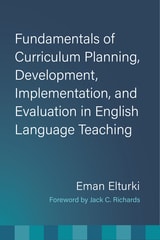
Fundamentals of Curriculum Planning, Development, Implementation, and Evaluation in English Language Teaching
Eman Elturki
University of Michigan Press, 2026
Since curriculum planning, development, implementation, and evaluation are closely interconnected, developing conceptual knowledge and practical understanding of these areas is essential for a quality curriculum. Effective curriculum practices examine the teaching and learning experience comprehensively to ensure its readiness, coherence, effectiveness, and consistency in meeting students’ needs. Fundamentals of Curriculum Planning, Development, Implementation, and Evaluation in English Language Teaching provides comprehensive knowledge and resources for English language teachers, teachers-in-training, curriculum developers, and language programs.
This book offers a systematic guide to navigating the different phases of the curriculum, from its inception to its evaluation. Part I explores the conceptual and theoretical foundations that shape curriculum and instruction. Part II provides practical knowledge and guidelines that programs and individual teachers can adopt or adapt to their specific educational contexts with the goal is to optimize the teaching and learning experience. Elturki draws largely on knowledge from the field of education, particularly curriculum studies, to complement what we know about L2 teaching and learning from Applied Linguistics, Second Language Acquisition, and English Language Teaching. Each chapter begins with pre-reading questions to stimulate thinking and concludes with post-reading questions for reflection, encouraging readers to connect the material to their own context.
This book offers a systematic guide to navigating the different phases of the curriculum, from its inception to its evaluation. Part I explores the conceptual and theoretical foundations that shape curriculum and instruction. Part II provides practical knowledge and guidelines that programs and individual teachers can adopt or adapt to their specific educational contexts with the goal is to optimize the teaching and learning experience. Elturki draws largely on knowledge from the field of education, particularly curriculum studies, to complement what we know about L2 teaching and learning from Applied Linguistics, Second Language Acquisition, and English Language Teaching. Each chapter begins with pre-reading questions to stimulate thinking and concludes with post-reading questions for reflection, encouraging readers to connect the material to their own context.
[more]