Results by title
91 books match the query 'Desire' and 6 start with f

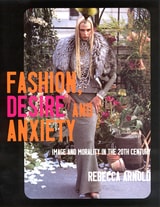
Fashion, Desire and Anxiety
Image and Morality in the Twentieth CenturyArnold, Rebecca
Rutgers University Press, 2001
These dreams and freedoms, Rebecca Arnold proposes, are contradictory. Fashion and its surrounding imagery elicit fear and anxiety in their consumers as well as pleasure. Fashion has come to incorporate the underside of modern life, with violence and decay becoming a dominant theme in clothing design and photography.
Arnold draws on diverse written sources to explore the complex nature of modern fashion. She discusses a range of key themes: how fashion uses and abuses the power of wealth; the alienating promotion of "good" taste; the power plays of sex and display; and how identities can be blurred to disguise and confuse. In order to unravel the contradictory emotions of desire and anxiety they provoke, she never loses sight of the historical and cultural contexts in which fashion designers and photographers perform.
Generously illustrated, Fashion, Desire and Anxiety focuses on the last thirty years, from photographic works of the 1970s to the beginning of the twenty-first century.
Fashion, Desire and Anxiety
Image and Morality in the Twentieth CenturyArnold, Rebecca
Rutgers University Press, 2001
These dreams and freedoms, Rebecca Arnold proposes, are contradictory. Fashion and its surrounding imagery elicit fear and anxiety in their consumers as well as pleasure. Fashion has come to incorporate the underside of modern life, with violence and decay becoming a dominant theme in clothing design and photography.
Arnold draws on diverse written sources to explore the complex nature of modern fashion. She discusses a range of key themes: how fashion uses and abuses the power of wealth; the alienating promotion of "good" taste; the power plays of sex and display; and how identities can be blurred to disguise and confuse. In order to unravel the contradictory emotions of desire and anxiety they provoke, she never loses sight of the historical and cultural contexts in which fashion designers and photographers perform.
Generously illustrated, Fashion, Desire and Anxiety focuses on the last thirty years, from photographic works of the 1970s to the beginning of the twenty-first century.
Feeling Like a State
Desire, Denial, and the Recasting of AuthorityDavina Cooper
Duke University Press, 2019
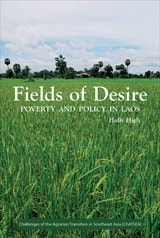
Fields of Desire
Poverty and Policy in LaosHolly High
National University of Singapore Press, 2014
Based on long-term fieldwork in a Lao village that has been the subject of multiple poverty reduction and development programs, High’s account looks at implementation on the ground. While these efforts were laudable in their aims of reducing poverty, they often failed to achieve their objectives. Local people received them with suspicion and disillusionment. Nevertheless, poverty reduction policies continued to be renewed by planners and even desired locally. High relates this to the force of aspirations among rural Lao, ambivalent understandings of power and the “post-rebellious” moment in contemporary Laos.
Fire and Desire
Mixed-Race Movies in the Silent EraJane M. Gaines
University of Chicago Press, 2001
Fire and Desire offers a penetrating look at the black independent film movement during the silent period. Gaines traces the profound influence that D. W. Griffith's racist epic The Birth of a Nation exerted on black filmmakers such as Oscar Micheaux, the director of the newly recovered Within Our Gates. Beginning with What Happened in the Tunnel, a movie that played with race and sex taboos by featuring the first interracial kiss in film, Gaines also explores the cinematic constitution of self and other through surprise encounters: James Baldwin sees himself in the face of Bette Davis, family resemblance is read in Richard S. Robert's portrait of an interracial family, and black film pioneer George P. Johnson looks back on Micheaux.
Given the impossibility of purity and the co-implication of white and black, Fire and Desire ultimately questions the category of "race movies" itself.
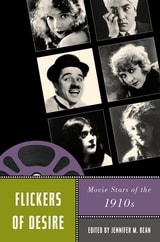
Flickers of Desire
Movie Stars of the 1910sBean, Jennifer M
Rutgers University Press, 2011