Results by title
240 books match the query 'Diaries' and 9 start with f
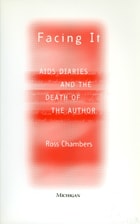
Facing It
AIDS Diaries and the Death of the AuthorRoss Chambers
University of Michigan Press, 2001
"Groundbreaking in its approach and potentially wide in its appeal. . . . The rigor of the ideas, their dramatic nature, and the political drive of the rhetoric all should win Facing It a large readership that could extend far beyond students of narrative or queer theory." --David Bergman, Towson University, editor of Camp Grounds: Style and Homosexuality
Ross Chambers is Distinguished University Professor of French and Comparative Literature, University of Michigan, and author of Room for Maneuver: Reading (the) Oppositional (in) Narrative and Story and Situation: Narrative Seduction and the Power of Fiction.
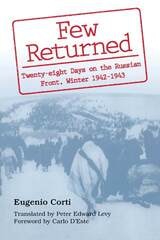
Few Returned
Twenty-eight Days on the Russian Front, Winter 1942-1943Eugenio Corti, Translated by Peter Edward Levy, & Foreword by Carlo D'Este
University of Missouri Press, 1997
After World War II more than one hundred books appeared that dealt with the experience of the Italian army in Russia, and particularly the terrible winter retreat of 1942-1943. Few Returned (I piu' non ritornano) is the only one of these that is still regularly reissued in Italy.
Eugenio Corti, who was a twenty-one-year-old second lieutenant at the time, found himself, together with 30,000 Italians and a smaller contingent of Germans, encircled on the banks of the River Don by enemy forces who far outnumbered them. To break out of this encirclement, these men undertook a desperate march across the snow, with constant engagements and in temperatures ranging from -20 to -30 degrees Fahrenheit. Whereas supplies were air-dropped to the Germans, the predicament of the Italians was far more difficult: lacking gasoline, they were compelled to abandon their vehicles and to proceed without heavy arms, equipment, ammunition, or provisions. Even the wounded had to be abandoned, though it was well known that the soldiers of the Red Army"enraged by the brutality of the German invasion"killed all the enemy wounded who fell into their hands. After twenty-eight days of encirclement, only 4,000 of the 30,000 Italians made it out of the pocket.
Why is it that Corti's book, which was first published in 1947, continues after fifty years to be reprinted in Italy? Because, as Mario Apollonio of the University of Milan said, when the book first appeared: "It is a chronicle . . . but it is much more than that: behind the physical reality, there is the truth" about man at his most tragic hour. Apollonio adds: "The power of the writing immediately transforms the document into drama"; the result is a "novel-poem-drama-history." The philosopher Benedetto Croce found in Corti's book "the not infrequent gleam of human goodness and nobility." Few Returned is a classic of war literature that succeeds in bringing home the full hatefulness of war.
Eugenio Corti began writing his diary at a military hospital immediately after being repatriated from the Russian front. When in September 1943 Italy found itself cut in two by the Armistice, Corti, loyal to his officer's oath, joined up with what remained of the Italian army in the south and with those few troops participated in driving the Germans off Italian soil, fighting at the side of the British Eighth and the American Fifth Armies.
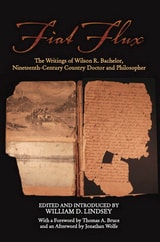
Fiat Flux
The Writings of Wilson R. Bachelor, Nineteenth-Century Country Doctor and PhilosopherWilliam D. Lindsey
University of Arkansas Press, 2013
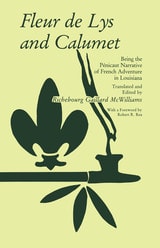
Fleur de Lys and Calumet
Being the Penicaut Narrative of French Adventure in LouisianaEdited by Richebourg McWilliams
University of Alabama Press, 1988
Andre Penicaut, a carpenter, sailed with Iberville to the French province of Louisiana in 1699 and did not return to France until 1721. The book he began in the province and finished upon his return to France is an eyewitness account of the first years of the French colony, which stretched along the Gulf Coast from Florida to Texas and in the Mississippi Valley from the Balize to the Illinois country. As a ship carpenter, Penicaut was chosen as a member of several important expeditions: he accompanied Le Sueur up the Mississippi River in 1700 to present-day Minnesota, and he went with Juchereau de St. Denis on the first journey from Mobile to the Red River and overland to the Rio Grande, to open trade with the Spaniards in Mexico. Penicaut helped to build the first post in Louisiana, at Old Biloxi, and the second post on the Mobile River.
Penicaut was at his best when describing the lives and social customs of the Indians of the region. He saw them in realistic terms, showing no prejudice toward their native habits. Neither were his French colleagues cast in heroic or villainous molds—though their accomplishments must strike modern readers as truly epic.
When first published, Fleur de Lys and Calumet was a major stimulus to scholarship in the field. This new edition will be welcomed by a new generation of scholars and readers interested in the colonial history of the Deep South and the Mississippi Valley.
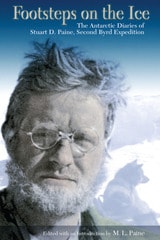
Footsteps on the Ice
The Antarctic Diaries of Stuart D. Paine, Second Byrd ExpeditionStuart D. Paine, Edited & Intro by M. L. Paine
University of Missouri Press, 2007
In 1933 Antarctica was essentially unexplored. Admiral Richard Byrd launched his Second Expedition to chart the southernmost continent, primarily relying on the muscle power of dog teams and their drivers who skied or ran beside the loaded sledges as they traveled. The life-threatening challenges of moving glaciers, invisible crevasses, and horrific storms compounded the difficulties of isolation, darkness, and the unimaginable cold that defined the men’s lives.
Stuart Paine was a dog driver, radio operator, and navigator on the fifty-six-man expedition, the bold and complex venture that is now famous for Byrd’s dramatic rescue from Bolling Advance Weather Base located 115 miles inland. Paine’s diaries represent the only published contemporary account written by a member of the Second Expedition. They reveal a behind-the-scenes look at the contentiousness surrounding the planned winter rescue of Byrd and offer unprecedented insights into the expedition’s internal dynamics.
Equally riveting is Paine’s breathtaking narrative of the fall and summer field operations as the field parties depended on their own resources in the face of interminable uncertainty and peril. Undertaking the longest and most hazardous sledging journey of the expedition, Paine guided the first American party from the edge of the Ross Sea more than seven hundred miles up the Ross Ice Shelf and the massive Thorne (Scott) Glacier to approach the South Pole. He and two other men skied more than fourteen hundred miles in eighty-eight days to explore and map part of Antarctica for the first time.
Footsteps on the Ice reveals the daily struggles, extreme personalities, and the matter-of-fact bravery of early explorers who are now fading into history. Detailing the men’s frustrations, annoyances, and questioning of their leader, Paine’s entries provide rare insight into how Byrd conducted his expeditions. Paine exposes the stresses of living under the snow in Little America during the four-month-long winter night, trapped in dim, crowded huts and black tunnels, while the men uneasily mulled over their leader’s isolation at Advance Base. The fates of Paine’s dogs, which provided some of his most difficult and rewarding experiences, are also described—his relationship with Jack, his lead dog, is an entrancing story in itself.
Featuring previously unpublished photographs and illustrations, Footsteps on the Ice documents the period in Antarctic exploration that bridged the “heroic era” and the modern age of mechanized travel. Depicting almost incomprehensible mental and physical duress and unhesitating courage, Paine’s tale is one of the most compelling stories in polar history, surpassing other accounts with its immediacy and adventure as it captures the majesty and mystery of the untouched Antarctic.
For Duty and Destiny
The Life and Civil War Diary of William Taylor Stott, Hoosier Soldier and EducatorLloyd A. Hunter
Indiana Historical Society Press, 2011
From Beacon Hill to the Crystal Palace
The 1851 Travel Diary of a Working-Class WomanLorenza Stevens Berbineau
University of Iowa Press, 2002
Because prior studies of American women’s travel writing have focused exclusively on middle-class and wealthy travelers, it has been difficult to assess the genre and its participants in a holistic fashion. One of the very few surviving working-class travel diaries, Lorenza Stevens Berbineau’s account provides readers with a unique perspective of a domestic servant in the wealthy Lowell family in Boston. Staying in luxurious hotels and caring for her young charge Eddie during her six-month grand tour, Berbineau wrote detailed and insightful entries about the people and places she saw.
Contributing to the traditions of women’s, diary, and travel literature from the perspective of a domestic servant, Berbineau's narrative reveals an arresting and intimate outlook on both her own life and the activities, places, and people she encounters. For example, she carefully records Europeans’ religious practices, working people and their behavior, and each region’s aesthetic qualities. Clearly writing in haste and with a pleasing freedom from the constraints of orthographic and stylistic convention, Berbineau offers a distinctive voice and a discerning perspective. Alert to nuances of social class, her narrative is as appealing and informative to today's readers as it no doubt was to her fellow domestics in the Lowell household.
Unobtrusively edited to retain as much as possible the individuality and texture of the author’s original manuscript, From Beacon Hill to the Crystal Palace offers readers brief framing summaries, informative endnotes, and a valuable introduction that analyzes Berbineau’s narrative in relation to gender and class issues and compares it to the published travel writing of her famous contemporary, Harriet Beecher Stowe.
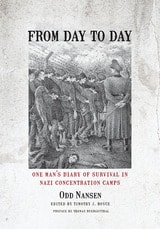
From Day to Day
One Man's Diary of Survival in Nazi Concentration CampsOdd Nansen
Vanderbilt University Press, 2016
Nansen, a Norwegian, was arrested in 1942 by the Nazis, and spent the remainder of World War II in concentration camps--Grini in Oslo, Veidal above the Arctic Circle, and Sachsenhausen in Germany. For three and a half years, Nansen kept a secret diary on tissue-paper-thin pages later smuggled out by various means, including inside the prisoners' hollowed-out breadboards.
Unlike writers of retrospective Holocaust memoirs, Nansen recorded the mundane and horrific details of camp life as they happened, "from day to day." With an unsparing eye, Nansen described the casual brutality and random terror that was the fate of a camp prisoner. His entries reveal his constantly frustrated hopes for an early end to the war, his longing for his wife and children, his horror at the especially barbaric treatment reserved for Jews, and his disgust at the anti-Semitism of some of his fellow Norwegians. Nansen often confronted his German jailors with unusual outspokenness and sometimes with a sense of humor and absurdity that was not appreciated by his captors.
After the Putnam's edition received rave reviews in 1949, the book fell into obscurity. In 1956, in response to a poll about the "most undeservedly neglected" book of the preceding quarter-century, Carl Sandburg singled out From Day to Day, calling it "an epic narrative," which took "its place among the great affirmations of the power of the human spirit to rise above terror, torture, and death." Indeed, Nansen witnessed all the horrors of the camps, yet still saw hope for the future. He sought reconciliation with the German people, even donating the proceeds of the German edition of his book to German refugee relief work. Nansen was following in the footsteps of his father, Fridtjof, an Arctic explorer and humanitarian who was awarded the Nobel Peace Prize in 1922 for his work on behalf of World War I refugees. (Fridtjof also created the "Nansen passport" for stateless persons.)
Forty sketches of camp life and death by Nansen, an architect and talented draftsman, provide a sense of immediacy and acute observation matched by the diary entries. The preface is written by Thomas Buergenthal, who was "Tommy," the ten-year-old survivor of the Auschwitz Death March, whom Nansen met at Sachsenhausen and saved using his extra food rations. Buergenthal, author of A Lucky Child, formerly served as a judge on the International Court of Justice at The Hague and is a recipient of the 2015 Elie Wiesel Award from the US Holocaust Memorial Museum.
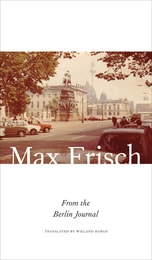
From the Berlin Journal
Max Frisch
Seagull Books, 2017
Max Frisch (1911–91) was a giant of twentieth-century German literature. When Frisch moved into a new apartment in Berlin’s Sarrazinstrasse, he began keeping a journal, which he came to call the Berlin Journal. A few years later, he emphasized in an interview that this was by no means a “scribbling book,” but rather a book “fully composed.” The journal is one of the great treasures of Frisch’s literary estate, but the author imposed a retention period of twenty years from the date of his death because of the “private things” he noted in it. From the Berlin Journal now marks the first publication of excerpts from Frisch’s journal. Here, the unmistakable Frisch is back, full of doubt, with no illusions, and with a playfully sharp eye for the world.
From the Berlin Journal pulls from the years 1946–49 and 1966–71. Observations about the writer’s everyday life stand alongside narrative and essayistic texts, as well as finely-drawn portraits of colleagues like Günter Grass, Uwe Johnson, Wolf Biermann, and Christa Wolf, among others. Its foremost quality, though, is the extraordinary acuity with which Frisch observed political and social conditions in East Germany while living in West Berlin.