Results by title
69 books match the query 'Digital Age' and 5 start with f

Film Criticism in the Digital Age
Frey, Mattias
Rutgers University Press, 2015
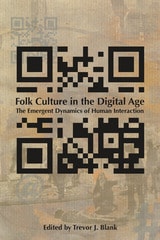
Folk Culture in the Digital Age
The Emergent Dynamics of Human InteractionTrevor J. Blank
Utah State University Press, 2012
Smart phones, tablets, Facebook, Twitter, and wireless Internet connections are the latest technologies to have become entrenched in our culture. Although traditionalists have argued that computer-mediated communication and cyberspace are incongruent with the study of folklore, Trevor J. Blank sees the digital world as fully capable of generating, transmitting, performing, and archiving vernacular culture. Folklore in the Digital Age documents the emergent cultural scenes and expressive folkloric communications made possible by digital “new media” technologies.
New media is changing the ways in which people learn, share, participate, and engage with others as they adopt technologies to complement and supplement traditional means of vernacular expression. But behavioral and structural overlap in many folkloric forms exists between on- and offline, and emerging patterns in digital rhetoric mimic the dynamics of previously documented folkloric forms, invoking familiar social or behavior customs, linguistic inflections, and symbolic gestures.
Folklore in the Digital Age provides insights and perspectives on the myriad ways in which folk culture manifests in the digital age and contributes to our greater understanding of vernacular expression in our ever-changing technological world.
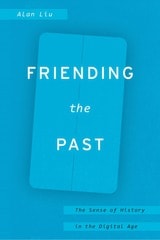
Friending the Past
The Sense of History in the Digital AgeAlan Liu
University of Chicago Press, 2018
In Friending the Past, Alan Liu proposes fresh answers to these innovative questions of connection. He explores how we can learn from the relationship between past societies whose media forms fostered a communal and self-aware sense of history—such as prehistorical oral societies with robust storytelling cultures, or the great print works of nineteenth-century historicism—and our own instantaneous present. He concludes with a surprising look at how the sense of history exemplified in today’s JavaScript timelines compares to the temporality found in Romantic poetry.
Interlaced among these inquiries, Liu shows how extensive “network archaeologies” can be constructed as novel ways of thinking about our affiliations with time and with each other. These conceptual architectures of period and age are also always media structures, scaffolded with the outlines of what we mean by history. Thinking about our own time, Liu wonders if the digital, networked future can sustain a similar sense of history.
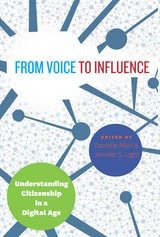
From Voice to Influence
Understanding Citizenship in a Digital AgeEdited by Danielle Allen and Jennifer S. Light
University of Chicago Press, 2015
With From Voice to Influence, Danielle Allen and Jennifer S. Light have brought together a stellar group of political and social theorists, social scientists, and media analysts to explore this transformation. Threading through the contributions is the notion of egalitarian participatory democracy, and among the topics discussed are immigration rights activism, the participatory potential of hip hop culture, and the porous boundary between public and private space on social media. The opportunities presented for political efficacy through digital media to people who otherwise might not be easily heard also raise a host of questions about how to define “good participation:” Does the ease with which one can now participate in online petitions or conversations about current events seduce some away from serious civic activities into “slacktivism?”
Drawing on a diverse body of theory, from Hannah Arendt to Anthony Appiah, From Voice to Influence offers a range of distinctive visions for a political ethics to guide citizens in a digitally connected world.

Future of Art in a Digital Age
From Hellenistic to Hebraic ConsciousnessMel Alexenberg
Intellect Books, 2006
This work develops the thesis that the transition from pre-modernism to postmodernism in art of the digital age represents a paradigm shift from the Hellenistic to the Hebraic roots of Western culture.
Semiotic and morphological analysis of art and visual culture demonstrate the contemporary confluence between the deep structure of Hebraic consciousness and new directions in art that arise along the interface between scientific inquiry, digital technologies, and multicultural expressions.
Complementing these two analytic methodologies, alternative methodologies of kabbalah and halakhah provide postmodern methods for extending into digital age art forms. Exemplary artworks are described in the text and illustrated with photographs.