Results by title
152 books match the query 'Diplomacy' and 7 start with f
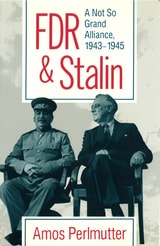
FDR & Stalin
A Not So Grand Alliance, 1943–1945Amos Perlmutter
University of Missouri Press, 1993
Perlmutter's hard-hitting, revisionist history of Roosevelt's foreign policy explores FDR's not-so-grand alliance with the ruthless Soviet leader. As the first Western scholar granted access to key foreign ministry documents recently declassified in the former Soviet Union, Perlmutter provides a provocative portrait of a popular leader whose failure to comprehend Stalin's long-range goals had devastating results for the postwar world.
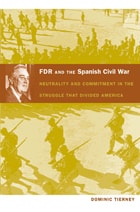
FDR and the Spanish Civil War
Neutrality and Commitment in the Struggle that Divided AmericaDominic Tierney
Duke University Press, 2007
Between 1936 and 1939, Roosevelt’s perceptions of the Spanish Civil War were transformed. Initially indifferent toward which side won, FDR became an increasingly committed supporter of the leftist government. He believed that German and Italian intervention in Spain was part of a broader program of fascist aggression, and he worried that the Spanish Civil War would inspire fascist revolutions in Latin America. In response, Roosevelt tried to send food to Spain as well as illegal covert aid to the Spanish government, and to mediate a compromise solution to the civil war. However unsuccessful these initiatives proved in the end, they represented an important stage in Roosevelt’s emerging strategy to aid democracy in Europe.
Fallout
Nuclear Diplomacy in an Age of Global FractureGrégoire Mallard
University of Chicago Press, 2014
In Fallout, Grégoire Mallard seeks to understand why some nations agreed to these limitations of their sovereign will—and why others decidedly did not. He builds his investigation around the 1968 signing of the Nuclear Nonproliferation Treaty (NPT), which, though binding in nature, wasn’t adhered to consistently by all signatory nations. Mallard looks at Europe’s observance of treaty rules in contrast to the three holdouts in the global nonproliferation regime: Israel, India, and Pakistan. He seeks to find reasons for these discrepancies, and makes the compelling case that who wrote the treaty and how the rules were written—whether transparently, ambiguously, or opaquely—had major significance in how the rules were interpreted and whether they were then followed or dismissed as regimes changed. In honing in on this important piece of the story, Mallard not only provides a new perspective on our diplomatic history, but, more significantly, draws important conclusions about potential conditions that could facilitate the inclusion of the remaining NPT holdouts. Fallout is an important and timely book sure to be of interest to policy makers, activists, and concerned citizens alike.
Floundering Stability
US Foreign Policy in EgyptAmir Magdy Kamel
University of Michigan Press, 2023
The US commitment to stability—both domestically and abroad—has been a consistent feature in the way Washington, DC carries out international relations. This commitment is complimented by the increased overlap between the economic and political spheres in international affairs. Consequently, this US approach to foreign interaction is informed by an assumption that foreign policy tools can influence global stability for the better. In order to investigate this assumption, this book details the foundations of what Amir Magdy Kamel refers to as the US Stability Policy—how it evolved over time and how it was implemented in Egypt. He finds that domestic and global forces were left unaccounted for by the Stability Policy, ultimately leading to a failure to achieve the self-stated stability goals.
Kamel’s analysis is informed through a unique mixed-method approach that sheds light on how and why this policy fared so poorly under Mubarak’s Egypt. He develops and tests a unique and particular way of examining the Stability Policy and presents a framework for future work to replicate and build on in the quest to understand other state-on-state relationships and the effectiveness of other foreign economic policies in achieving stability goals. Floundering Stability reflects on what Kamel’s findings mean for the relationship between the US and Egypt, as well as specific US foreign policy suggestions on how the same mistakes can be avoided in the future.
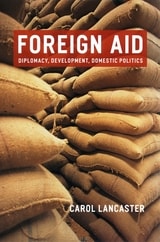
Foreign Aid
Diplomacy, Development, Domestic PoliticsCarol Lancaster
University of Chicago Press, 2006
A twentieth-century innovation, foreign aid has become a familiar and even expected element in international relations. But scholars and government officials continue to debate why countries provide it: some claim that it is primarily a tool of diplomacy, some argue that it is largely intended to support development in poor countries, and still others point out its myriad newer uses. Carol Lancaster effectively puts this dispute to rest here by providing the most comprehensive answer yet to the question of why governments give foreign aid. She argues that because of domestic politics in aid-giving countries, it has always been—and will continue to be—used to achieve a mixture of different goals.
Drawing on her expertise in both comparative politics and international relations and on her experience as a former public official, Lancaster provides five in-depth case studies—the United States, Japan, France, Germany, and Denmark—that demonstrate how domestic politics and international pressures combine to shape how and why donor governments give aid. In doing so, she explores the impact on foreign aid of political institutions, interest groups, and the ways governments organize their giving. Her findings provide essential insight for scholars of international relations and comparative politics, as well as anyone involved with foreign aid or foreign policy.

From Kosovo to Darfur
The Regional Biases within Humanitarian Military InterventionismSidita Kushi
University of Michigan Press, 2025
Using in-depth case studies and new data on all post–Cold War internal armed conflicts matched to third-party responses, From Kosovo to Darfur offers the first regionally sensitive analysis of humanitarian military intervention since the end of the Cold War. It shows that international military interventions in the context of acute humanitarian crises are driven by different pathways within the Western versus the non-Western world and fueled by elite perceptions of the crisis, making interventions closer to the geographic and cultural West most probable and most intense. As our international community becomes increasingly interdependent and aware of human suffering across borders, From Kosovo to Darfur points to new pathways of conflict trajectories and reveals vital implications for leaders, scholars, and nongovernmental actors advocating for or against international military intervention as a policy choice.

From Washington to Moscow
US-Soviet Relations and the Collapse of the USSRLouis Sell
Duke University Press, 2016