Results by title
230 books match the query 'Doctrines' and 5 start with f
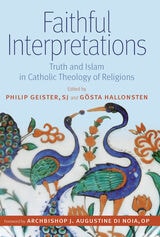
Faithful Interpretations
Truth and Islam in Catholic Theology of ReligionsPhilip Geister
Catholic University of America Press, 2021
”Theology of Religions” is among the most burning issues within Christian theology today. The challenge to study and discuss different ways of handling conflicting truth claims and religious narratives between religions is taken up by a growing number of theologians across denominational boundaries. This is a common and ecumenical effort undertaken by Christian theologians all over the world. And yet, the impact of specific ecclesiastical or theological traditions on different concepts of theology of religions should not be underestimated. As well known, the Second Vatican council with its pivotal decree Nostra Aetate (On the relation to other religions) not only set the agenda for Catholic theology, but even influenced the wider discussion on the topic. The papers of this volume were all given at a conference in Uppsala, Sweden in October 2017. The structure of Faithful Interpretations follows closely the way the conference was conducted.
A general introduction to the development and present status of ”Theology of Religions” by Marianne Moyaert opens the book. Archbishop J Augustine Di Noia of the Vatican Congregation for the Doctrine of Faith then treats the recent developments in the teaching of the Magisterium regarding theology of religions. Anna Bonta Moreland adresses the issue of Muhammad and Christian Prophecy. Diego R Sarrió Cucarella focuses on early Christian theological views of Islam and concludes that Islam has been from the begining a ”disturbing” factor in the Christian view of salvation history. Wilhelmus G B M Valkenberg discusses the impact of Nostra Aetate on the Church’s relation to Muslims, using especially the precedent of Nicolaus of Cues as regards a constructive approach to Islam. Klaus von Stosch adresses a sensitive issue in Muslim-Christian relations and illustrates the advantages of the comparative theology approach for the theology of religions.
Complementing this perspective, Peter Jonkers offers a hermeneutical perspective on truth claims, and reflects on ”the religious Other” with references to Jacques Derrida among others. Reinhold Bernhardt argues in favour of a biblically grounded “relational-existential” theory of truth, which would be most helpful with regard to other religions. To conclude, the prominent Catholic specialist on Theology of Religions, Gavin D’Costa, widened the perspective by addressing the relation to Judaism from the point of view of the covenant and the promises of the land. Altogether, the papers of this volume give a clear impression of the status of Roman Catholic Theology of Religions.
[more]
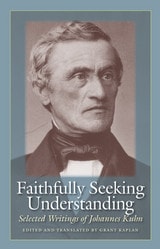
Faithfully Seeking Understanding
Selected Writings of Johannes KuhnJohannes Kuhn
Catholic University of America Press, 2009
Faithfully Seeking Understanding provides a first-hand opportunity for English-speaking readers to encounter the thought of Johannes Kuhn (1806-1887), widely considered the greatest speculative theologian of the renowned Catholic Tübingen School.
[more]
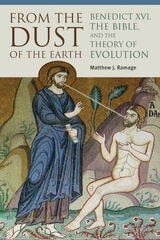
From the Dust of the Earth
Benedict XVI, the Bible , and the Theory of EvolutionMatthew J. Ramage
Catholic University of America Press, 2022
The claim that evolution undermines Christianity is standard fare in our culture. Indeed, many today have the impression that the two are mutually exclusive and that a choice must be made between faith and reason—rejecting Christianity on the one hand or evolutionary theory on the other. Is there a way to square advances in this field of study with the Bible and Church teaching?
In this book—his fourth dedicated to applying Joseph Ratzinger/Benedict XVI’s wisdom to pressing theological difficulties—Matthew Ramage answers this question decidedly in the affirmative. Distinguishing between evolutionary theory properly speaking and the materialist attitude that is often conflated with it, Ramage’s work meets the challenge of evolutionary science to Catholic teaching on human origins, guided by Ratzinger’s conviction that faith and evolutionary theory mutually enrich one another.
Pope Benedict gifted the Church with many pivotal yet often-overlooked resources for engaging evolution in the light of faith, especially in those instances where he addressed the topic in connection with the Book of Genesis. Ramage highlights these contributions and also makes his own by applying Ratzinger’s principles to such issues as the meaning of man’s special creation, the relationship between sin and death, and the implications of evolution for eschatology. Notably, Ramage shows that many apparent conflicts between Christianity and evolutionary theory lose their force when we interpret creation in light of the Paschal Mystery and fix our gaze on Jesus, the New Adam who reveals man to himself.
Readers of this text will find that it does more than merely help to resolve apparent contradictions between faith and modern science. Ramage’s work shows that discoveries in evolutionary biology are not merely difficulties to be overcome but indeed gifts that yield precious insight into the mystery of God’s saving plan in Christ.
[more]
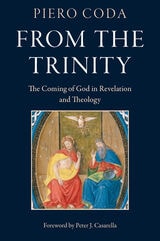
From the Trinity
The Coming of God in Revelation and TheologyPiero Coda
Catholic University of America Press, 2020
From the Trinity provides an overall view of the history and the philosophical and theological significance of God the Trinity, not only from a religious point of view but from an anthropological and socio-cultural view as well. The perspective is that of Christian doctrine, specifically Catholic, in dialogue with the cultural sensitivity of our times and with the religious pluralism that characterizes it.
Following the generative-progressive method proposed by Vatican II, the book begins with a phenomenological reading of the signs of the times, with special focus upon the performative aspect of the announcement and the doctrine of faith. In particular, constant attention to the contribution made by the mystics and great charisms (from Augustine of Hippo to Francis of Assisi and Theresa of Avila up until Therese of Lisieux, Edith Stein and Chaira Lubich) toward a deeper understanding of the Trinitarian truth.
From the Trinity is unique in what it offers not only for Trinitarian theology, but also for other theological disciplines (Christology, Pneumatology, Anthropology, Ecclesiology, etc.) – in which the Trinity shines forth as the central and enlightening truth – as well as for philosophy, the humanities and the natural sciences. This perspective is especially developed in terms of a Trinitarian ontology (see Part V) by which reality is understood in light of the revelation of the Trinity. The implications of the incarnation of the Son of God and the gift of the Holy Spirit are taken seriously in studying the truth of all things as they are perceived in the space created by living and thinking “in” Jesus, united to the Father in the Spirit, as suggested by the title of the book, looking upon reality “From the Trinity.”
[more]
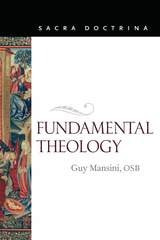
Fundamental Theology
Guy Mansini, OSB
Catholic University of America Press, 2018
Fundamental Theology examines the light by which the mysteries of Christ and the Church, the Trinity and the Sacraments, are revealed to us. That light we call "revelation," and fundamental theology examines in the first place what this light shows about itself, and how it is sustained in the world. Or again, fundamental theology considers what the word of God has to say both about itself and what it has to say about where in the world it is to be heard. So, first it is a theology of Revelation (chapter 1), and second, a theology of the transmission of Revelation in Tradition, Scripture, and the Church (chapters 2, 3, and 4). Why must Revelation have the shape it does, and why must it be constituted by both word and event? Why is Tradition prior to Scripture, why must the word of God be written down, and why must Scripture come to us in two testaments? And why must the message conveyed in Tradition and Scripture have a living interpreter in the Church?
Since no word is spoken unless it is heard, fundamental theology also investigates the conditions of hearing the word of God, the very hearing itself in the assent of faith, and a necessary consequence of this hearing. The remote conditions of hearing are also what theology calls our ability to come to the knowledge of the preambula fidei- the things about God than can be known by the natural light (chapter 5). The immediate condition of hearing is the credibility of the word (chapter 6). Hearing is faith (chapter 7). And true hearing gives the hearer to recapitulate what is heard in his own wondering and thankful voice in theology (chapter 8). The introduction to theology in the last chapter is by way of considering the history of Catholic theology in the 20th century.
Since no word is spoken unless it is heard, fundamental theology also investigates the conditions of hearing the word of God, the very hearing itself in the assent of faith, and a necessary consequence of this hearing. The remote conditions of hearing are also what theology calls our ability to come to the knowledge of the preambula fidei- the things about God than can be known by the natural light (chapter 5). The immediate condition of hearing is the credibility of the word (chapter 6). Hearing is faith (chapter 7). And true hearing gives the hearer to recapitulate what is heard in his own wondering and thankful voice in theology (chapter 8). The introduction to theology in the last chapter is by way of considering the history of Catholic theology in the 20th century.
[more]