Results by title
55 books match the query 'Documentary films' and 7 start with f
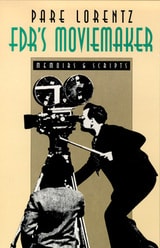
FDR's Moviemaker
Memoirs And ScriptsPare Lorentz
University of Nevada Press, 1992
"The films of Pare Lorentz are acknowledged masterpieces of world cinema. They are groundbreaking documentary records of our country in the hard years of the Depression." —William M. Drennen, Jr.
In the depths of the Great Depression, the U.S. Government produced a series of films about the pressing problems facing the nation—drought, flood, poverty, and slums. Starting with a minuscule initial budget of $6,000, Lorentz, a young film critic from New York who had never made a motion picture, was hired to head the project. The first fruit of his labor, The Plow That Broke the Plains, was a moving and dramatic account of the Dust Bowl that met with immediate and critical acclaim. Lorentz followed up his first film with The River, a history of the Mississippi River Basin and the effect of the Tennessee Valley Authority on the area. Both films demonstrated the potential of the documentary as a powerful impetus to social change, prompting widespread discussion not only of the problems they presented but also of the documentary form itself. This book combines the autobiographical history of a creative communicator and pioneer documentary filmmaker with the full scripts of The Plow That Broke the Plains, The River, Ecce Homo, and The Fight for Life.
Feminism And Documentary
Diane Waldman
University of Minnesota Press, 1999
The first book of essays to explore the intersection of these two vital disciplines.
Documentary and feminist film studies have long been separate or parallel universes that need to converse or collide. The essays in this volume, written by prominent scholars and filmmakers, demonstrate the challenges that feminist perspectives pose for documentary theory, history, and practice. They also show how fuller attention to documentary enriches and complicates feminist theory, especially regarding the relationship between gender and sexuality, race and ethnicity, class and nation.
Feminism and Documentary begins with a substantial historical introduction that highlights several of the specific areas that contributors address: debates over realism, the relationship between filmmaker and subject, historical thinking about documentary and thinking about the historical documentary, biography and autobiography, and the use of psychoanalysis. Other essays, most of which appear here for the first time, range from broad overviews to close analyses of particular films and videos and from discussions of well-known works such as Roger and Me and Don’t Look Back to lesser known texts that might revise the canon. The collection includes an extensive filmography and videography with useful distribution information and a bibliography of work in this neglected area of scholarship. Lucid, sophisticated, and eye-opening, this book will galvanize documentary studies and demonstrate the need for women’s and cultural studies to grapple with visual media. Contributors: Michelle Citron, Northwestern U; Gloria J. Gibson, Indiana U; Chris Holmlund, U of Tennessee; Alexandra Juhasz, Pitzer College; Ann Kaneko; Anahid Kassabian, Fordham U; David Kazanjian, U of California, Berkeley; Susan Knobloch; Silvia Kratzer-Juilfs; Deborah Lefkowitz; Julia Lesage, U of Oregon; Laura U. Marks, Carleton U, Ottawa; Paula Rabinowitz, U of Minnesota; Michael Renov, USC; Patricia R. Zimmermann, Ithaca College.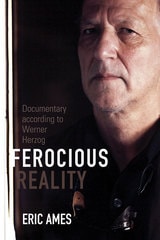
Ferocious Reality
Documentary according to Werner HerzogEric Ames
University of Minnesota Press, 2012
Over the course of his career Werner Herzog, known for such visionary masterpieces as Aguirre: The Wrath of God (1972) and The Enigma of Kaspar Hauser (1974), has directed almost sixty films, roughly half of which are documentaries. And yet, in a statement delivered during a public appearance in 1999, the filmmaker declared: “There are deeper strata of truth in cinema, and there is such a thing as poetic, ecstatic truth. It is mysterious and elusive, and can be reached only through fabrication and imagination and stylization.” Ferocious Reality is the first book to ask how this conviction, so hostile to the traditional tenets of documentary, can inform the work of one of the world’s most provocative documentarians.
Herzog, whose Cave of Forgotten Dreams was perhaps the most celebrated documentary of 2010, may be the most influential filmmaker missing from major studies and histories of documentary. Examining such notable films as Lessons of Darkness (1992) and Grizzly Man (2005), Eric Ames shows how Herzog dismisses documentary as a mode of filmmaking in order to creatively intervene and participate in it. In close, contextualized analysis of more than twenty-five films spanning Herzog’s career, Ames makes a case for exploring documentary films in terms of performance and explains what it means to do so. Thus his book expands the field of cinema studies even as it offers an invaluable new perspective on a little studied but integral part of Werner Herzog’s extraordinary oeuvre.
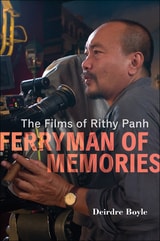
Ferryman of Memories
The Films of Rithy PanhDeirdre Boyle
Rutgers University Press, 2023
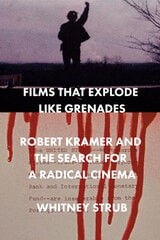
Films That Explode Like Grenades
Robert Kramer and the Search for a Radical CinemaWhitney Strub
University of Chicago Press, 2026
Robert Kramer (1939–99) was the emblematic filmmaker of the late-1960s New Left in the United States. Yet because most of his three dozen films have been out of circulation for decades, he has long been neglected by film historians and the Left. Kramer was the cofounder of the leftist documentary collective Newsreel and the director of underground films such as Ice (1970), Milestones (1975), and Route One/USA (1989). His films provide distinctive insights into how America’s political terrain has changed over time, capturing each era’s revolutionary ethos and its contradictions. Whitney Strub’s Films That Explode Like Grenades tracks the histories of leftist film and global revolutionary movements via Kramer’s life and travels. Moving among New York City, Chicago, North Vietnam, Paris, Portugal, Angola, and other crucial flashpoints, Kramer left a major and influential body of work in his wake that has fundamentally shaped the work of radical filmmakers across the globe.
For Strub, Kramer’s career is a key thread in an intimate history of the 1960s New Left, one that emphasizes the complexities of the movement’s internal tensions and its legacies. Drawing on visual analysis, extensive archival research across the United States and France, and myriad interviews with Kramer contemporaries, including Bernardine Dohrn, Tom Hayden, Jonas Mekas, and Kramer’s relatives, Strub transforms Kramer’s life story into a dynamic and engaging social history of 1960s radicalism and its generational legacies.
With detailed mapping of Robert Kramer’s many social and artistic contexts, Films That Explode Like Grenades restores him to a place of global importance in leftist cinema.

First Person Jewish
Alisa S. Lebow
University of Minnesota Press, 2008
Documentaries have increasingly used the first person, with a number of prominent filmmakers finding critical and commercial success with this intimate approach. Jewish filmmakers have particularly thrived in this genre, using it to explore disparate definitions of the self in relation to the larger groups of family and community.
In First Person Jewish, Alisa S. Lebow examines more than a dozen films from Jewish artists to reveal how the postmodern impulse to turn the lens inward intersects provocatively (and at times unwittingly) with historical tropes and stereotypes of the Jew. Focusing her efforts on Jewish filmmakers working on the margins, Lebow analyzes the work of Jonathan Caouette, Chantal Akerman, and Alan Berliner, among others, also including a discussion of her own first person film Treyf (1998), made with Cynthia Madansky. The filmmakers in this study, Lebow argues, are confronting a desire to both define and reimagine contemporary Jewishness.
Using a multidisciplinary approach to first person films, Lebow shows how this form of self-expression is challenging both autobiography and documentary and, in the process, changing the art of cinema and recording the cultural shifts of our time.
Alisa S. Lebow is a filmmaker and lecturer in film and TV studies at Brunel University.
French Colonial Documentary
Mythologies of HumanitarianismPeter J. Bloom
University of Minnesota Press, 2008
Despite altruistic goals, humanitarianism often propagates foreign, and sometimes unjust, power structures where it is employed. Tracing the visual rhetoric of French colonial humanitarianism, Peter J. Bloom’s unexpected analysis reveals how the project of remaking the colonies in the image of France was integral to its national identity.
French Colonial Documentary investigates how the promise of universal citizenship rights in France was projected onto the colonies as a form of evolutionary interventionism. Bloom focuses on the promotion of French education efforts, hygienic reform, and new agricultural techniques in the colonies as a means of renegotiating the social contract between citizens and the state on an international scale. Bloom’s insightful readings disclose the pervasiveness of colonial iconography, including the relationship between “natural man” and colonial subjectivity; representations of the Senegalese Sharpshooters as obedient, brave, and sexualized colonial subjects; and the appeal of exotic adventure narratives in the trans-Saharan film genre.
Examining the interconnection between French documentary realism and the colonial enterprise, Bloom demonstrates how the colonial archive is crucial to contemporary debates about multiculturalism in France.
Peter J. Bloom is associate professor of film and media studies at the University of California-Santa Barbara.y debates about multiculturalism in France.